
People in Paris are jumping into the Seine to cool off. Germany has recorded drowning deaths as people tried to escape the heat in rivers and lakes.
France alone reported around 1,000 excess deaths between June 24 and June 27. The images are stark: elderly citizens collapsing in unventilated apartments, hospital emergency rooms overwhelmed, and a continent that prides itself on climate leadership suddenly realising that its infrastructure was never built for this.
And yet, when ordinary Europeans cry out for air conditioning, the European Union refuses to take a side. That silence speaks volumes. It is not neutrality. It is a moral judgement dressed up as policy restraint.
The Great AC Debate That Misses the Point
Only about 20 percent of European homes have AC installed, according to the International Energy Agency. The critics argue that air conditioning is energy-guzzling, uses polluting refrigerants, and pushes hot air outside—making dense cities even hotter. They point to the environmental cost, the carbon footprint, the vicious cycle of cooling that warms the planet further.
These are legitimate concerns. But they are also a convenient distraction.
Let us put the numbers in perspective.
The average household's annual CO₂ emissions from all energy use—including cooling—is roughly 5 tons per year. That is everything: heating, cooking, appliances, and air conditioning combined.
Now consider the aviation industry. It alone emitted 985 million tonnes of CO₂ in 2025. That is nearly 2.7 million tonnes per day.
Data centres? They generated around 180 million tonnes of indirect CO₂ emissions in 2024—about half a million tonnes every single day.
The industrial sector? It accounts for more than a quarter of global CO₂ emissions—roughly 10 billion tonnes annually. Over 27 million tonnes per day.
One household's AC usage against a single plane, a single data centre, a single factory. The numbers are not even in the same league.
Survival Is Not a Luxury
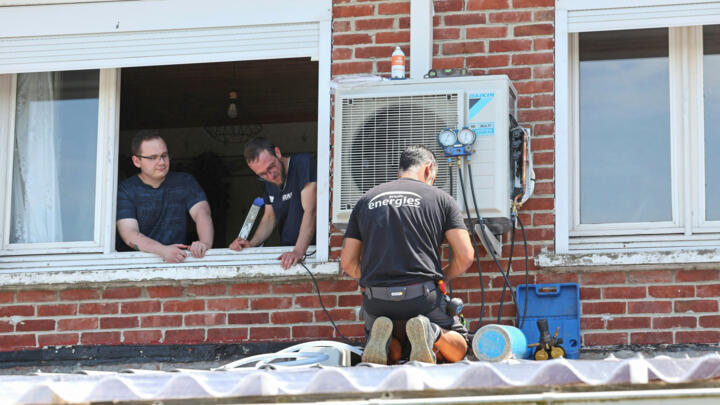
Let us be honest. In places like Singapore and Hong Kong, where humidity hits 35°C and above, air conditioning is not a luxury. It is survival. The same logic applies to Europe now. Buildings there were designed to trap heat, not release it—a sensible choice for cold winters, but a death sentence during summer heatwaves. Elderly residents in poorly insulated apartments are dying because their bodies cannot regulate temperature.
When critics shame Europeans for wanting AC, they are effectively telling people: "Suffer quietly for the sake of the planet." That is not environmentalism. That is cruelty dressed up as virtue.
The Real Conversation We Should Be Having
The real debate should not be about whether you can have air conditioning. It should be about how we generate the power to run it.
If the grid runs on renewables—solar, wind, hydro—the footprint drops dramatically. Europe has the resources and the wealth to accelerate its green transition. Instead of shaming individuals, the EU should be investing in grid modernisation, renewable energy storage, and passive cooling building designs. It should be subsidising heat pumps and solar-powered AC units, not moralising from air‑conditioned boardrooms.
Moderation matters, of course. Set your AC to 24°C instead of 16°C. Use timers. Insulate your home better. Every small reduction in energy consumption adds up. But these are individual choices, not systemic solutions.
Who Really Needs to Change?
The uncomfortable truth is that household emissions—even with AC—are a fraction of industrial and corporate emissions. The climate crisis is not caused by ordinary families trying to survive a heatwave. It is caused by fossil fuel companies, industrial agriculture, aviation, shipping, and a global economic system built on infinite growth.
When the EU stays silent on AC, it is not taking a stand for the environment. It is avoiding accountability. It is easier to make citizens feel guilty than to regulate industries. It is easier to shame a family for using a fan than to tax a corporation for its emissions.
Europe's heatwave is a wake‑up call. But pointing fingers at ordinary people trying to survive 40‑degree heat is missing the point entirely.
When you use your air conditioner next time, use it responsibly. Set it to a reasonable temperature. Don't leave it running when you are out. But do not feel guilty for wanting to survive.
The real question is not whether you deserve to stay cool. It is whether the institutions that claim to protect the planet will finally hold the biggest polluters accountable—or continue to shift the blame onto the very people who are suffering the most.
Because if the only answer to a killer heatwave is "sweat it out," then we have already lost the plot.