
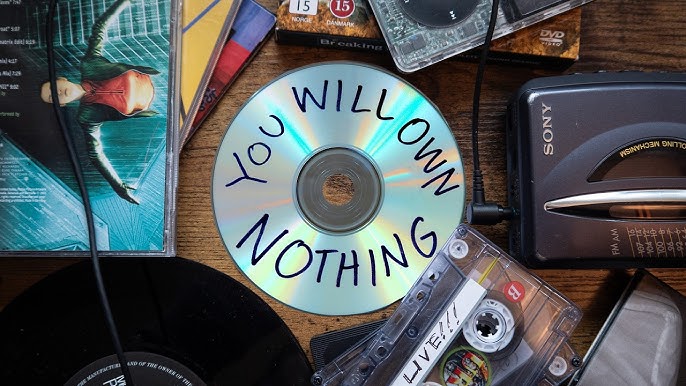
Tell me, when was the last time you ever used physical media? A CD? A DVD? A vinyl record? For most of us, the answer is: I can't remember.
Let's be honest — the rise of the internet changed everything. With a phone in your pocket and a Wi-Fi connection, you can stream, download, and binge-watch almost anything. No CDs. No DVDs. No clunky players. Just a screen and a signal.
And it's convenient. People want that. Why fumble with discs and cables when you can click a button and have your entire library at your fingertips? Even older generations are now streaming their favourite shows instead of visiting the local video rental shop.
The streaming revolution has been nothing short of total. Netflix, Disney+, HBO Go, Amazon Prime — they've replaced the video rental store, the DVD shelf, and the late-night trip to the mall for the latest release. It's all there. All the time. Anywhere.
But here's the problem. That convenience comes at a cost — and not just money.
The Cost of Convenience
When you pay for a streaming service, you don't own anything. You're renting access. Stop paying? Your library disappears. Want to watch that one show? It's not on Netflix — it's on Disney+. Oh, that movie? That's on HBO. Before you know it, you're subscribed to five platforms, each taking a bite out of your wallet every month.
And with shows and movies constantly being removed due to licensing deals, what you watched yesterday might not be available tomorrow. You're at the mercy of the platform, not the other way around.
This is the dirty secret of the streaming economy: you are not a customer. You are a tenant. And the landlord can evict you at any time.
The Gaming Industry Delivers the Final Blow
Meanwhile, physical media is quietly fading. Sony announced this year that its latest console, the PS5, will no longer produce physical discs for certain games — the final nail in the coffin for physical media in the gaming world.
Let's be honest, modern games are so massive they can't even fit on a disc anyway. A single game can exceed 100 gigabytes, far beyond what a standard Blu-ray can hold. Digital downloads were inevitable. It was only a matter of time.
DVD players are now a novelty. Something to show off. A relic. Go into any electronics store and you'll struggle to find one. Walk into a friend's house and you might see a player gathering dust — if they even have one at all.
And that's a little unfortunate — because physical media meant ownership. When you bought a CD, a vinyl, or a Blu-ray, it was yours. No license expiration. No internet required. No buffering. Just you and the media.
You could lend it to a friend. You could sell it. You could pass it down to your children. It was a tangible thing in a world that increasingly values the intangible.
The ownership argument is not just about sentimentality. It's about control. When you own a physical copy, you control when and how you access it. When you "own" a digital copy, you are at the mercy of servers, licensing agreements, and corporate decisions. You don't own a digital library. You own a permission slip that can be revoked at any time.
Nostalgia as Rebellion
But there's a counter-movement brewing. The younger generation is now keeping physical media alive — not just for ownership, but for culture.
Vinyl sales are up. CDs are making a comeback. It's become a trend to collect physical media — a statement. A way to prove how hip you are. People want something tangible in a world that's becoming increasingly digital and disposable.
There's something special about holding an album in your hands, reading the liner notes, seeing the artwork. Streaming can't replicate that. It can't replicate the ritual of placing a needle on a record or the satisfaction of a perfectly organized shelf of Blu-rays.
This is not just nostalgia. It's a rebellion against disposability. It's a refusal to accept that culture should be fleeting, that art should be ephemeral, that ownership should be a relic of the past.
My Collection, My Memory
For me, I collect Huey Lewis and the News. Michael Jackson's Invincible. I buy them because I love them. Because I want to support the artists. And because they're my memorabilia — physical proof of what shaped me.
There's a connection that digital can't replicate. When I hold that CD, I remember where I was when I first heard that album. I remember the person I was then. It's not just music. It's a time capsule.
The digital world is convenient. But the physical world is permanent. One is fleeting. The other is forever — as long as you hold onto it.
The streaming revolution has made culture more accessible than ever. But it has also made it more fragile. A show that exists only on a server can disappear overnight.
A song that's only available on a platform can be removed without warning. A movie that's exclusive to a service can become unavailable when licensing deals expire.
Physical media doesn't have that problem. It doesn't need permission. It doesn't need a signal. It just needs you to care enough to keep it.
And maybe that's the real question: in a world where everything is available, do we still care enough to keep anything?
Because when the internet goes down, when the servers shut off, when the licensing deals expire — what will you have left?