
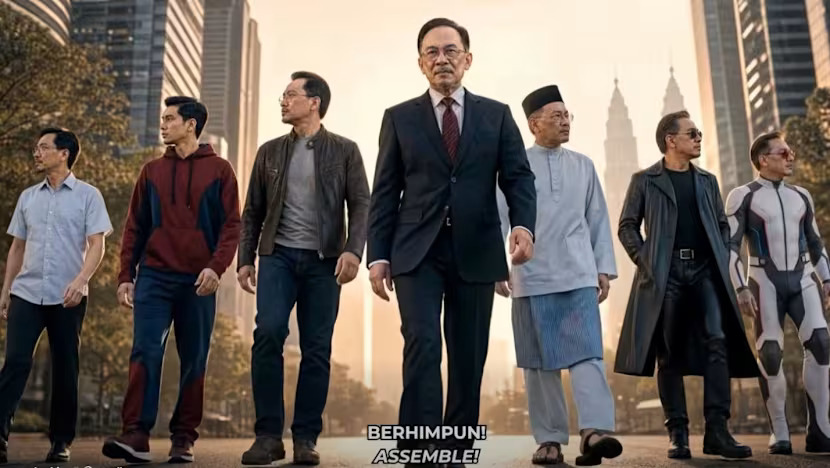
Malaysia's Prime Minister Anwar Ibrahim has introduced PMX.AI, an artificial intelligence avatar designed to engage with the public through WhatsApp.
Built using his speeches, writings and the government's policies, the AI assistant is intended to answer questions, provide information and help citizens navigate government services.
Supporters see it as an innovative way to improve accessibility, while critics have questioned everything from its necessity to its cost and potential political implications.
Those debates are understandable.
But regardless of where one stands on PMX.AI itself, its launch raises a broader question. What happens when political communication enters the age of artificial intelligence?
Throughout history, political leaders have consistently adopted new technologies to communicate with the public. Each innovation has brought governments closer to the people they serve.
Radio allowed leaders to speak directly to citizens without requiring them to attend public gatherings.
Television transformed politics into a visual medium, bringing leaders into living rooms across the country.
The rise of social media then enabled politicians to communicate directly with millions of people without relying solely on traditional media.
Artificial intelligence may represent the next chapter in that progression.
The difference is that AI does not simply broadcast information. It enables conversations.
From one-way messaging to two-way engagement
For decades, communication between governments and citizens has largely been one-directional.
Political leaders deliver speeches. Ministries issue press statements. Social media posts announce new policies. Citizens receive the information, but interaction remains limited.
PMX.AI introduces a different model.
Instead of waiting for the next press conference or searching through government websites, citizens can ask questions directly through a messaging application.
Whether it is about government assistance, policy initiatives or public services, each interaction can be tailored to the individual's needs.
In that sense, AI changes not just how information is delivered, but how citizens engage with political leadership.
Technology is removing the limits of scale
Every political leader faces the same limitation, time.
A prime minister can only attend so many events, conduct so many interviews and meet so many people in a day.
Technology has always expanded that reach.
Radio allowed one speech to reach millions.
Television extended that audience even further.
Social media enabled politicians to interact with supporters instantly.
Artificial intelligence removes another practical constraint.
Rather than communicating with large audiences at scheduled events, an AI representative can, in theory, engage with millions of citizens simultaneously through individual conversations.
No previous communication technology has offered that level of personalised interaction at such scale.
A new expectation of accessibility
The launch of PMX.AI also reflects changing public expectations.
Citizens today increasingly expect services to be immediate, digital and available whenever they need them.
The same expectation is gradually extending to public communication.
Accessibility is no longer measured solely by how often political leaders visit constituencies or hold town hall sessions. Increasingly, it is also about how easily citizens can obtain information, ask questions and receive responses.
AI has the potential to become another channel through which governments meet those expectations.
A communication tool, not a substitute for leadership
None of this suggests that AI can replace political leadership.
An AI avatar cannot negotiate international agreements, make policy decisions or exercise political judgment.
Nor should it.
Its role is far more limited.
It serves as a communication tool that extends the reach of a political leader while making information more readily available to the public.
Whether PMX.AI ultimately succeeds will depend on execution.
If it provides accurate information, improves access to government services and enhances public engagement, it could become a useful addition to the government's communication strategy.
If not, it risks becoming little more than a technological novelty.
Either way, PMX.AI represents something larger than a single AI project.
It reflects the continuing evolution of political communication.
Every major communication technology has reduced the distance between political leaders and the people they serve.
Artificial intelligence may be the first that attempts to make that distance almost disappear.