
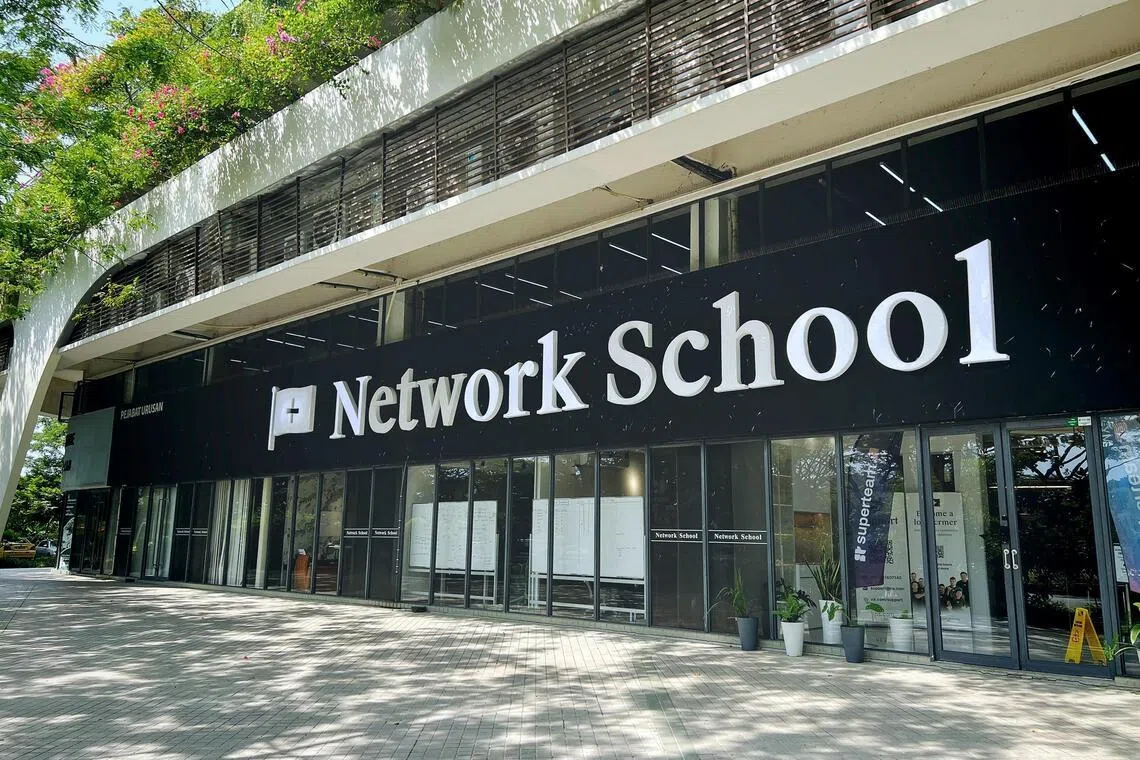
On July 22, 2026, the Iskandar Puteri City Council (MBIP) revoked the business licence of NSO Malaysia Sdn Bhd, the operator of Network School in Forest City, Johor. Enforcement officers arrived at the premises around 11.40am, sealed an entrance, and affixed an official closure notice.
The school's main signboard had already been removed. Nearby, foreigners believed to be school participants were seen packing luggage and saying goodbye in a hotel lobby.
Within hours, founder Balaji Srinivasan announced that Network School had signed a memorandum of understanding with Kazakhstan to establish a new campus there.
He framed it as a loss for Malaysia—a RM500 million expansion put on hold, investment plans cancelled, and a warning that other global tech firms would follow suit.
But here is the truth that Srinivasan and his supporters refuse to acknowledge: Malaysia did not lose anything of value. It defended its sovereignty, enforced its laws, and sent a clear message that no foreign entity—regardless of how much money it promises—is above the nation's rules.
The Government's Position Was Clear from the Start
Prime Minister Anwar Ibrahim made Malaysia's position unequivocal: "If there are Israeli citizens, because we do not recognise Israel, they will be expelled immediately". He reiterated that the government would not compromise on its policy of refusing entry to Israeli nationals and that anyone found to have entered the country would be deported immediately.
When the allegations first surfaced on July 14—through an anonymous social media account claiming that Network School was harbouring undocumented immigrants and Israelis using second-country passports—the government did not hesitate.
Johor Menteri Besar Datuk Onn Hafiz Ghazi immediately urged the Home Ministry and relevant agencies to investigate. A multi-agency raid was launched within days. The investigation was thorough. Immigration officers inspected hundreds of passports belonging to people from 40 countries. T
he Immigration Department later confirmed that all 266 foreign nationals inspected possessed valid immigration documents based on its records. No evidence of Israeli nationals was found.
But the government did not stop there. It went further. It revoked the business licence. It sealed the premises. And it made clear that operating a business in Malaysia means operating within Malaysian law.
The Real Violations Were Clear
Srinivasan and his supporters have tried to frame the closure as an overreaction to "unsubstantiated online allegations." But the reality is far simpler: Network School violated the law.
MBIP's investigation revealed that the company had failed to comply with licensing conditions and the approved use of its premises. The actual business activities on-site differed significantly from its approved office-use licence. The council also revoked the company's advertising licence after discovering that the signboard displayed at the premises did not match the approved licence details.
MBIP had conducted inspections and compliance audits on July 12, 14, 19, and 20. The company was found to be operating one of its premises without a valid licence and failing to comply with conditions governing the use of the premises.
These are not minor technicalities. They are fundamental breaches of the regulatory framework that every business in Malaysia is expected to respect. If a company cannot even follow basic licensing rules, what guarantee is there that it will follow anything else?
Srinivasan himself acknowledged receiving two notices—one requiring a change to a signboard, another stating that only one of two adjoining units had a valid licence. He claimed these were minor issues that would be rectified. But the council's multiple inspections over eight days suggest a pattern of non-compliance that went beyond a simple paperwork error.
Defending Sovereignty, Not Chasing Headlines
Srinivasan has tried to paint Malaysia's actions as a blow to its reputation as a tech hub. He put a planned RM500 million expansion on hold, saying the company would not proceed without assurances that "such issues won't recur".
He warned that "the investment plans of many of our friends, including the execs and investors at global tech firms that we brought to Forest City" were also on hold.
But here is the question that Srinivasan does not want to answer: what exactly was Network School building?
The project was not a conventional educational institution. It was a "co-living and co-working technology commune" charging memberships starting at US$1,500 (RM6,135) a month. It was founded by a man who wrote a book called The Network State: How To Start a New Country—a book that critics describe as a blueprint for creating parallel societies outside traditional governance structures.
When allegations emerged that the school was harbouring Israeli nationals using second-country passports, the concerns were not just about immigration violations. They were about something deeper: the creation of an insulated, self-governing enclave that operated outside Malaysia's legal framework. A "network state" within a state.
Srinivasan has not commented on the closure of the school's operations in Johor since the announcement. His last post on X, published on July 18, dismissed reports that the school was being shut down as "fake news". By July 22, he was already in Kazakhstan, signing an MOU with a government that apparently offered faster visa processing, streamlined relocation support, and active talent recruitment.
Let that sink in. A man who claimed to be committed to Malaysia's development was ready to leave within days of his licence being revoked. His loyalty was never to Malaysia. It was to his project. And his project will follow whoever offers the easiest terms.
The Economic Threat Is Hollow
Srinivasan has threatened that Malaysia's actions will scare away foreign investment. He has pointed to the RM100 million already invested and the RM500 million expansion that will never happen. He has claimed that Network School had attracted "thousands of engineers, investors and entrepreneurs from more than 70 countries".
But let us be honest about the numbers. The RM100 million was largely self-contained—spent within the Network School ecosystem on facilities, infrastructure, and services that primarily benefited its own residents.
The jobs created were "dozens", not thousands. The economic contribution to Johor's broader economy was minimal. The amount would not even cover a month of the government's fuel subsidy bill.
Kazakhstan may welcome Network School with open arms. It may offer expedited visas and streamlined redomiciliation. But that is Kazakhstan's choice. Malaysia has a different set of values, a different legal framework, and a different understanding of what sovereignty means.
The reality is that Malaysia does not need projects that come with hidden ideologies. It does not need investments that demand special treatment. And it certainly does not need foreign entities that believe they can operate outside the law.
A Model for Future Enforcement
The Network School case sets an important precedent. It demonstrates that Malaysia's regulatory framework works when it is enforced. It shows that the government is willing to act decisively when national security or sovereignty is at stake.
The Malaysia Digital Economy Corporation (MDEC) also took action, revoking NSO Malaysia's Malaysia Digital status. This sends a clear signal to all digital and tech companies operating in Malaysia: compliance is not optional.
The fact that no evidence of Israeli nationals was found does not make the investigation a failure. On the contrary, it proves that the system works. The government investigated credible allegations thoroughly. It took enforcement action based on clear violations of licensing conditions. And it did so without fear of economic retaliation.
Network School is gone. Its founder has moved on to Kazakhstan. The empty buildings in Forest City are once again empty.
But Malaysia has not lost anything. It has gained something far more valuable: a demonstration that its sovereignty is not for sale.
Srinivasan and his supporters can threaten to take their investments elsewhere. They can claim that Malaysia is unfriendly to tech innovation. They can warn that other investors will follow.
But the truth is that Malaysia does not need projects that operate in the shadows. It does not need investments that come with conditions. And it certainly does not need foreign entities that believe they can pick and choose which laws to follow.
Investors come and go. Projects rise and fall. But Malaysia's sovereignty is permanent. And the government's decision to shut down Network School was not a loss—it was a victory for the rule of law, for national security, and for the principle that no one is above the law.
The message to future investors is clear: you are welcome in Malaysia. But you will operate by our rules. And if you cannot accept that, the door is open. Just ask Balaji Srinivasan.