
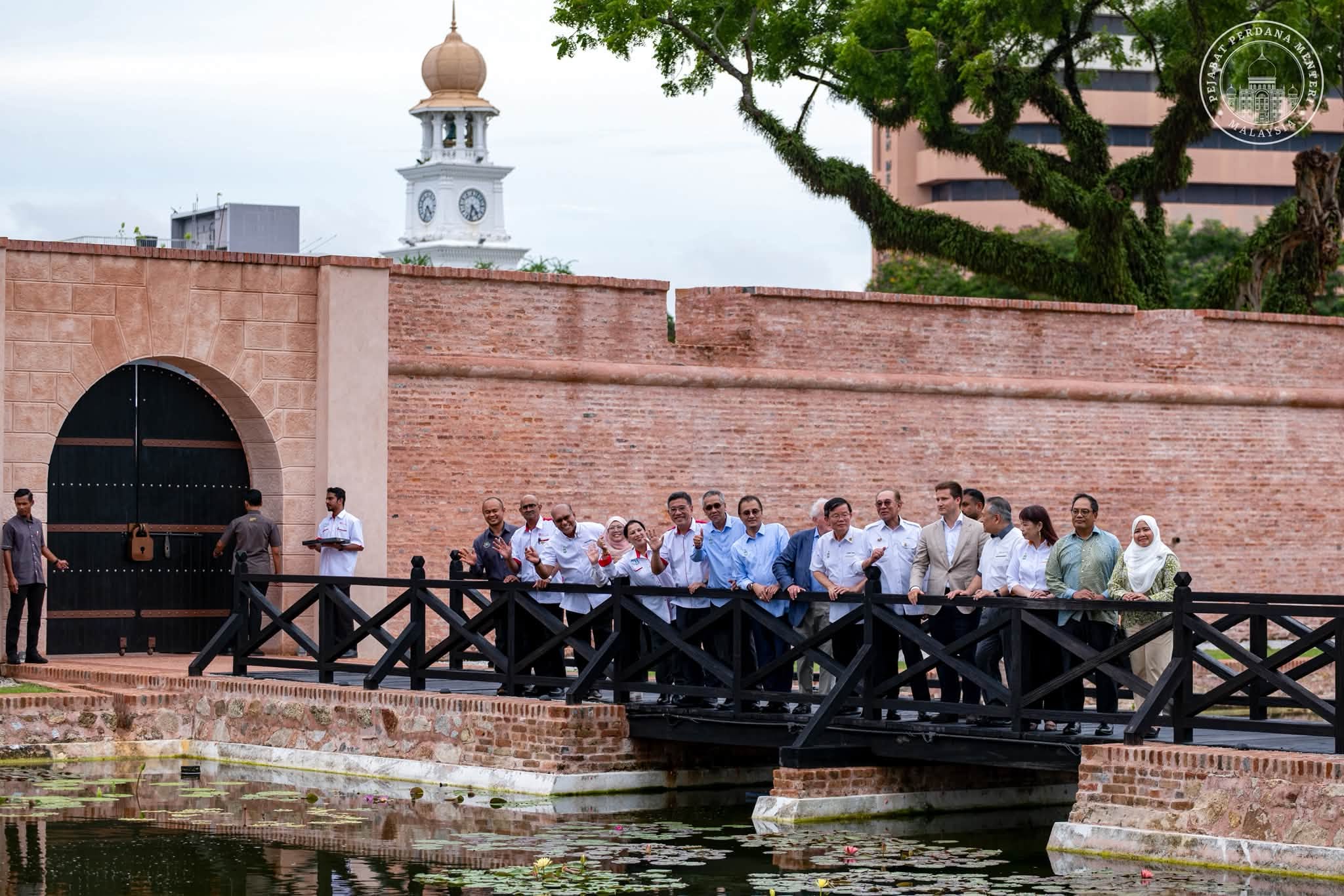
Why spend nearly RM15 million restoring a colonial fort?
At first glance, it may seem like an unusual investment. Fort Cornwallis is, after all, one of the most recognisable reminders of Penang's colonial past.
For some, allocating public funds towards restoring a structure built during British rule may appear difficult to justify, particularly when governments face competing priorities such as housing, healthcare and public infrastructure.
Yet the reopening of Fort Cornwallis tells a much bigger story than the restoration of a single historical landmark. It reflects a development philosophy that views heritage not as something standing in the way of progress, but as something that can contribute to it.
For decades, development has often been measured by what is newly built. New roads, towering skyscrapers and modern commercial districts have become visible symbols of economic growth and urban progress.
Heritage buildings, meanwhile, are sometimes seen as obstacles occupying valuable land or limiting opportunities for redevelopment.
Fort Cornwallis challenges that assumption.
Since 2016, the Penang state government has invested nearly RM15 million in conserving the historic fort, not to preserve colonialism, but to preserve the history, identity and character that have shaped the state into what it is today.
Rather than allowing a significant part of Penang's past to deteriorate through neglect, the state has chosen to restore it and return it to public life.
More importantly, the fort has not been restored in isolation.
Its reopening forms part of the Penang Northern Seafront Masterplan, which also includes projects such as seawall improvements, the restoration of the Queen Victoria Memorial Clock Tower, the Linear Garden and Astaka Kota Selera.
Taken together, these initiatives demonstrate that modernisation does not have to come at the expense of heritage. A city can continue to grow while protecting the places that give it its identity.
This reflects a broader understanding of what development can look like.
Progress is not always about replacing the old with the new. Sometimes, it is about recognising the value of existing places and ensuring they remain relevant for future generations.
That identity is also an economic asset.
Heritage does more than preserve the past, it can also generate economic value.
Well-preserved historical sites attract visitors, support local businesses and encourage people to spend more time exploring surrounding neighbourhoods.
Restaurants, cafés, hotels and other tourism-related businesses all benefit when heritage sites remain active parts of the urban landscape rather than forgotten relics.
For George Town, whose UNESCO World Heritage status is one of its defining strengths, protecting historic landmarks is about more than preserving old buildings.
It is about safeguarding the unique character that distinguishes the city from countless others.
Modern commercial developments can be replicated almost anywhere. George Town's heritage, however, is something that cannot simply be rebuilt once it is lost.
This is why the perceived choice between development and conservation can be misleading.
Heritage, when properly maintained and integrated into wider development plans, can itself become a driver of economic activity.
Conservation and development do not have to compete with one another.
Instead, they can complement each other in creating cities that are both economically vibrant and culturally distinctive.
Of course, questions about public spending are understandable. Nearly RM15 million represents a significant investment, and there will always be debate about how public funds should be allocated.
However, treating heritage conservation as money taken away from development overlooks the long-term value these projects can create.
Restoring places like Fort Cornwallis is not simply an investment in an old building.
It is an investment in tourism, education, cultural identity and the long-term attractiveness of Penang as both a place to visit and a place to live.
There is another reason why the fort matters.
During the reopening ceremony, Prime Minister Datuk Seri Anwar Ibrahim emphasised that preserving Fort Cornwallis is not about glorifying colonial rule.
Rather, it is about ensuring future generations understand that chapter of the nation's history.
The fort stands as a reminder of a period when Penang and Malaya were shaped by foreign rule, and of the long journey that eventually led to independence.
Preserving such sites allows history to be experienced in a tangible way, offering opportunities for reflection that textbooks alone cannot always provide.
History does not have to be celebrated to be preserved. Sometimes, its greatest value lies in helping society understand where it came from and how far it has come.
Ultimately, the reopening of Fort Cornwallis demonstrates what can happen when heritage is treated as part of development rather than an obstacle to it. Instead of choosing between preservation and progress, Penang has shown that the two can move forward together.
Development should not be measured solely by what a city builds next, but also by what it chooses to protect.
Roads, buildings and commercial projects may shape a city's future, but its heritage shapes its identity.
Penang's decision to restore Fort Cornwallis suggests that the strongest cities are not those that erase their history in pursuit of modernity, but those that recognise their past as part of their future.
In doing so, the state offers an important reminder that meaningful development is not only about creating new landmarks, but also about ensuring that the ones we already have continue to tell the stories that define us.