
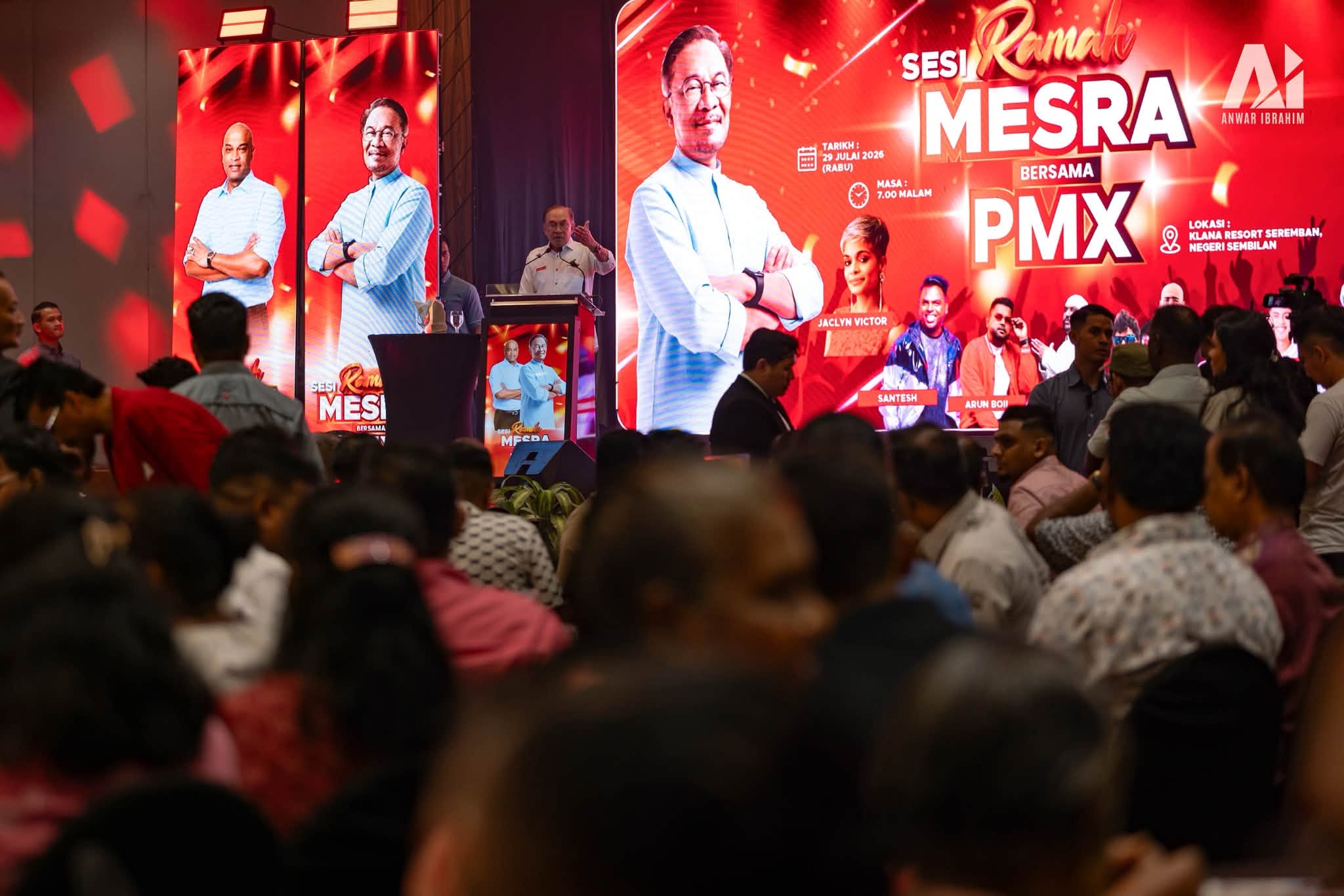
Prime Minister Datuk Seri Anwar Ibrahim's decision to personally oversee issues affecting the Indian community has understandably drawn attention.
Some will view it as a political move, especially with elections on the horizon.
Others will see it as a signal that the government is placing greater emphasis on the welfare and development of the community.
Whatever one's interpretation, the announcement points to a broader question. What should the next phase of government policy look like?
Based on Anwar's recent statements, the answer does not appear to be the introduction of an entirely new slate of initiatives.
Instead, the focus is on ensuring that the programmes already in place deliver more effectively.
In a recent Facebook post following his engagement with the Indian community in Negeri Sembilan, the Prime Minister highlighted a wide range of existing efforts.
These include initiatives through the Malaysian Indian Transformation Unit (MITRA), education, skills training, entrepreneurship, youth development and welfare programmes.
He also announced that he would personally oversee matters concerning the Indian community at the federal level, working alongside Human Resources Minister Datuk Seri R. Ramanan, to ensure that issues are addressed more effectively.
Taken together, these statements suggest a shift in emphasis.
Rather than expanding the number of programmes, the priority appears to be improving how existing initiatives are coordinated and delivered.
This is an important distinction.
Communities rarely benefit from government support through a single programme or agency.
A student seeking to improve future prospects may require educational assistance, skills training and career guidance at different stages of life.
An aspiring entrepreneur may need financing, business development support, mentoring and access to new markets.
Families facing financial hardship may rely on welfare assistance while also seeking opportunities to improve their long-term economic standing.
These forms of assistance often fall under different ministries, agencies and funding mechanisms.
When they operate independently, navigating the system can become unnecessarily complex for those they are intended to serve.
This is where stronger coordination has the potential to make a meaningful difference.
By taking direct oversight, the Prime Minister is placing himself in a position to facilitate greater alignment across the various initiatives already available.
Better coordination can help reduce duplication, improve communication between agencies and ensure that assistance reaches beneficiaries more efficiently.
The success of this approach, however, will ultimately depend on implementation.
Announcements alone are not what communities remember.
What matters is whether students are able to access educational opportunities more easily, whether entrepreneurs can obtain financing without unnecessary hurdles, whether skills training leads to meaningful employment and whether welfare programmes reach those who need them most.
It is also inevitable that some will question the timing of the announcement.
With elections approaching, political motives will naturally be part of the public conversation.
Yet politics and public policy are not always mutually exclusive.
An initiative introduced during an election season is no less valuable if it produces tangible improvements in people's lives.
Ultimately, the public is unlikely to judge this announcement based solely on who made it or when it was made.
They will judge it on whether it results in better opportunities, more effective service delivery and measurable improvements for the Indian community.
If the Prime Minister's direct involvement succeeds in bringing together the many programmes that already exist and ensures they deliver the outcomes they were designed to achieve, then this announcement will represent more than a change in oversight.
It will mark a shift from expanding initiatives to making existing ones work better.
That, in the end, may prove to be the more meaningful reform.