
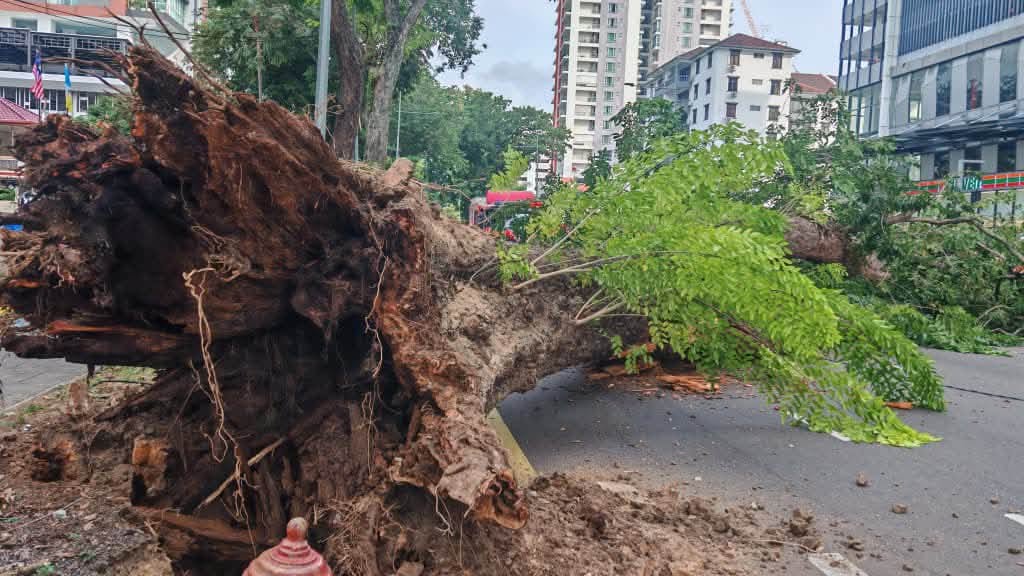
The 90-year-old Angsana tree that crashed onto a car along Jalan Macalister had been assessed through a satellite remote-sensing system last year and found to have no warning indicators.
On Sunday 9th August, it came crashing down, injuring three people and prompting the Penang Island City Council (MBPP) to order urgent action on other potentially dangerous trees along the road.
The tree had about 30% root decay and a cavity affecting about 40% of the base of its trunk, according to MBPP mayor Datuk A. Rajendran.
Standing at about 28 metres tall, it was also affected by chronic soil compaction and limited rooting space.
There were no reports of heavy rain or strong winds when the tree fell.
In May this year, MBPP launched the “Smart Sight Trees” system, which is believed to be the first of its kind in the country.
The system uses a satellite remote-sensing study intended to provide an early warning system for tree health.
The system has classified the same tree as being in good condition, with no warning indicators.
The tree's condition raises a question over what current monitoring systems can actually detect.
Satellite remote sensing can provide authorities with information on vegetation and tree health across large areas. The data is then analysed using AI to identify potentially unhealthy trees.
This helps them identify trees that may need closer attention.
But a tree's condition from above does not necessarily reveal what is happening inside its trunk or beneath the ground.
Decay within the trunk, deterioration of the root system and other structural problems can develop without being immediately visible from above.
This is where physical assessments by trained arborists come in.
MBPP's Landscape Department has an Arborist and Trees Division responsible for assessing at-risk trees, carrying out risk assessments, recommending mitigation measures and maintaining information on individual trees.
The council also carries out maintenance, pruning and felling programmes based on safety assessments.
Jalan Macalister had already gone through this process.
MBPP assessed mature and aged trees along the road in 2024, resulting in 13 trees being felled.
The latest tree maintenance work along the road was carried out on Jan 29 this year, according to Rajendran.
Seven months later, the 90-year-old Angsana came down.
That does not necessarily mean the earlier assessments were wrong. Trees are living structures and their condition can change over time.
But it does raise the issue of how often ageing trees, particularly those in heavily built-up areas, should be reassessed.
And Jalan Macalister is not an isolated case.
Rajendran said MBPP had approved 179 trees for removal this year, with 148 already felled.
The reasons included trees that were dead, leaning or at risk of falling, as well as trees affected by blocked drains, development projects, road and river widening and the installation of Perbadanan Bekalan Air Pulau Pinang pipelines.
In other words, the council is managing trees in spaces that are also being used for roads, drains, utilities and other infrastructure.
Many of these trees were planted in a very different environment. Decades of road works, pavement construction, drainage upgrades and utility installations may have altered the conditions around them.
The space available to a tree's roots can change considerably over its lifetime, as can the condition of the surrounding soil.
MBPP has identified constrained rooting conditions and infrastructure works as factors requiring particular attention.
The response following the Macalister Road incident reflects that concern.
Rajendran said MBPP had instructed its appointed contractor to expedite work to reduce the height of trees and fell those with the potential to topple along Jalan Macalister, based on assessments by certified arborists.
It also shows the limits of relying on any single method of monitoring.
Satellite technology can help authorities keep track of a large number of trees, but decisions on whether a tree should be pruned, monitored more closely or removed still depend on what is found on the ground.
And that becomes harder as Penang's urban trees continue to age.
The answer cannot simply be to remove every old tree.
Mature trees provide shade, environmental benefits and much of the character associated with Penang's older streets.
But keeping them also means knowing when one has moved from being an ageing tree to becoming a safety risk.
The Macalister Road tree had already passed through several layers of the city's tree-management system.
It had been assessed as part of the road's mature-tree review, subjected to satellite remote sensing and maintained.
And yet, it still fell.
One incident alone cannot establish that Penang's tree-management system failed.
But it does expose a gap that is harder to ignore. A tree can be classified as healthy while still having structural problems that eventually cause it to fail.
As Penang's urban forest gets older, the challenge will be keeping track of those changes before they become a problem for the people and infrastructure around them.