
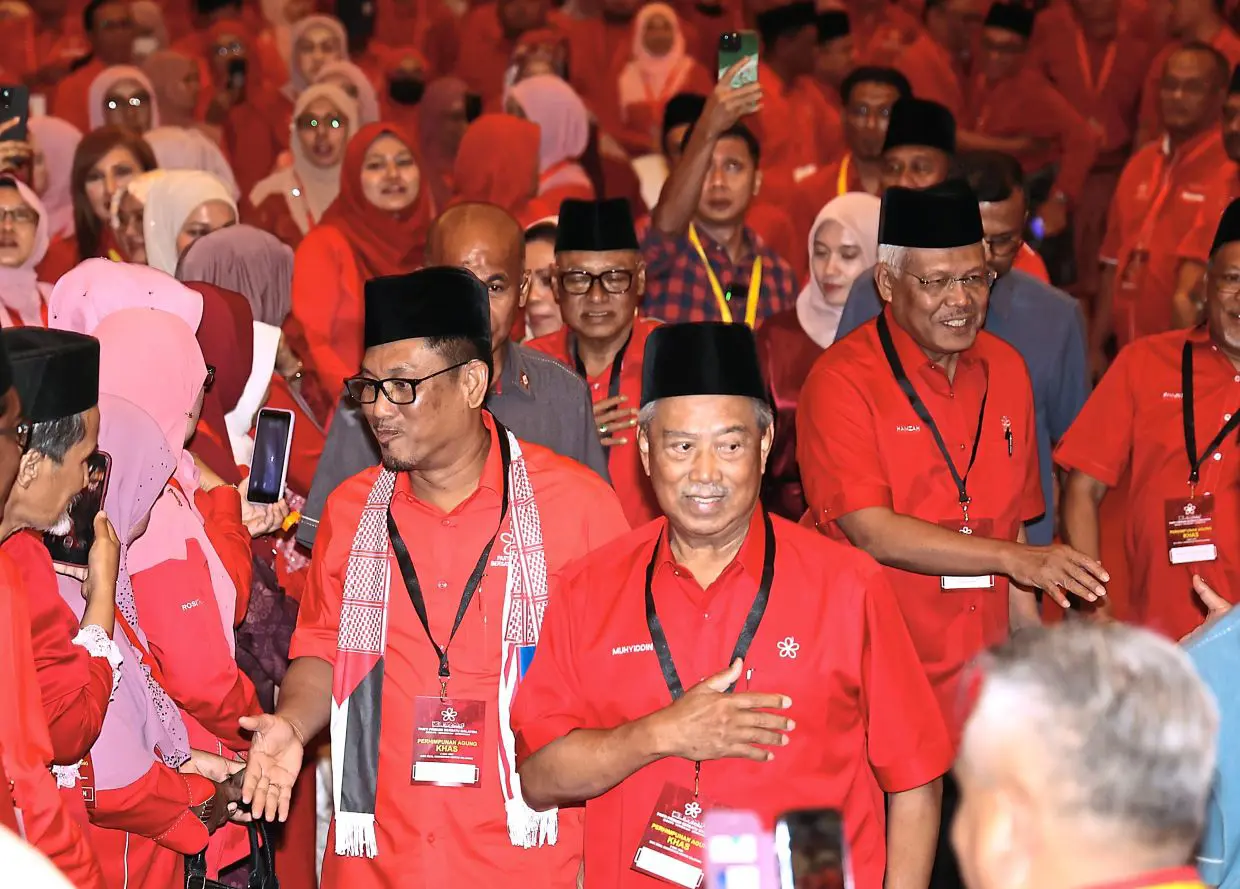
Negeri Sembilan was supposed to be a test of endurance. For Bersatu, it became a funeral.
Of the 24 candidates it fielded in the 16th Negeri Sembilan state election, 23 lost their deposits — failing to secure even one-eighth of the total votes cast. The party's information chief, Tun Faisal Ismail Aziz, lost his deposit in Sikamat. Its state chief, Hanifah Abu Baker, lost in Labu — a seat Bersatu was defending.
The sole candidate who avoided the ignominy of losing his deposit was R Sri Sanjeevan, the head of its associate wing, who finished third in a four-cornered fight.
Zero seats. Twenty-three lost deposits. A party that once shook Malaysian politics is now a political corpse twitching for relevance.
How did Bersatu end up here? And more importantly — what happens next?
The Coalition That Forgot Its Founder
Bersatu's predicament is not just about electoral failure. It is about being systematically sidelined by the very coalition it helped build.
Perikatan Nasional was formed in 2020 after the Sheraton Move toppled the Pakatan Harapan government. Bersatu was its backbone, the vehicle that brought Muhyiddin Yassin to the prime minister's office. But the party that once led the coalition is now being treated as an inconvenience.
In June 2026, PN chairman Ahmad Samsuri Mokhtar pushed through the admission of Parti Wawasan Negara (Wawasan) and Pejuang as PN components. Bersatu objected, accusing Samsuri of rushing the process. Its objections were dismissed.
Then came the Negeri Sembilan election. Under a seat-sharing arrangement, BN contested 25 seats while PN fielded 11 candidates. Bersatu was not allocated a single seat under the PN banner. It was forced to contest under its own logo, running against the very coalition it was supposed to be part of.
And when it lost, its own coalition members celebrated.
Wawasan president Hamzah Zainudin, a former Bersatu deputy president expelled in February 2026 mocked his former party: "In Johor they lost, and here they got nothing".
He declared Bersatu "no longer relevant in the current political landscape". He invited former Bersatu members to join Wawasan instead.
The message could not be clearer: Bersatu is no longer needed.
The Contradiction at the Heart of PN
Here is where the situation becomes almost absurd.
On August 7, PAS president Hadi Awang declared that Bersatu had automatically ceased to be a member of PN after Muhyiddin announced plans to form a new political coalition. He claimed no formal letter or committee decision was needed, the announcement itself triggered the termination.
Two days later, PN chairman Samsuri contradicted him, stating that Bersatu "remains a member of PN" and that its status "has not changed".
The chairman of PN says Bersatu is in. The president of PN's largest party says Bersatu is out. This is not a minor disagreement. This is a fundamental crisis of authority.
As one analysis put it, "Coalitions cannot operate indefinitely according to competing interpretations of membership. If Bersatu has not formally withdrawn and has not been formally expelled, its status cannot simply depend on what one component president declares publicly".
Yet that is precisely what is happening. Bersatu is being treated politically as though it has disappeared even when institutionally it has not.
Wawasan: The Bridge That Is Also a Replacement
Wawasan positions itself as a bridge — between PAS and Bersatu, between PN and BN. Hamzah even coined the term "PBN" during the Negeri Sembilan election to describe the electoral understanding between the two coalitions.
But a bridge cannot be neutral when it is also replacing one of the sides it claims to connect.
Wawasan increasingly occupies political territory once associated with Bersatu. It has already been accepted as a PN component and participated directly in the Negeri Sembilan arrangement. It won three of the four seats it contested on its electoral debut. Bersatu, meanwhile, won nothing.
Yet Bersatu's continued formal membership means PN now contains two political vehicles competing for substantially overlapping Malay constituencies, leadership networks and political space. Hamzah himself emerged from Bersatu. His rise inevitably affects Bersatu's political relevance.
The stronger Wawasan becomes inside PN, the more existential the question becomes for Bersatu: what exactly is Bersatu's remaining function inside the coalition?
What Are Bersatu's Options?
First, it could remain in PN and fight for relevance. This is the official position. Bersatu secretary-general Azmin Ali has dismissed calls to dissolve the party, insisting it "will remain active and contest every election to offer Malaysians an alternative".
But remaining in a coalition that is actively replacing you is not a strategy, it is a slow death. As one analyst noted, Bersatu's "internal struggles and declining influence had become a major weakness for PN". Another advised the party to "move on from a bleak future in PN" and "stop dwelling on past achievements".
Second, it could leave PN and form a new coalition. Muhyiddin has already hinted at this, signalling that Bersatu "will not be alone" after the Negeri Sembilan election and that a "new opposition alliance could take shape".
The party's youth information chief has confirmed that "all political options remain open ahead of GE16". But leaving PN means abandoning the coalition it helped create and potentially contesting against the very partners it once called allies. The Negeri Sembilan results show that without a coalition, Bersatu cannot win.
Third, it could attempt to rejoin Pakatan Harapan. This seems unlikely, the betrayal of the Sheraton Move is not easily forgiven. PH voters would be outraged. As the saying goes, two wrongs do not make a right. But in Malaysian politics, stranger things have happened.
The Irony That Cannot Be Ignored
There is a cruel irony in Bersatu's fate.
The party was founded in 2016 as a vehicle for Malay political discontent, a direct challenge to Umno. It succeeded beyond anyone's expectations, helping topple the BN government in 2018. It then became the backbone of PN and propelled Muhyiddin to the prime minister's office.
Now, it is being replaced by a party led by its own expelled deputy president. The party that once dared to take on Umno is now being taken on by its own offspring. And it is losing.
Bersatu's position is unsustainable.
It cannot stay in PN while being treated as irrelevant. It cannot leave PN and expect to win alone. It cannot join PH without betraying everything it once stood for.
As BN and PN cooperation deepens, potentially moving towards Malacca, Perlis and even PAS heartlands. Bersatu's role becomes even more marginal. The electoral arrangement in Negeri Sembilan worked precisely because both PN and BN had a powerful incentive to avoid splitting votes. Bersatu was the casualty of that arrangement.
The party's leadership must now make a choice. Remain in a coalition that no longer wants them. Leave and risk irrelevance. Or find a third path that does not yet exist.
One thing is certain: the party that once shook Malaysian politics is now fighting just to stay relevant. And in Malaysian politics, irrelevance is a death sentence.