
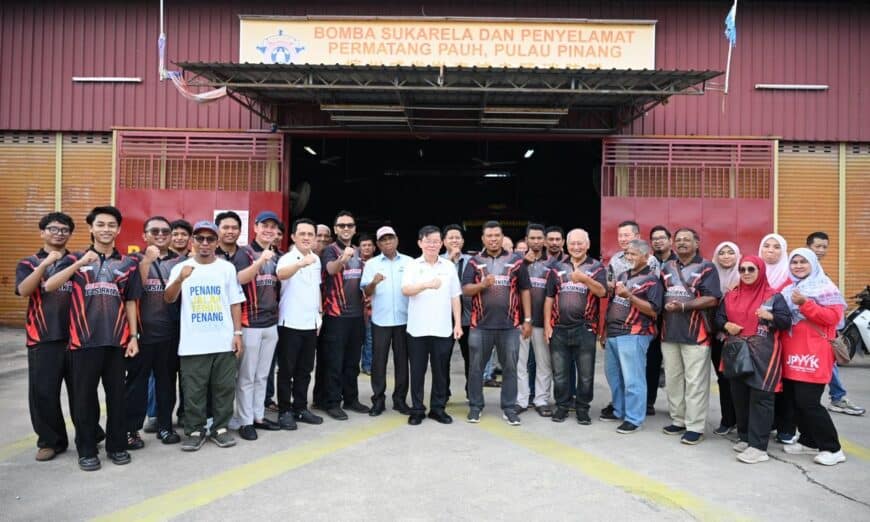
The Penang government will continue its annual RM10,000 contribution to each of the state’s 36 volunteer fire and rescue teams, while also considering additional allocations for teams that require new vehicles, equipment or other operational upgrades.
Chief Minister Chow Kon Yeow said the volunteer brigades play an important role in supporting the Fire and Rescue Department during fires and other emergencies, forming a grassroots network that strengthens Penang’s overall emergency response capabilities.
The additional allocations, which can range from RM10,000 to RM30,000 depending on the needs of individual teams, are particularly significant because many volunteer brigades operate under financial constraints.
Government assistance, however, is only part of the picture.
Many teams also rely on donations from the public, local businesses and industries, as well as fundraising activities to maintain their operations and improve their equipment.
During Chow’s visit to the Permatang Pauh Volunteer Fire and Rescue Station, its chairman Goh Soon Eik called for continued support to upgrade stations and improve basic infrastructure.
He also urged more young people to join volunteer fire brigades, highlighting the importance of younger generations to the continuity of the movement.
That second point deserves more attention than it might initially seem.
Because for Penang’s volunteer fire brigades, the biggest challenge in the years ahead may not simply be finding enough money to keep the trucks running.
It may be finding enough people willing to climb into them.
Penang has something many places would struggle to build from scratch. A grassroots emergency network made up of people willing to leave their homes, jobs and daily routines when disaster strikes.
Its 36 volunteer fire and rescue teams are an important part of that network.
They provide additional manpower, vehicles and logistical support during major incidents, while their presence within local communities gives them something that a centralised emergency service cannot easily replicate.
Familiarity with the people and places they serve. That is an asset worth protecting.
The state’s decision to continue its annual contribution is therefore a positive step.
RM10,000 may not be enough to cover everything a volunteer brigade needs, but continued government support gives teams a degree of stability.
Additional funding for vehicles, equipment and infrastructure is equally important, particularly for brigades already struggling to maintain their facilities and operations.
But there is a difference between keeping a system functioning and making sure it can survive.
And that is where the conversation about sustainability needs to begin.
A volunteer fire brigade can have a station, a vehicle and equipment neatly stored and ready for deployment. But none of those things can respond to an emergency on their own.
People do.
That makes volunteer recruitment just as important as equipment funding.
Volunteer fire brigades occupy an unusual position.
They are community organisations, but their work can have immediate consequences for public safety. At the same time, they are not fully funded emergency services.
Their survival therefore depends on a mixture of government assistance, community donations, business support and the personal commitment of volunteers.
There is strength in that model because local teams understand their communities.
They are embedded in neighbourhoods and often have long-standing relationships with residents, businesses and local organisations.
They know the roads, the surrounding areas and, in many cases, the people they may be called upon to help.
When an emergency happens, that local knowledge and proximity can be invaluable. But there is also a vulnerability.
If a brigade has to organise fundraising simply to maintain essential equipment, replace ageing vehicles or keep its facilities in reasonable condition, its ability to respond can ultimately depend on how generous and financially capable its surrounding community happens to be.
That is not necessarily a sustainable foundation for an emergency-response network.
The solution is not to remove the community element. Community involvement is precisely what gives these brigades their strength.
Instead, Penang needs to think about how the government, communities and businesses can share that responsibility more systematically.
Annual allocations can keep teams going, but long-term planning needs to go further. Vehicles have finite lifespans. Equipment becomes outdated. Stations deteriorate. Training needs to be maintained. These require planning before they become urgent problems.
The state could therefore look at longer-term equipment replacement programmes, station upgrades and structured training support rather than treating every major need as an individual funding request.
Businesses operating in these communities could also have a larger role to play.
A strong emergency-response network does not only protect residents. It protects businesses, employees, industrial areas and local economies.
There is a clear community interest in supporting the people who may one day be responding to an emergency at a factory, shop lot, workplace or neighbourhood.
But even the best-funded brigade will eventually face a much harder problem if there are not enough volunteers to operate it.
That is why Goh’s call for more young people to join should not be treated as a side note. It may be one of the most important issues facing the movement.
Every volunteer organisation eventually has to confront the same uncomfortable question. Who comes next?
Today’s volunteers will not be available forever.
People move, careers change, families grow and responsibilities increase. Eventually, even the most committed volunteers will have to step back.
If younger people are not coming through behind them, the experience and leadership built within these teams can gradually disappear.
And that cannot simply be solved by recruiting more people at the last minute.
Firefighting requires training and discipline. It requires people who understand their equipment, know how to work with others and are prepared to respond when the situation is difficult.
That cannot be built overnight.
Which means succession planning needs to start long before today’s volunteers are ready to leave.
The challenge, however, is that young people already have plenty competing for their attention.
Education, university, work, family, friendships and other commitments all take up time.
Volunteering itself has also changed, with younger generations having access to countless organisations and causes competing for their involvement.
Volunteer firefighting has to offer something compelling enough for them to choose it.
That does not mean turning firefighting into another trendy activity.
It means recognising what young volunteers can gain from being part of the movement.
They can learn practical emergency-response skills, develop teamwork and leadership abilities, build discipline and confidence, and form a stronger connection to their communities.
More importantly, they can become part of something with a tangible purpose.
There is a difference between volunteering because it looks good on a résumé and volunteering because you know your community may genuinely need you.
Penang’s volunteer fire brigades have the opportunity to make that sense of purpose part of their appeal.
But recruitment cannot stop at getting young people through the door. They need reasons to stay.
A young volunteer who joins a brigade should be able to see where that commitment can take them. There should be opportunities to learn, train, take on greater responsibilities and eventually lead.
Without that pathway, younger volunteers may remain on the margins rather than becoming the next generation of experienced firefighters.
This is where the state can play a role beyond simply providing money.
Government support could help create more structured training and development opportunities for young volunteers across the 36 brigades.
It could encourage knowledge-sharing between teams, strengthen safety and operational standards and help brigades develop clearer pathways for volunteers to take on leadership roles.
The goal should not be to make every volunteer brigade identical. Their local character is part of what makes them useful.
But there should be enough support and structure to ensure that a young person joining a brigade in Permatang Pauh, Balik Pulau or elsewhere in Penang has a genuine opportunity to develop their skills and contribute meaningfully.
There is also an important cultural element to this.
Volunteer firefighting has to remain visible within the communities it serves. Young people are more likely to consider joining something they understand.
That means brigades should not only be visible when responding to fires.
Training exercises, community events, school engagement and public education can all help make the work of volunteer firefighters more familiar to younger residents.
If the next generation only sees a volunteer firefighter when an emergency is already happening, it is harder for them to imagine themselves becoming one.
The state and the brigades should also be honest about the commitment involved.
Recruitment should not be about collecting as many names as possible. It should be about finding people who are prepared to learn, train and eventually take responsibility. That makes retention just as important as recruitment.
A young volunteer who feels overworked, poorly equipped or ignored is unlikely to stay. A young volunteer who sees that their time is valued, their training is taken seriously and their contribution matters has far more reason to build a future within the organisation.
This is why the sustainability of Penang’s volunteer fire brigades cannot be measured simply by how many teams exist.
Thirty-six teams on paper do not necessarily mean 36 strong and sustainable teams.
The more meaningful measure is whether those teams have enough active volunteers, whether people are being trained to take on leadership roles, whether their equipment is being maintained and replaced, and whether younger members are actually coming through the ranks.
The state should be looking at those indicators now, rather than waiting for a shortage of volunteers or equipment to become a crisis.
These are not merely administrative matters. They are the foundations of whether Penang’s volunteer fire network can continue to function when today’s volunteers are no longer the ones answering the call.
There is a tendency to think about disaster preparedness only when disaster strikes.
By then, it is too late to start building capacity.
You cannot wait for a major fire to discover that a brigade does not have enough trained volunteers. You cannot wait for an ageing vehicle to fail before thinking about its replacement. And you cannot wait for an entire generation of experienced firefighters to step aside before asking where their successors are.
Preparedness is built during the quiet periods, long before the sirens go off.
Penang’s volunteer fire brigades have already spent years building relationships, acquiring equipment and developing local knowledge.
The state has something valuable here.
The task now is to make sure that value is not lost through neglect, ageing infrastructure or a shrinking volunteer base.
Continued government funding is important. So are community donations and business support.
But sustainability requires something deeper than keeping the existing system alive from one year to the next.
It requires investment in people.
It requires giving today’s volunteers the support they need while giving tomorrow’s volunteers a reason to step forward.
Penang should be proud of having 36 volunteer fire and rescue teams. But the real achievement will not be having 36 teams today.
It will be having 36 strong teams years from now, staffed by people who have been trained, supported and prepared to take responsibility when the current generation eventually steps aside.
Because the strength of a grassroots emergency network is not measured only by the vehicles in its stations or the money in its budget.
It is measured by whether, when the call comes, someone is still willing to answer.
And whether there is another generation ready to answer after them.