
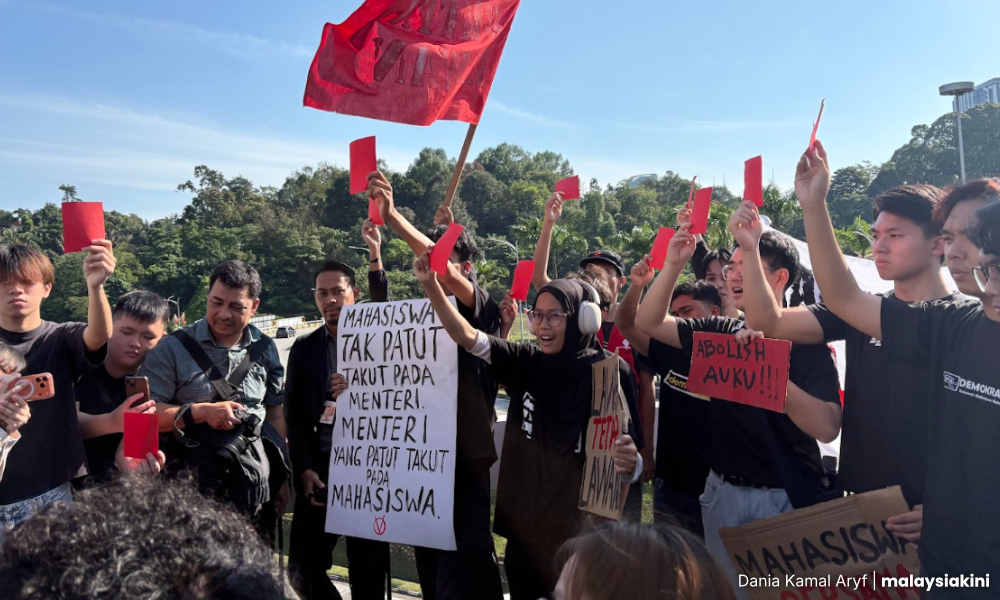
For years, the question surrounding the Universities and University Colleges Act 1971, better known as AUKU, was whether Malaysia was finally ready to abolish it.
That question has now been answered in principle.
Prime Minister Datuk Seri Anwar Ibrahim has announced that the government intends to abolish AUKU, beginning a process that will still need to go through Parliament and the necessary legislative steps.
It is a significant moment. AUKU has governed Malaysia's public universities since 1971 and, particularly after amendments in the 1970s, became closely associated with restrictions on student political activity and activism.
But the announcement of abolition is not the end of the argument.
In fact, it creates a more difficult one.
If AUKU is abolished, what governs our universities? And once students are given greater freedom, are we prepared to trust them to use it responsibly?
These are not arguments for keeping AUKU. They are the questions that have to be answered if its eventual abolition is going to mean something.
AUKU is set to go but universities still need rules
There is an important distinction that risks getting lost in the excitement over the government's announcement.
AUKU was not only a law about students.
It also provides the legal framework for the establishment, administration and governance of public universities. That means its eventual repeal cannot simply mean that universities suddenly operate without a legal structure.
Universities still need rules governing their finances, administration, governing bodies, disciplinary processes, student organisations and institutional responsibilities.
Higher Education Minister Datuk Seri Dr Zambry Abd Kadir has already acknowledged this, saying that abolishing AUKU cannot simply mean removing the Act without considering the wider legislative framework.
That is a reasonable concern.
But it does not follow that Malaysia needs another AUKU under a different name.
The real question is what a new framework is supposed to govern.
There is a difference between having rules that ensure a university manages its finances properly, conducts fair elections and provides due process, and having rules that determine how much political expression students should be allowed.
The first is governance. The second is control.
For decades, those two ideas have often been bundled together. The opportunity now is to separate them.
Malaysia can have properly governed public universities without having a special legal regime that treats students' political participation as something inherently requiring state supervision.
Trusting students does not mean abandoning accountability
There is also a more uncomfortable question for students and student activists. They have spent years asking to be trusted. Now they have to show what that trust looks like.
The case for greater student autonomy is stronger than it was when AUKU was introduced.
Malaysia has changed considerably since 1971. One of the clearest examples is Undi18.
An 18-year-old Malaysian can now vote in a general election. Young Malaysians can participate in political parties and subject to the law, seek elected office.
We have therefore already decided that young adults can participate in deciding who governs the country.
It is increasingly difficult to justify treating the same citizens as incapable of handling political discussion simply because they happen to be studying at a university.
But recognising students as adults does not mean assuming they are automatically responsible.
Students can make poor decisions. Student organisations can misuse funds. Elections can become unfair. Political parties can try to capture campus organisations. Political events can become disruptive. Freedom of expression can be exercised irresponsibly.
None of this is an argument against freedom. It is an argument for accountability.
If students want meaningful autonomy over their organisations, they should also accept transparent financial management.
If they want independent student elections, they should accept rules that protect those elections from manipulation.
If they want freedom to organise political forums, they should accept that the same freedom belongs to people whose views they strongly disagree with.
If they want university administrators to respect their right to criticise, they should also understand that criticism does not place them above ordinary laws governing violence, harassment, intimidation or other unlawful conduct.
Freedom and responsibility are not opposing principles. They are supposed to develop together.
Universities should be places where democracy is practised
This is perhaps the biggest opportunity created by the proposed abolition of AUKU.
Universities should not merely prepare young Malaysians for employment. They should prepare them for citizenship.
A student should be able to attend a debate about government policy, listen to a politician, challenge that politician, invite someone from the opposing side and decide for themselves what they believe.
That does not mean universities should become recruitment centres for political parties.
In fact, the opposite should be true.
A politically healthy university should expose students to competing ideas without telling them which ideas they should adopt.
Government politicians should be able to speak. Opposition politicians should be able to speak. Students should be able to challenge both.
A student who supports the government and one who opposes it should be able to sit in the same room, argue over policy and leave without treating each other as enemies.
That is not political indoctrination. It is democratic education.
And democracy is something that has to be practised.
Running a student election teaches students about campaigning and accepting defeat. Managing an organisation teaches them about accountability. Debating an opponent teaches them how to persuade. Managing money teaches them responsibility. Losing an argument teaches them that disagreement is not a personal attack.
These lessons cannot be fully reproduced in a classroom.
If Malaysia wants citizens who can participate intelligently in public life, there is little reason to keep politics entirely outside the university gates.
But the university must not become the new gatekeeper
There is another danger in the transition away from AUKU.
Abolishing a centralised law does not automatically make universities autonomous. Power can simply move somewhere else.
If the government no longer directly regulates certain aspects of student political activity but university administrators are given broad and unclear powers to decide what is acceptable, students could still face restrictions. The difference would be that the decision is being made at university level rather than through a national law.
That would not be much of a democratic transformation.
It is therefore important that the new framework establishes clear limits on institutional discretion.
Students need to know what their rights are, what universities can regulate, what disciplinary processes look like and how decisions can be challenged.
The same principle applies to academics.
Academic freedom cannot be reduced to whether AUKU remains on the statute book. Other laws, institutional policies and administrative practices can affect whether academics feel able to criticise government policy, discuss controversial subjects or challenge university decisions.
A university can be formally autonomous and still have a culture in which people learn to stay quiet.
That is why the reform cannot stop at repealing AUKU.
Autonomy must also be protected from political capture
There is one more balance that Malaysia needs to get right.
Greater campus freedom must not mean allowing political parties to capture universities.
There is a difference between political participation and political control.
Students should be free to join political parties, debate policies and invite politicians to campus.
But no party should assume that a more open university gives it the right to turn student organisations into political machinery.
The safeguard is not to restrict politics. It is to allow more politics.
If students can hear competing parties, question competing politicians and organise independently of them, outside political influence becomes easier to challenge.
The best protection against political capture is not political silence. It is political pluralism.
The real test begins now
For years, governments argued that AUKU could be amended rather than abolished. That argument produced incremental reforms, including greater financial autonomy for student organisations and changes to student disciplinary arrangements.
But student activists kept asking a more fundamental question. Why should a special law continue to define the boundaries of student political life at all?
The government has now answered them in principle.
AUKU is set to go.
That is a historic achievement for those who campaigned for its abolition. But the harder work begins with the announcement and the legislative process that follows.
The government has to build a legal and institutional framework that governs universities without quietly recreating the restrictions that made AUKU controversial in the first place.
Universities have to learn to exercise autonomy without turning themselves into new centres of arbitrary control.
And students have to learn what it means to be trusted.
Trust does not mean students will always make the right decision. It means they should be allowed to make decisions, make mistakes and face proportionate consequences without having their freedom treated as a problem in itself.
The government cannot demand responsibility from students as a reason to restrict their freedom. Students, in turn, cannot demand freedom as a reason to escape responsibility.
For 55 years, Malaysia debated how much freedom university students should be allowed.
Now that the government has chosen to pursue abolition, the question has changed.
The challenge is no longer simply whether students can be trusted with freedom.
It is whether Malaysia is prepared to build universities mature enough to give them that freedom and students mature enough to use it well.