
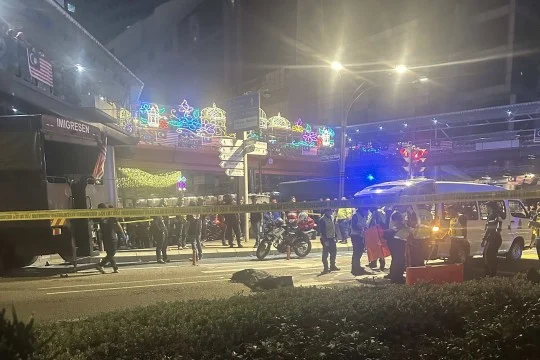
At 1am on August 19, 2026, a 53-year-old man and his two daughters — aged 25 and 12 — were walking across the Maju Junction intersection on Jalan Sultan Ismail in Kuala Lumpur.
A Malaysian Immigration Department truck, travelling without detainees from the Kuala Lumpur Immigration Office towards Chow Kit to pick up undocumented immigrants, entered the intersection against a red light. Its beacon lights and siren were activated. A Proton Saga travelling through a green light collided with the truck. The truck lost control, skidded, and hit the family of four.
The father and his two daughters died at the scene. The mother survived with injuries to her head, arms, and both legs. The drivers of all three vehicles including the Immigration truck were uninjured.
The truck driver and the Proton Saga driver have been detained. Both tested negative for alcohol and drugs. The case is being investigated under Section 41(1) of the Road Transport Act 1987.
Prime Minister Anwar Ibrahim has ordered an immediate and thorough investigation, vowing that "if there was negligence or a breach of the law, appropriate action must be taken without compromise".
But here is the uncomfortable question that no one wants to ask: why does this keep happening?
A Recurring Pattern of Recklessness
This is not the first time an Immigration Department vehicle has been involved in a fatal or serious accident while on official duty.
In 2014, an Immigration Department "Black Maria" transport truck overturned at North-South (PLUS) Highway near the Pedas-Linggi exit. The heavy enforcement vehicle was transporting 35 undocumented migrants at the time of the crash. It lost control and flipped onto its side, injuring five detainees.
In December 2024, an Immigration Department MPV was involved in a five-vehicle pile-up in Permas Jaya, Johor Bahru. Five Immigration officers were among the 10 injured.
And now, this. Three lives ended because someone decided that the urgency of an immigration operation outweighed the basic rules of the road.
The Siren Culture: Privilege or Entitlement?
Immigration vehicles routinely stop traffic, activate sirens, and push through intersections often for routine operations. One could argue that immigration operations require speed catching undocumented migrants red-handed requires surprise and rapid movement. There is a legitimate operational need for enforcement vehicles to move through traffic quickly.
But there is a difference between operational necessity and convenience. We have all seen it: VIP vehicles lighting up sirens to beat traffic. Convoy after convoy stopping entire junctions for no apparent reason. Enforcement vehicles treating the road as their personal right-of-way rather than a shared public space.
The Immigration Department is authorised to use red and blue lights — the same as fire trucks, civil defence vehicles, and SMART teams.
But authorisation is not a blank cheque. With the privilege of emergency lights comes the responsibility to use them only when absolutely necessary, and to exercise extreme caution even then.
Are Immigration Officers Above the Law?
The preliminary police investigation has already established that the truck entered the intersection against a red light. The driver has been detained under Section 41(1) of the Road Transport Act 1987.
But here is the deeper legal question: does official duty exempt enforcement personnel from traffic laws?
No law in Malaysia grants Immigration Department personnel blanket immunity from traffic regulations. Emergency vehicles are permitted to exceed speed limits and pass through red lights only when responding to genuine emergencies and even then, they are required to exercise due care.
Running a red light with sirens activated does not automatically make it legal. It is the circumstances that matter. Was there a genuine emergency? Was there an immediate threat to life or a critical operation underway? Or was it simply a matter of convenience getting to Chow Kit a few minutes faster?
The truck was travelling from the Kuala Lumpur Immigration Office to Chow Kit to pick up detainees. It was not carrying any detainees at the time. The operation was already over. The urgency if there ever was any had passed.
The Human Cost of Complacency
We have become desensitised to enforcement vehicles stopping traffic. It happens so often that we barely notice anymore. A convoy passes. We wait. Life goes on.
But this complacency has a cost.
When enforcement personnel treat traffic rules as optional, they create a culture of impunity. When they routinely stop entire junctions for routine operations, they train themselves — and the public — to accept that the rules do not apply to them.
And then an accident happens. A red light is run. A family is destroyed. And everyone asks: how did this happen?
It happened because we allowed it to become normal. We allowed sirens to become a convenience rather than a necessity. We allowed enforcement vehicles to treat the road as their own. And we failed to hold them accountable until three people were dead.
The Path Forward: Accountability and Reform
Prime Minister Anwar has ordered a thorough investigation. That is a necessary first step. But it cannot be the only step.
The Immigration Department must conduct a full review of its vehicle usage policies. When are sirens and lights permitted? What constitutes a genuine emergency? What safeguards are in place to prevent reckless driving?
Enforcement personnel must be trained to understand that emergency lights are a privilege, not a right. They must be held to the same standard as any other road user — and if they violate traffic laws, they must face the same consequences.
Because the next time a truck runs a red light, it might not be a stranger. It might be someone you love.
The Bottom Line
Three people are dead. A father and his two daughters. A family destroyed in an instant. And the driver of the truck that killed them walked away without a scratch.
This is not about blaming the Immigration Department. It is about recognising a systemic problem. Enforcement vehicles have become accustomed to treating the road as their own. Sirens have become a tool of convenience rather than necessity. And the public has become desensitised to the risk.
The investigation must be thorough. The findings must be public. And the consequences must be clear: no one is above the law — not even those entrusted with enforcing it.
Because the next time an Immigration truck runs a red light, it might not be a family of four crossing the street. But it will be someone's family. And that is one tragedy too many.