
Penang faces a challenge common to successful cities.
Its economy, population and urban development are advancing faster than transport infrastructure can be delivered.
Its population reached 1.81 million in 2026, while the economy grew 7.3% in 2025. By October 2024, the state had recorded 2.67 million registered vehicles, including inactive and out-of-state vehicles.
More factories, homes and businesses mean more journeys, yet major infrastructure takes years to deliver. Penang must close this gap while sustaining its growth.
Building a balanced transport system
State Infrastructure, Transport and Digital Committee chairman Zairil Khir Johari envisions a progressive shift from car dependency towards a more balanced transport structure, combining rail, buses, roads and other mobility services.
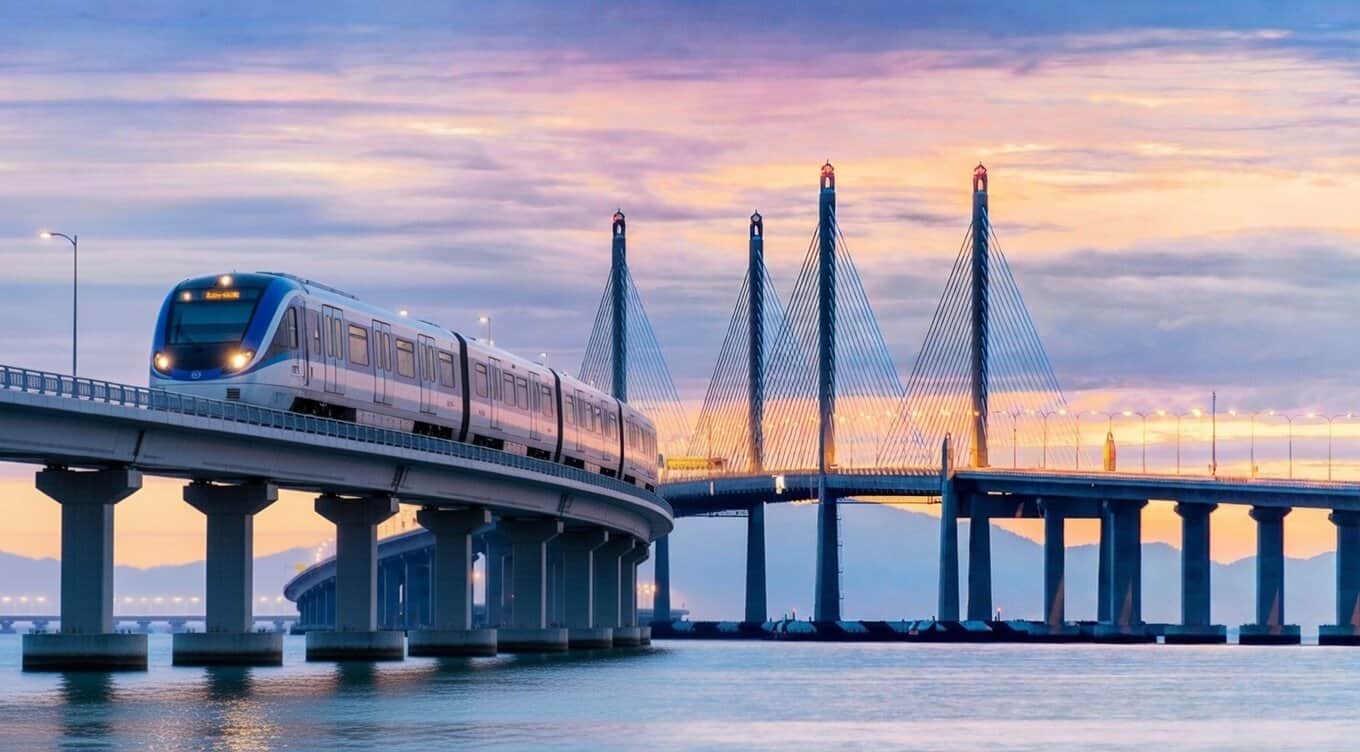
The centrepiece is the 29.67km Mutiara LRT Line, connecting Silicon Island, Bayan Lepas, the airport, George Town and Penang Sentral through 22 stations. It is designed to carry up to 10,910 passengers per hour per direction.
The project reached 8.99% completion in June 2026 and is scheduled to begin operations in December 2031.
Zairil has emphasised the importance of extending the line to Penang Sentral. The mainland contributes substantially to the island’s daytime population. Connecting the LRT to KTM and the national railway will allow travellers to reach George Town, Bayan Lepas and the airport without completing their journeys by car.
Road projects have a complementary role. The approximately RM852 million Air Itam–Tun Dr Lim Chong Eu Expressway bypass was 91.8% complete in June 2026. It is intended to divert through-traffic from congested local roads.
A warning from a transport expert
Transport expert Professor Datuk Dr Ahmad Farhan Mohd Sadullah observes that congestion is becoming increasingly evident on both Penang Island and the mainland, particularly along major corridors.
He also highlights Penang’s lack of sufficiently detailed traffic data for diagnosing congestion and planning targeted interventions.
His warning matters. Authorities need to know where journeys begin, where they end, why people travel and how congestion changes by hour. Without this information, projects may treat visible bottlenecks while overlooking the forces creating them.
Penang also lacks an authoritative estimate of congestion’s economic cost.
Seven-factor test
Pulau Tikus assemblyman Joshua Woo offers a practical framework for deciding what infrastructure a city needs.
His seven factors are population density, ridership, population growth, population policy, development cost, time efficiency and private vehicle affordability.
Together, they explain Penang’s predicament.
Dense, growing corridors can justify an LRT because thousands of passengers can be collected within a limited area. Lower-density communities may be served more efficiently by buses or demand-responsive vans.
Ridership also depends on land-use policy. Housing, offices, schools and shops built around stations can generate passengers through transit-oriented development. Dispersed development produces more car journeys.
Cost must correspond with demand. Rail requires billions of ringgit but offers high capacity. Buses and vans cost less and provide wider flexibility.
Time efficiency is equally decisive. Commuters assess their complete journey, including walking, waiting and transfers. Public transport must be connected, frequent and predictable to compete with driving.
Finally, affordable cars, fuel and parking make changing behaviour difficult. Woo captures the choice sharply: would people rather be stuck in traffic or travel in a crowded train? A crowded train is still moving thousands of people efficiently.
Development and liveability can coexist
MY Mobility Vision founder Wan Agyl Wan Hassan argues that Penang does not need to choose between development and liveability.
He recommends continuous pavements, shaded walkways, safe crossings, faster feeder buses and parking reform near stations. Public transport, he argues, must become faster and more predictable than driving before motorists will switch.
This supports Woo’s framework and Zairil’s vision. Rail supplies capacity. Roads provide strategic connections. Buses extend coverage. Urban planning creates ridership.
Penang is investing in the right foundations. Its next task is to integrate these projects, measure their results and keep infrastructure aligned with development.
A successful city cannot stop growing while waiting for transport. It must build a mobility system that allows growth to continue without sacrificing liveability.