
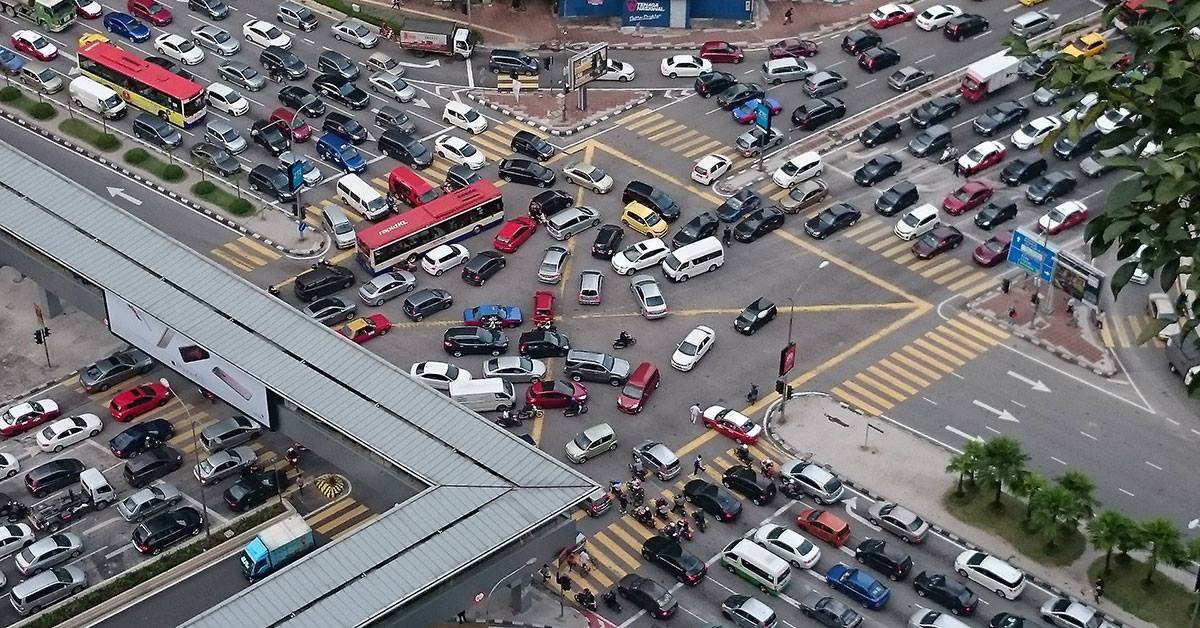
The new Ombak KLCC mall opened recently, and as expected, Malaysians flocked to it in droves. The mall's unique design has drawn praise, but social media has been flooded with videos of a different kind: overcrowded parking lots, frustrated drivers circling for spaces, and traffic snarls stretching for blocks.
There are obvious reasons for the chaos. The mall is new. People are curious. And it sits right next to KLCC, already one of the busiest commercial hubs in the country. But there is another factor that deserves closer scrutiny: despite an MRT2 line that connects directly to the mall — a train that takes you there with zero traffic — most visitors still chose to drive.
Price Isn't the Problem
Here is the irony: Malaysians actually find public transport affordable. The Ipsos survey found that 62 percent of Malaysians agree that public transport in their area is reasonably priced, significantly higher than the global average of 53 percent.
Government initiatives like the My50 unlimited travel pass have made significant headway in reducing the financial burden on commuters. Yet affordability is not translating into usage.
More than half of Malaysians reported that limited transport options make it difficult to reach their destinations. Ipsos Malaysia research director identified the "last-mile connectivity" as the primary obstacle. Trains may be cheap and fast, but if you cannot get from the station to your front door without a car, the system remains broken.
A Car-Centric Nation
Malaysia has become a country defined by the car. There are now more vehicles than people. Many job listings explicitly require applicants to have their own vehicle. Those without one are often eliminated from consideration before they even get a chance.
This is not just a cultural preference. It is a structural problem. The country has been built around the car, with sprawling urban development, insufficient pedestrian infrastructure, and a public transport system that, while improving, remains underutilised.
The government has been trying to address this. New LRT lines connect Shah Alam to the city centre, giving rural and suburban residents better access. For National Day, public transport services were extended to 24 hours — a gesture meant to encourage more people to leave their cars at home.
Park-and-ride facilities have been built next to MRT and LRT stations to make the transition from car to train seamless. Yet the behaviour persists.
What Other Countries Do Better
The problem is not unique to Malaysia. But other countries have found ways to strike a better balance.
Japan is the gold standard. In Tokyo, the train system is so efficient, reliable and extensive that owning a car is almost unnecessary in the city centre. Congestion pricing makes driving expensive. Parking is scarce and costly. And the government has invested decades in building a public transport culture that starts from childhood.
The Netherlands offers a different model. Cycling infrastructure is world-class, with dedicated lanes, traffic lights and parking facilities that make biking safer and more convenient than driving for short trips.
Singapore has taken a regulatory approach. Certificate of Entitlement (COE) systems keep car ownership expensive and controlled. Electronic road pricing charges drivers for using congested routes during peak hours. The result is a city where public transport carries the majority of commuters, and traffic flows relatively smoothly.
Malaysia has tried none of these with real conviction. The LRT and MRT are improving, but they are still seen as second-class options, a choice for those who cannot afford a car, not a preferred choice for those who can.
The Convenience Trap
Of course, there is convenience in owning a car. You leave when you want. You carry what you need. You are not subject to train schedules or bus routes. But that convenience comes at a cost, not just financially, but socially and environmentally.
The average Malaysian spends hours in traffic each week. The average commute is getting longer. And the more cars there are on the road, the worse it gets for everyone, including those who do not have a choice and are forced to drive because public transport does not reach them.
Ironically, the solution to traffic jams is not more lanes. It is fewer cars. And the only way to achieve that is to make public transport more attractive and to make driving less attractive.
The Endless Loop
The Ombak KLCC traffic jam is not an isolated incident. Malaysia has built a society around the car, and it is paying the price in lost time, higher costs, worsening pollution and declining quality of life.
The government has built the infrastructure. The MRT lines are there. The LRT is expanding. Park-and-ride facilities exist. But infrastructure alone is not enough. People need to use it.
And they will only use it when it becomes the more attractive option when trains run frequently, when last-mile connectivity improves, when driving is less convenient and more expensive.
Until then, every new mall, every new attraction, will bring the same familiar scene: cars circling, horns blaring, and drivers wondering why they did not take the train.
The question is not whether Malaysia can build better public transport. The question is whether Malaysians are willing to use it. And the answer, so far, is no.