
Some 5.3 million Malaysians have begun receiving the third phase of the Sumbangan Tunai Rahmah (STR), with the latest RM1.2 billion payout forming part of a broader shift in how federal assistance is being delivered to households facing persistent cost-of-living pressures.
The Phase 3 payments, which began on Aug 15, involve 3.9 million low and lower-middle-income households and 1.4 million senior citizens without spouses.
Recipients will receive between RM150 and RM600 in this phase, depending on household income and the number of children, while eligible senior citizens without spouses receive RM150.
The latest disbursement brings total STR payments for the first three phases of 2026 to RM3.6 billion.
But the significance of this year's programme lies beyond the Phase 3 payment alone.
Under a restructuring introduced this year, the government has increasingly divided direct assistance between two programmes with different functions: STR provides periodic cash assistance, while Sumbangan Asas Rahmah (SARA) provides more regular monthly support for essential spending.
This means looking only at the STR payment can understate the amount of assistance received by some households.
According to the Finance Ministry, depending on their eligibility category, recipients may have received as much as RM3,300 cumulatively by August through the first three phases of STR and monthly SARA assistance.
That figure does not include the separate RM100 SARA Untuk Semua allocation provided earlier this year to Malaysian citizens aged 18 and above.
More households added during the year
The number of STR Phase 3 recipients has also expanded since January.
At the beginning of 2026, five million households and eligible senior citizens were approved for STR. By Phase 3, that figure had increased by 300,000 to 5.3 million.
Among households specifically, the number rose from 3.7 million at the start of the year to 3.9 million.
Prime Minister Datuk Seri Anwar Ibrahim said the increase reflected the government's intention to ensure assistance continued reaching households as living costs remained a concern.
Unlike assistance schemes with a single annual application window, new STR applications and appeals remain open throughout the year.
The mechanism allows households whose circumstances change — or applicants who were previously unsuccessful but subsequently meet the criteria — to seek reconsideration without waiting until the following year.
For recipients with registered bank accounts, the Phase 3 payment is credited directly into their accounts.
Those without bank accounts can collect the assistance in cash at Bank Simpanan Nasional branches nationwide.
Why are there fewer STR recipients than last year?
The headline figure of 5.3 million may appear lower than STR recipient numbers recorded in previous years.
In August 2025, for example, STR Phase 3 covered 8.6 million recipients.
That comparison, however, does not reflect a simple reduction in assistance.
A major change in 2026 is the treatment of the single-recipient category.
Eligible single Malaysians aged 21 to 59 earning RM2,500 or less no longer receive their RM600 annual assistance through conventional quarterly STR payments. Instead, the assistance is delivered through SARA at RM50 a month.
Official 2026 payment guidelines state that assistance for the single category is paid through SARA.
Monthly SARA payments began in January for 8.1 million recipients, including households, senior citizens and 3.1 million single recipients.
This makes the distinction important when comparing year-on-year headline figures: fewer people appearing under the STR payment count does not necessarily mean fewer Malaysians are receiving federal assistance.
Instead, part of the recipient base has shifted to a different payment channel.
From occasional cash payouts to monthly support
The restructuring also represents a policy shift in the timing of government assistance.
Cash transfers such as BR1M and earlier iterations of STR were largely associated with payments made at specific points during the year.
Under the current arrangement, eligible Malaysians may receive support through a combination of quarterly STR payments and monthly SARA credits.
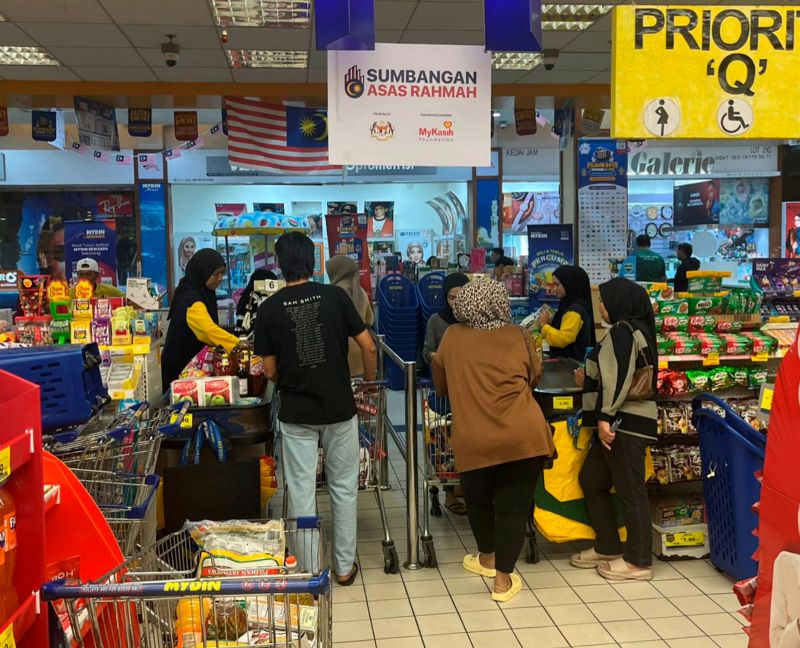
SARA is credited through recipients' MyKad and can be used to purchase more than 140,000 approved basic items across 15 categories, including food, personal care products, household necessities and selected medicines.
More than 13,000 participating outlets were listed under the scheme earlier this year, with the network continuing to expand.
For a low-income family, this creates a different form of support from a single cash payout.
Instead of relying exclusively on larger transfers several times a year, part of the assistance is available every month for essential expenditure.
The government has allocated RM15 billion to STR and SARA for 2026, the largest combined allocation for the two programmes to date.
The Finance Ministry says eligible households can receive as much as RM4,600 over the full year when STR and SARA are combined.
For example, under the 2026 structure, a household earning RM2,500 or less with five or more children is eligible for up to RM2,200 in STR and RM1,200 in regular SARA assistance.
Households that are also classified as poor or hardcore poor under eKasih may receive additional SARA support, bringing the maximum combined assistance to RM4,600.
Bigger assistance does not remove the cost-of-living challenge
The expansion of cash assistance comes at a time when household expenses remain a politically sensitive issue.
Food prices, housing costs and other everyday expenses continue to place pressure on lower- and middle-income households, even as headline economic indicators have improved.
Anwar has acknowledged that direct assistance alone cannot resolve the cost-of-living problem.
In announcing the latest STR payment, he said STR and SARA were intended to meet immediate needs while the government pursued economic reforms aimed at raising incomes and living standards.
That distinction matters.
Cash assistance can cushion households against immediate pressure, but its longer-term effectiveness depends on whether wages, productivity and household purchasing power improve at the same time.
The government has therefore increasingly framed STR and SARA not as substitutes for income growth, but as a social safety net operating alongside wider economic and subsidy reforms.
There are signs that the model could be expanded further.
Anwar said in July that the government was considering increasing SARA allocations under Budget 2027 if fiscal and economic conditions permit, acknowledging that many Malaysians continued to face pressure from rising prices.
The Finance Ministry's Pre-Budget Statement for 2027 has also identified household living costs and targeted assistance as continuing priorities.
A wider change in Malaysia's welfare model
The evolution of STR and SARA also reflects a larger change in Malaysia's approach to subsidies and welfare.
Rather than using broad subsidies alone to keep prices artificially low for everyone, including higher-income consumers and non-citizens, the government's stated strategy is to gradually redirect part of the fiscal savings from targeted subsidy reforms towards assistance for eligible Malaysians.
Budget 2026 specifically linked the increase in STR and SARA allocations to savings generated from the targeting of subsidies such as diesel and RON95 petrol.
That makes STR Phase 3 more than another round of cash payments.
The more significant policy question is whether Malaysia is moving towards a social assistance system that is both more targeted and more predictable — one in which lower-income households receive support throughout the year rather than only when a major payout is announced.
For the 5.3 million recipients receiving the latest STR payment, however, the immediate impact is simpler.
Between RM150 and RM600 is now being deposited into household accounts at a time when groceries, school expenses and other daily costs remain an ongoing concern.
And for those who may have been left out, the window has not closed: STR applications and appeals remain open throughout the year through the official STR portal.
The Finance Ministry has also warned recipients to avoid unofficial links and scams, and to verify their status only through government channels.