
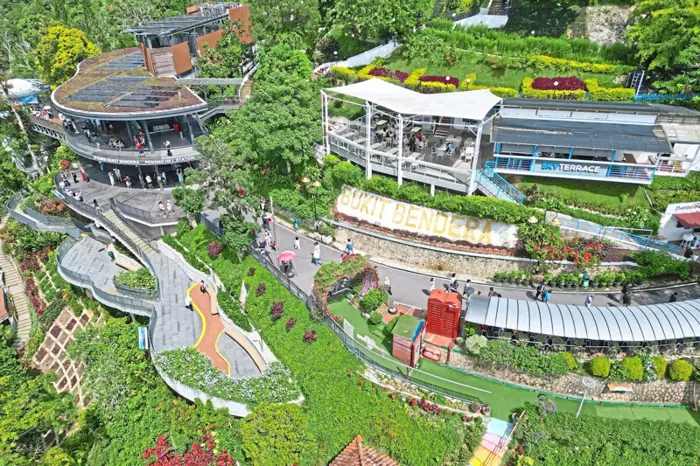
Penang Hill sits at just 833 metres above sea level. By global standards, it is not a tall mountain. But what it lacks in height, it makes up for in biological richness.
The hill is the heart of the 12,481-hectare Penang Hill Biosphere Reserve, recognised by UNESCO in 2021. The reserve covers 7,285 hectares of land and 5,196 hectares of marine areas, encompassing everything from coastal lowland and hill dipterocarp forest to mangroves, wetlands, sandy beaches and coral reefs.
It is home to more than 2,000 plant species and 500 animal species, including threatened fauna like the Irrawaddy dolphin and the Sunda pangolin.
The hill already attracts between 1.6 and 1.8 million visitors annually, and in 2025, Penang recorded 8.76 million hotel guests, including 3.47 million international visitors. The demand is there.
Now, a RM367.2 million cable car project is under development, scheduled for completion by early 2027. The cable car will span 2.73 kilometers from the Penang Botanical Gardens to the top of the hill, carrying up to 1,400 passengers per hour.
The Luxury Ecotourism Opportunity
Nepal's Chandragiri Hills offers a useful comparison. At around 2,500 metres above sea level, it combines forested hills, panoramic mountain views and a cable car journey with a high-end hilltop resort. The result is a destination where nature itself becomes the luxury experience.
Penang Hill has similar ingredients, with far stronger biodiversity credentials. The question is whether Penang can do what Chandragiri did — but better, and more sustainably.
Singapore's Mandai Rainforest Resort by Banyan Tree offers another model. Built on just 4.6 hectares, it has 338 rooms and suites, including 24 elevated treehouses designed to resemble seed pods.
The resort's design follows the natural terrain, with elevated structures that allow wildlife to pass freely beneath. It has achieved Green Mark Platinum Super Low Energy certification.
The Fine Line Between Progress and Destruction
This is where the caution must come in. The cable car is infrastructure. It will improve access, reduce congestion, and support the state's long-term tourism growth. But infrastructure without a clear conservation framework is just another invitation for overdevelopment.
The challenge is not whether to build. The challenge is what to build, and where.
The Habitat Penang Hill already sits on the fringes of a forest reserve protected since 1911. The Penang Hill Gallery@Edgecliff, a restored heritage building, has been granted Green Index certification. Four hotels already operate on the hill. The footprint is already there.
The opportunity lies in carefully selected, environmentally suitable sites for premium experiences: boutique forest retreats, rainforest spas, treehouse accommodations, fine dining and guided biodiversity experiences. The model should be low density, low ecological impact and high tourism value.
The alternative — simply bringing more visitors uphill without a clear plan for what they do when they arrive — is not development. It is degradation.
The Uncomfortable Balance
There will be voices that oppose any development on Penang Hill. They will point to the fragility of the ecosystem, the threat to endangered species, the risk of deforestation. These concerns are valid. They must be taken seriously.
But there is also a case for careful, conservation-led development. The biosphere reserve's own UNESCO designation recognises the need to balance conservation with sustainable development.
The communities around the hill have already diversified into tourism, some fishers now use their boats as ferries, others run homestays and work as guides. Sustainable tourism can support conservation. It can also support livelihoods.
The key is not to stop development. The key is to ensure that development serves conservation, not the other way around.
That means clear rules. Strict environmental impact assessments. Limits on visitor numbers. Investment in waste management and water conservation. A commitment to keeping the rainforest intact, not just as a backdrop for luxury experiences, but as the reason those experiences exist at all.
Penang’s Yearn for Tourism
Penang Hill has the ingredients to become a world-class luxury ecotourism destination. The cable car is coming. The visitors are coming. The question is whether Penang will manage that growth with the care and foresight that a UNESCO biosphere reserve demands.
The goal should be higher tourism value, not simply higher visitor volume. Carefully planned forest retreats, premium wellness experiences, and exclusive guided nature experiences — concentrated on suitable existing or previously developed sites — could generate more revenue with less environmental impact than mass tourism ever could.
Penang already has heritage, food and beaches. Luxury ecotourism could become the next major attraction. But only if conservation remains at the centre of every decision.
Because the hill is not just a destination. It is a living ecosystem. And if we lose that, no amount of luxury will bring it back.