
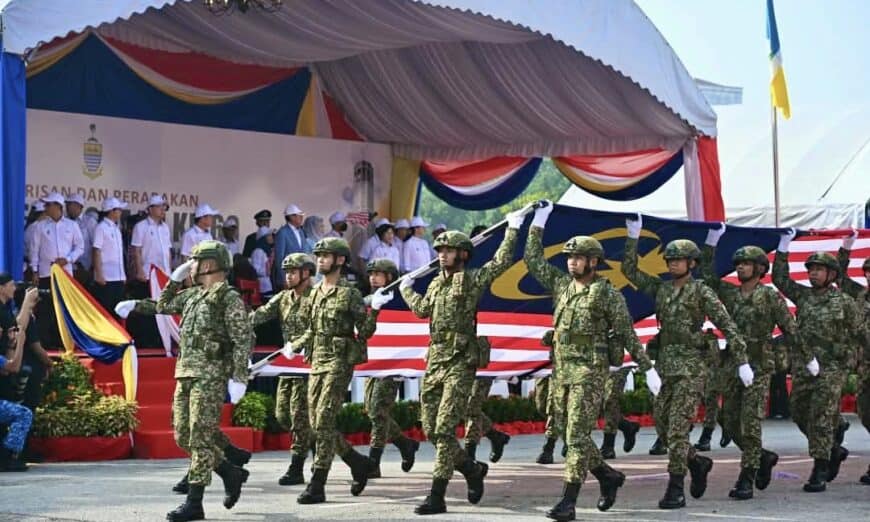
Around 25,000 people gathered at Padang Kota Lama on Aug 31 for the 69th National Day celebration, braving hazy conditions to watch the state’s Merdeka parade.
The crowd began arriving early, filling the historic field as 125 walking contingents and 29 vehicle contingents prepared to take part in the morning’s celebrations.
But beyond the size of the turnout and the spectacle of the parade, what stood out was how Penang brought its different cultural traditions together.
A Parade of More Than 9,000 Participants
The celebration, themed “Malaysia MADANI: Kesejahteraan Dinikmati”, opened with a Guard of Honour by the 2nd Battalion Royal Malay Regiment.
The Jalur Gemilang was then raised by Royal Malaysian Navy personnel, accompanied by around 80 students from SMJK Jit Sin Bukit Mertajam singing Jalur Gemilang and Tanggal 31.
After the Rukun Negara pledge, taekwondo athlete Ikhwan Irfan Rus Hisham led the crowd in seven shouts of “Merdeka!”, followed by cultural performances and choirs.
The parade featured 125 walking contingents and 29 vehicle contingents, involving around 9,152 participants from government agencies, schools, uniformed organisations, statutory bodies and NGOs. The vehicle contingents alone comprised 731 vehicles and 1,120 personnel.
One of the more dramatic displays came from the 2nd Royal Military Police Regiment, which staged an unarmed combat demonstration featuring simulated combat techniques, defensive moves and physical displays of discipline and courage.
For families and other visitors, the celebration also included buskers, traditional performances, clown and balloon shows, Merdeka crafts, colouring activities, face painting, Malaysian ice cream, games and e-sports.
Penang’s Heritage Takes Centre Stage
Penang’s heritage also took centre stage, with the Penang Tourism and Creative Economy Office bringing together eight forms of intangible cultural heritage in a single contingent. These included Kebaya, Chingay, lion dance, Silat Siku 12, Silambam, Boria, Batik and Nyonya beaded shoes.
Six Penang trishaws were also part of the contingent.
Rather than presenting each tradition separately, the contingent combined them in creative ways.
A pair of lion dance figures made from batik cloth brought Malay batik craftsmanship into a traditional Chinese performance. A Penang trishaw was paired with women dressed in Kebaya, while one of the Chingay flags also featured a Kebaya theme.
The 81-member contingent brought together Malay, Chinese and Indian participants from different generations, showing how Penang’s heritage continues to be shared across communities and age groups.
More Than Just Different Cultures Side by Side
Penang’s multicultural character is shaped not only by different communities living alongside one another, but also by the way their traditions have influenced each other over generations.
The heritage contingent reflected this, bringing different cultural practices together instead of presenting them separately.
This mix can be seen across Penang’s food, architecture, festivals, languages and communities, which have developed through generations of cultural interaction.
The same spirit was reflected at another Merdeka celebration in the state, where the North Malaysia Malayali Samajam combined Merdeka and Onam in one celebration.
Chief Minister Chow Kon Yeow described the gathering as different traditions and identities coming together at “one shared table”.
Penang’s Malayali community has a long history of doing this. Members gathered to celebrate Onam and Hari Raya Haji together as early as 1951, before the Samajam was formally established in 1952.
More than seven decades later, the community continues to preserve its Malayali traditions while being part of Penang’s wider cultural identity.
Keeping Penang’s Heritage Moving
Preserving Penang’s heritage also means allowing its traditions to evolve and remain relevant to younger generations.
The batik lion dance is one example of this. It brings together existing Malay and Chinese traditions in a new form while keeping both cultural elements recognisable.
This reflects Penang’s broader cultural identity, where different communities can maintain their own traditions while sharing the same spaces, celebrations and experiences.
Rather than making every community the same, Penang’s strength lies in allowing its different traditions to coexist, interact and evolve together.