
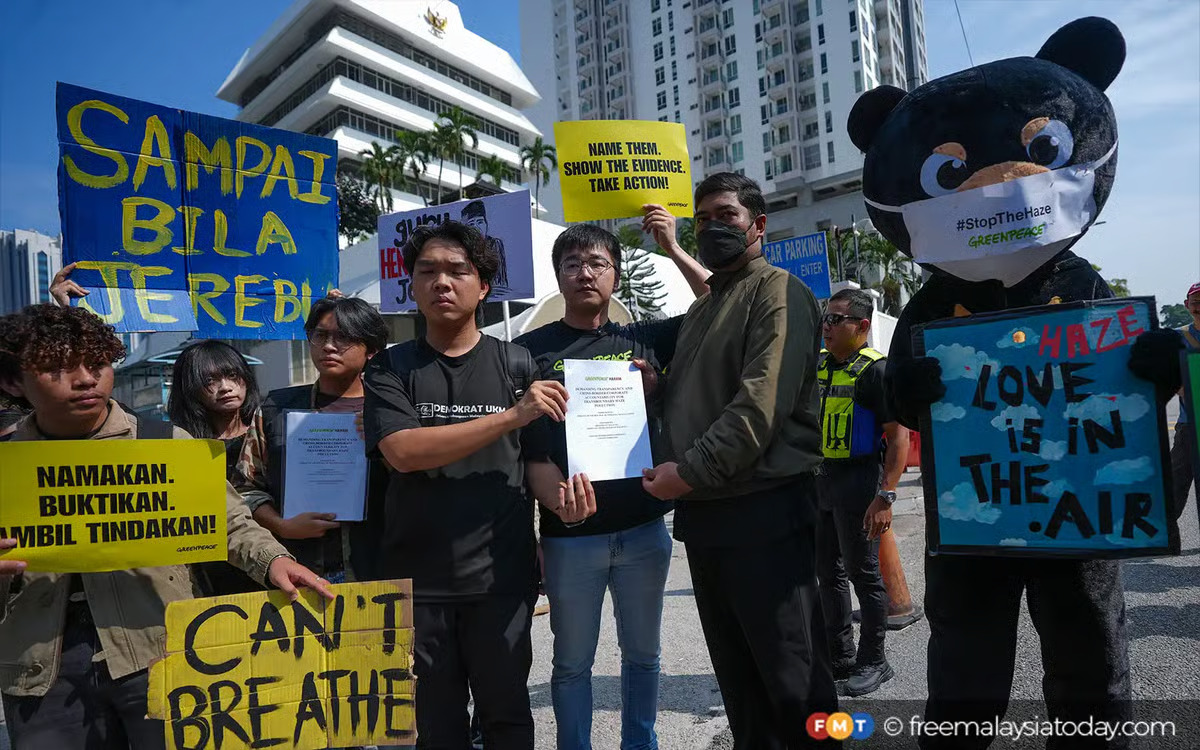
Greenpeace Malaysia and Himpunan Advocacy Rakyat Malaysia are asking Indonesia to publicly disclose the companies allegedly linked to forest fires and open burning, particularly Malaysian-owned firms.
It is a reasonable demand.
If companies are being blamed for fires that are sending haze across borders, the public deserves to know who they are, what evidence exists and whether authorities have taken action.
Indonesia should not expect neighbouring countries to accept accusations without evidence.
Indonesia already has the power to act
The fact that some companies operating in Indonesia may be Malaysian or Singaporean owned does not put them outside Indonesian law.
Companies operating plantations on Indonesian soil are subject to Indonesia's environmental, forestry and plantation regulations.
Indonesia's Plantation Law prohibits plantation businesses from opening or cultivating land by burning, with violations carrying serious criminal penalties.
Indonesia has also demonstrated that it can act against companies over forest and land fires.
In 2019, Indonesian authorities investigated three palm-oil companies suspected of involvement in fires in Borneo and another 24 companies whose concession areas had experienced fires.
However, enforcement has repeatedly faced criticism.
Greenpeace reported in 2019 that major palm-oil and pulp companies with extensive burned areas between 2015 and 2018 had escaped serious civil or administrative sanctions. At the time, the organisation said no palm-oil licences had been revoked because of forest fires.
There have also been cases where companies fined over fires failed to pay those penalties for years.
Indonesia therefore has the laws and authority to act, but its enforcement record shows why transparency and consistent action remain necessary.
This year's action still leaves questions over transparency
Indonesia has taken some action during the current fire crisis.
On Aug 25, authorities sanctioned six forestry concession holders after fires affected 1,511.55 hectares across their concession areas in Kalimantan.
On Aug 31, Indonesian authorities said they were inspecting 19 companies where fires had occurred within concession areas covering more than 11,000 hectares.
Satellite imagery had also identified 42 companies considered to have high wildfire risk.
Yet the names of the companies under investigation have not been publicly disclosed.
That is precisely why Greenpeace Malaysia's demand matters.
Authorities have identified companies and are investigating their possible links to fires, but the public still has limited information about who they are, what the investigations have found and what action will follow.
Transparency should not be treated as an unreasonable demand.
If a company is found responsible, it should face appropriate penalties. If it is cleared, that should also be made public.
Malaysian ownership is not proof of guilt
The Malaysian and Singaporean connection also needs to be established with evidence.
Indonesian lawmaker Marwan Dasopang has pointed to Malaysian and Singaporean companies operating plantations in Indonesia and called on both countries to help prevent forest and land fires.
But that does not establish that particular Malaysian or Singaporean companies caused the fires currently contributing to the haze.
A company's nationality should not be used as a substitute for proof.
If a Malaysian-owned company caused a fire, failed to prevent one or failed to fulfil its responsibilities within its concession, Indonesia should show the evidence and enforce its laws.
If it did not, the company should not be left to carry an unsubstantiated accusation simply because it is foreign-owned.
Accountability requires evidence, not implication.
Indonesia cannot shift the burden to Malaysia
Malaysia should take responsibility for Malaysian companies if they are found to have contributed to transboundary haze.
That is why calls for a Malaysian Transboundary Haze Act deserve serious consideration.
But the existence of foreign-owned companies does not remove Indonesia's responsibility to enforce its own laws.
The fires are occurring in Indonesia. The companies are operating under Indonesian jurisdiction. Indonesia has laws to regulate them.
Malaysia can strengthen its own laws to ensure Malaysian companies do not escape accountability for activities abroad, but that should complement Indonesian enforcement, not become a substitute for it.
Haze victims deserve accountability
For Malaysians living under unhealthy or hazardous air quality, the nationality of a company's shareholders is not the issue.
They need to know why the fires happened, who was responsible and whether anyone was held accountable.
That makes Greenpeace Malaysia's call for transparency more than a political demand. It is a basic demand for accountability.
If Indonesian authorities have evidence implicating Malaysian or Singaporean companies, name them and show the evidence.
If those companies have broken Indonesian law, enforce it. If they have not, clear their names.
And if previous companies have been sanctioned but penalties were never properly enforced, Indonesia should explain why.
The region does not need another cycle of accusations whenever haze returns. It needs governments to stop pointing fingers and start showing their work.
Name the companies, show the evidence and take action.