
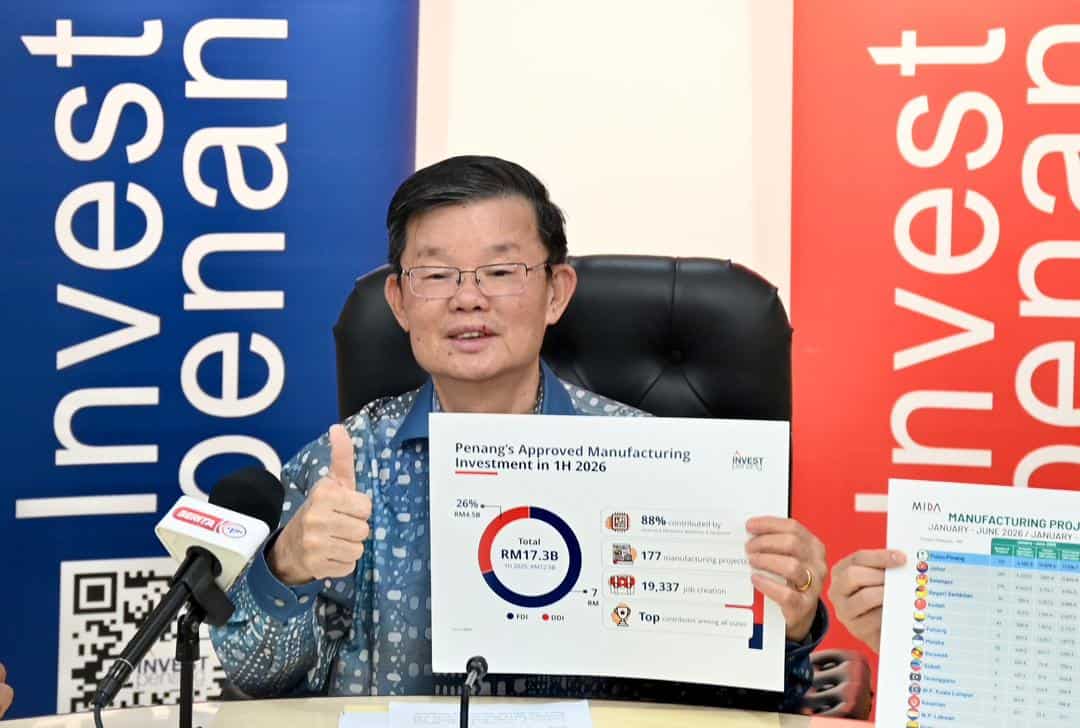
Penang recorded RM17.3 billion in approved manufacturing investments in the first half of 2026, making it Malaysia’s top contributor for the period.
The figure represents 34% of Malaysia’s total approved manufacturing investments and is a 38% increase from the same period last year.
The performance also puts Penang on track to surpass the RM22.4 billion in approved manufacturing investments recorded for the whole of 2025.
These figures reinforce Penang’s position as one of Malaysia’s strongest manufacturing and investment hubs.
Chief Minister Chow Kon Yeow said the performance reflects the strength and resilience of Penang’s established industrial ecosystem, which has continued to attract investment despite global economic and geopolitical uncertainty.
Existing companies are still expanding
A significant part of the RM17.3 billion comes from companies that are already operating in Penang.
Expansion projects accounted for RM11.9 billion, or 69% of the total, while new projects accounted for RM5.4 billion.
This shows that Penang’s appeal is not limited to attracting companies for the first time. Companies already operating in the state are continuing to invest in additional capacity and operations.
Chow said the state had received enquiries and requests for additional land from existing companies looking to expand. He also noted that the current investment figures reflect work and investment decisions made over the previous two to three years.
That gives Penang another reason to protect and strengthen the ecosystem that has already been built.
Foreign investors continue to back Penang
Foreign direct investment made up RM12.8 billion, or 74% of Penang’s approved manufacturing investments in the first half of the year.
That represented 39% of Malaysia’s total approved manufacturing FDI. Hong Kong, Singapore, China and the United States were the largest sources of Penang’s manufacturing FDI, collectively accounting for 77% of the state’s total.
The continued presence of international investors is significant for a state whose manufacturing economy has developed around multinational companies and global supply chains.
Penang's industrial ecosystem has been built over decades. The latest figures suggest that the ecosystem continues to provide an environment in which international companies see room to grow.
That is an advantage other states will have to work hard to replicate.
Local investment is growing too
Penang’s performance is not solely dependent on foreign companies.
The state recorded RM4.5 billion in approved domestic manufacturing investments in the first half of 2026, an increase of 125% from the same period last year.
The increase gives Penang an opportunity to strengthen the relationship between multinational companies and local businesses.
Chow has encouraged small and medium enterprises to take advantage of the opportunities created by the state’s large industrial ecosystem and supply chains.
This should remain an important part of Penang’s investment strategy.
The presence of major multinational companies creates demand for suppliers, engineering services, logistics, technology and other supporting industries. More local companies participating in these supply chains would allow investment entering Penang to generate wider economic benefits.
Manufacturing is moving towards higher-value industries
Electrical and electronics and machinery and equipment remain the main contributors to Penang’s manufacturing investment, accounting for 88% of the state’s total approved manufacturing investments in the first half of 2026.
The next challenge is to build on that foundation.
Penang is increasingly positioning itself around artificial intelligence and other advanced technologies. Chow has identified developing an AI-ready ecosystem and talent as one of the state’s priorities alongside attracting strategic investments and encouraging greater participation by local companies in global value chains.
This direction is consistent with Malaysia’s wider push towards higher-value manufacturing.
MIDA reported RM51.3 billion in approved manufacturing investments nationwide in the first half of 2026, with manufacturing projects expected to create 64,555 jobs.
MIDA also highlighted several Penang projects involving advanced photonics, semiconductor testing, AI-enabled automation and front-end semiconductor equipment.
Penang therefore has an opportunity to move beyond being known simply as a manufacturing base and strengthen its position as a centre for advanced industrial technology.
Investment needs to translate into opportunities
The 177 approved manufacturing projects in Penang are expected to create 19,337 jobs.
Those jobs are one of the clearest ways for investment to benefit people living in the state.
The state also needs to ensure that local workers have the skills required for the industries being attracted.
This becomes particularly important as Penang seeks to benefit from the AI boom. Attracting advanced manufacturing projects without developing the talent to fill higher-skilled positions would limit the long-term value of those investments.
Penang already has a strong base of manufacturing companies, suppliers and technical talent. The next step is to deepen that talent pool through education, training and stronger links between industry and local institutions.
Penang should be more confident
Chow's comment that Penang should not be “too quiet” about its achievements is worth taking seriously.
The state has consistently ranked among Malaysia’s leading investment destinations, and the latest figures show that its industrial ecosystem continues to attract both new investment and expansion from existing companies.
Being confident does not mean ignoring Penang’s challenges.
It means recognising what the state has built and using that position to pursue bigger opportunities.
Penang recorded RM17.3 billion in approved manufacturing investments in just six months. InvestPenang chief executive officer Datuk Seri Loo Lee Lian has also said the state is optimistic about surpassing its 2025 record of RM22.4 billion, with additional projects yet to be reflected in the latest figures.
The investment numbers give Penang a strong platform heading into the second half of the year.
The priority now should be to turn that momentum into more high-value jobs, stronger local businesses, better talent and greater participation in global supply chains.
Penang has spent decades building its industrial reputation. The latest figures show that investors still see value in it.
The state should be confident about that strength and use it to aim even higher.