
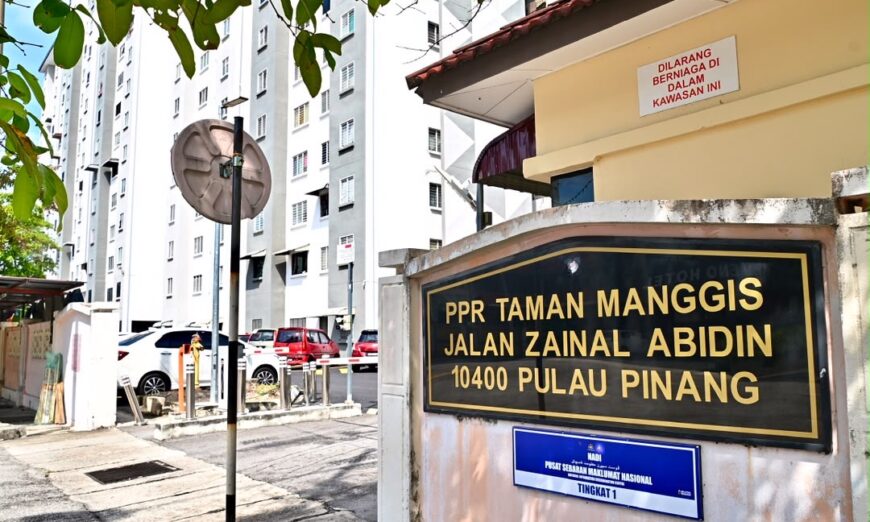
The sealing of five People’s Housing Project (PPR) units at Taman Manggis has drawn attention to the families who were asked to leave.
But the issue goes beyond the five units.
The question now is why enforcement became necessary.
Penang Chief Minister Chow Kon Yeow said the affected occupants had lost their eligibility and failed to cooperate with the relocation process.
He also said the enforcement was not carried out suddenly. Residents had received repeated notices and opportunities to resolve their status, while some had appealed for extensions on humanitarian grounds.
PPR is meant to be temporary
PPR housing is designed to provide temporary accommodation for low-income families who meet the eligibility requirements.
Tenancies generally last three years and can be extended to five years. Some residents have also received a further three-year extension on humanitarian grounds.
Yet some residents at Taman Manggis have stayed for as long as 19 years.
That creates a problem when the number of people waiting for housing continues to grow.
The shortage makes every unit count
Penang currently has four PPR schemes. PPR Taman Manggis in George Town, PPR Taman Bagan Jaya and PPR Mak Mandin in Butterworth, and PPR Permatang Tok Suboh in Bukit Mertajam.
The state has more than 1,000 eligible applicants waiting for units across these schemes.
At Taman Manggis alone, 434 applicants were waiting as of April.
For someone who has been waiting years for a home, an occupied PPR unit represents more than just another unavailable unit. It could be the home they have been waiting for.
Chow said some applicants have been waiting eight or even 10 years.
That makes it difficult for the authorities to allow residents who have lost their eligibility to remain indefinitely.
Authorities have also found cases involving PPR occupants who owned multiple vehicles, including luxury vehicles.
When residents no longer meet those requirements, the purpose of the housing programme becomes harder to maintain if they continue occupying the units.
Every unit occupied by someone who no longer qualifies is a unit that cannot be offered to another eligible family.
Enforcement was not the first step
The five units were not sealed immediately after the occupants lost their eligibility.
According to Chow, residents went through a process involving notices, appeals and opportunities to resolve their status.
Some residents cooperated with the authorities. Others appealed for extensions. Some did not cooperate with the relocation process.
Chow said enforcement would only follow when residents continued to refuse to vacate the units.
This is important because the eviction was presented as a final step after other options had been exhausted.
The state is not simply choosing between evicting five families and doing nothing.
It is also responsible for the people who have been waiting years for the same limited housing.
The system cannot keep extending indefinitely
There is a legitimate reason for humanitarian extensions.
Families can face financial difficulties, changes in employment and other circumstances that make moving out difficult. But extensions cannot continue forever.
The longer an ineligible occupant remains in a PPR unit, the longer another eligible applicant has to wait.
This is especially difficult in a system where more than 1,000 people are already waiting for housing.
PPR is supposed to help families get temporary housing while they improve their circumstances. It cannot work as intended if units become permanent homes for people who have already exceeded their eligibility period.
There is still a problem after eviction
Enforcing the rules may free up units for eligible applicants, but it does not solve the wider shortage of affordable housing.
Residents who have to leave still need somewhere to live. Being no longer eligible for PPR does not automatically mean a family can afford private housing.
This is where the government faces another challenge.
If PPR is meant to be temporary, residents need realistic options when their tenancy ends. Otherwise, the same problem can continue to appear in other housing schemes.
The state therefore has to manage two issues at the same time. First is making sure PPR units go to eligible applicants and then, ensuring residents who have to leave can find suitable alternatives.
Fairness has to include everyone
Chow said the state has to be fair to all parties. That includes the five families facing eviction.
It also includes the hundreds of applicants waiting for a PPR unit at Taman Manggis and the more than 1,000 eligible applicants waiting across Penang.
There is no way to make a limited number of units available to everyone at the same time.
At some point, eligibility rules have to be enforced.
The Taman Manggis case may be uncomfortable, but the principle is straightforward. Temporary housing must serve those who genuinely need it and qualify for it.
If residents are allowed to stay indefinitely after losing their eligibility, the people waiting at the other end of the queue are the ones who pay the price.
The eviction may be the most visible part of the issue, but the shortage of PPR homes is what makes the situation so difficult.
Until there are enough affordable housing options, cases like Taman Manggis will continue to put vulnerable families on opposite sides of the same problem.