
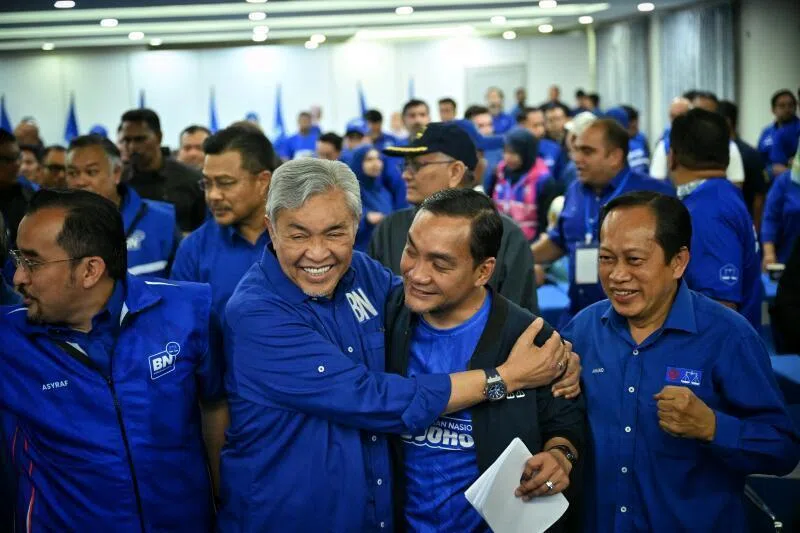
Barisan Nasional chairman Ahmad Zahid Hamidi gave Chief Minister Ab Rauf Yusoh the mandate to negotiate cooperation with any party for the upcoming Melaka state election.
The condition: the partner must be sincere, honest, and enable BN to continue leading the state government. “Choose a partner who speaks the same behind our backs as to our face,” Zahid warned, “not one that says one thing to your face and another behind your back”.
Meanwhile, PAS is openly pursuing cooperation with UMNO. Party secretary-general Takiyuddin Hassan confirmed that negotiations between PAS and Umno are ongoing and that he is directly involved in the process. PAS president Abdul Hadi Awang has disclosed that talks between the two coalitions have begun, describing the initial momentum as “promising” and noting that they are “taking inspiration from what was successfully achieved in Johor and Negeri Sembilan”.
Put these developments together. The question is increasingly not whether PAS and UMNO will become friends again. It is what happens to Pakatan Harapan if BN discovers that PAS is electorally more useful.
Arithmetic, Not Affection
The Unity Government was created because GE15 produced a hung Parliament. It was never proof that PH and BN had permanently converged politically. It was a marriage of necessity, not conviction. And state elections are now testing whether that arrangement survives once the electoral incentives change.
The Negeri Sembilan model worked. BN and PN reached an informal electoral pact, with BN contesting 25 seats while PN took the remaining 11. The result was a two-thirds majority for the alliance. That success has not gone unnoticed in Melaka, where BN won 21 of 28 seats in 2021 and is now targeting at least the same number.
Zahid has been explicit: “We proved it by going solo — we made the decision, and the people of Melaka stood with us in that blue wave”. But the very fact that he has given Ab Rauf a mandate to negotiate with any party suggests that BN is keeping its options open. It does not need a partner in Melaka. But it is willing to consider one if the arithmetic improves.
The Ego Problem
Zahid has already made clear that BN intends to defend all 21 seats it won in the 2021 Melaka election. That leaves just seven seats for any partner — PAS, PN, or anyone else.
BN's message is clear both explicitly and implicitly: it wants a minimum of 21 seats regardless of who it ultimately chooses to cooperate with. The implicit message is equally stark: BN is prepared to go solo if no party is willing to accept its terms.
Former Umno Supreme Council member Puad Zarkashi has been scathing about this approach. He mocked BN and PN over their “Malay-Muslim unity” rhetoric, pointing out that the narrative of “uniting the ummah” disappeared the moment seat negotiations began. He also claimed that covert discussions between UMNO and PAS had turned some UMNO leaders “egoistic and over-confident”.
PAS deputy president Tuan Ibrahim Tuan Man has even reminded both parties during negotiations that there should be no concept of a “big brother” or “little brother” in their cooperation. That remark alone reveals the underlying tension: PAS fears being treated as a junior partner, while BN refuses to see itself as anything but the senior.
PAS faces two main choices: accept the Negeri Sembilan model and contest only seven seats, or adopt the Johor model where PN fields candidates in targeted seats, potentially clashing with BN in some areas. Either way, PAS is negotiating from a position of weakness.
The Nightmare Scenario
For PH, this is a nightmare scenario. The coalition already lost Negeri Sembilan to the BN-PN pact. Melaka, where PH holds just five seats, could be next. And if BN-PN cooperation proves successful again, the question will inevitably shift to the federal level.
Analysts have noted that the Melaka election will be an important test of whether BN-PN cooperation could survive difficult seat negotiations and eventually extend to GE16.
Once constituencies start being exchanged between BN and PAS or PN, the story becomes much stronger. Seat allocations are not just about Melaka. They are about whether the two coalitions can find a formula that works nationally. Zahid is playing this carefully. He has said BN will not enter a pact with PN blindly and that grassroots sentiment is mixed.
The Unity Government Killer
The Unity Government was born from arithmetic. New arithmetic can kill it.
Melaka could become the laboratory for Malaysia's next federal coalition. The state election is not just about 28 seats. It is about whether BN and PN can make cooperation work beyond a single electoral cycle. And if they can, the federal government will face a question it has not had to answer since 2022: can it survive without BN?
Zahid has given Ab Rauf the mandate to negotiate. Hadi has confirmed talks are underway. The machinery is moving. And PH is watching from the outside, hoping that ego and history will keep BN and PAS apart.
But history suggests otherwise. The same ego that makes BN demand 21 seats may also make it believe it can dictate terms to any partner. And the same desperation that drives PAS to pursue cooperation may make it accept those terms.
But hope is not a strategy. And in Malaysian politics, arithmetic always wins.