
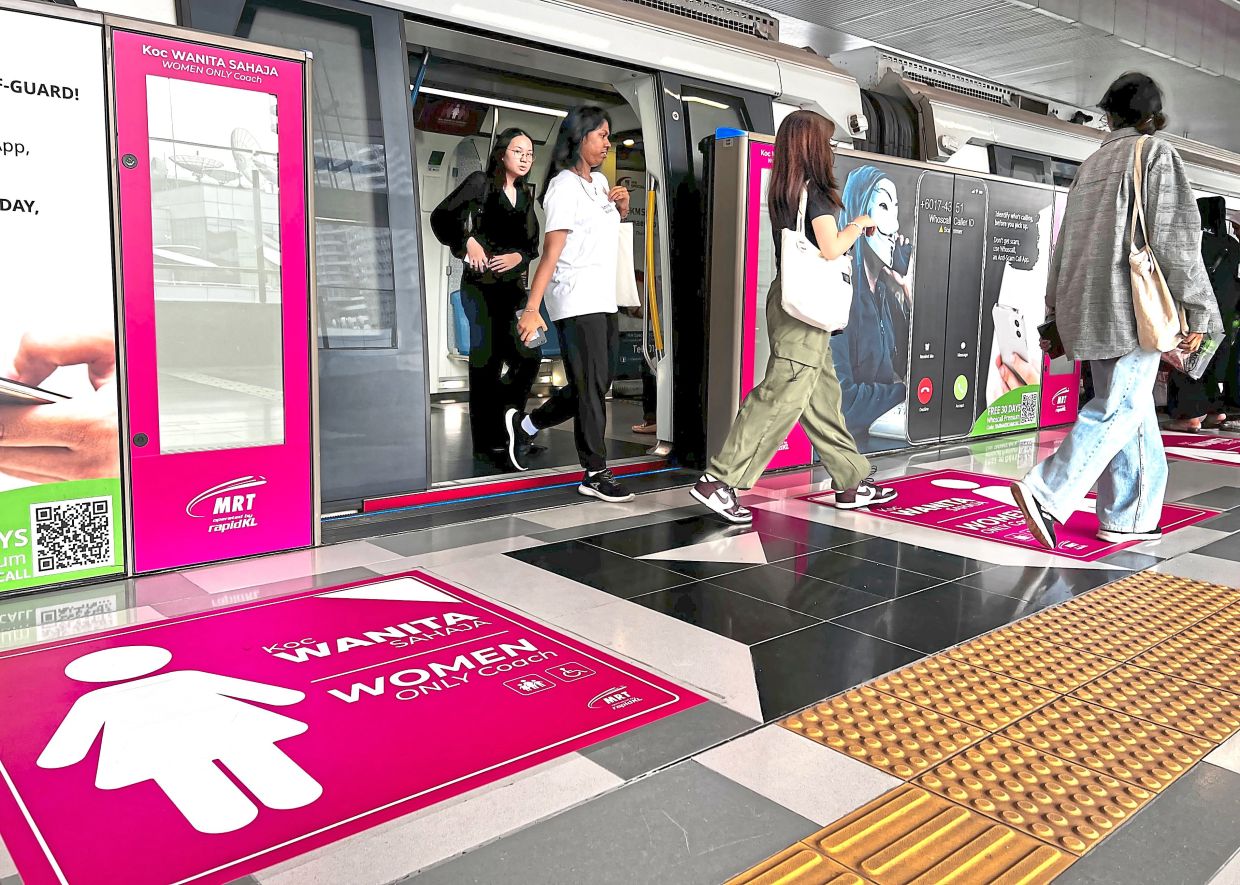
When Transport Minister Anthony Loke announced that e-hailing companies should offer female driver options for women passengers, and that Penang's upcoming LRT system should include women-only coaches, the usual suspects took to social media.
"Islamisation," they cried. "Segregation," they declared. Some even compared it to Terengganu's cinema seating policies, where opposite sexes must sit apart.
The comparison is not just wrong. It is bigoted. And it reveals a fundamental misunderstanding of what these measures are actually for.
The Data Speaks for Itself
Women make up nearly two-thirds of rail passengers in the Klang Valley. They are the majority users of public transport. And they are also the ones who face the greatest risks.
A study by the All Women's Action Society (AWAM) and Cent-GPS found that 57 percent of women experience verbal sexual harassment when walking in public, and 25 percent have been stalked all the way home. The Transport Ministry itself has received frequent complaints about sexual harassment on public transport, particularly during peak hours.
The women-only coach initiative was not pulled from thin air. It was a response to real, documented concerns. And it has worked. Since its introduction on the Kajang MRT Line, sexual harassment complaints have decreased from an average of 3.2 cases to two cases per month.
On KTM Komuter services, which introduced women-only coaches in 2010, complaints have dropped to just three cases as of April 2025. When women have a dedicated space, they feel safer. And when they feel safer, they use public transport more.
What the Critics Get Wrong
The critics argue that if women have their own coaches, then men should have their own too. This argument is deliberately obtuse.
Women-only coaches exist because women face specific risks that men do not. The goal is not to separate the sexes. The goal is to create a space where women are not subjected to unwanted attention, groping, or harassment.
During peak hours, the women's coach is often the most crowded. Women do not mind squeezing in with other women. They mind being squeezed by strangers who may not have good intentions. The mixed coaches are still there. No one is forcing women to use the women-only coach. It is an option. And it is an option that many women choose because it makes them feel safer.
The comparison to Terengganu's cinema policies is particularly disingenuous. That policy separates men and women in all contexts, regardless of safety concerns. It is about social regulation, not passenger protection. Women-only coaches are about addressing a specific problem: sexual harassment on public transport. The two have nothing in common.
The Last-Mile Problem
The women-only coach initiative has been implemented on the MRT Kajang Line, MRT Putrajaya Line, LRT Ampang Line, and KTM Komuter services in the Klang Valley. But safety does not end at the station.
Grab Malaysia launched its Women-Only Rides (Beta) service in March 2026, matching women passengers exclusively with women driver-partners. The service requires a one-time gender verification process using MyKad or passport. It is currently available through Advance Booking in the Klang Valley.
Loke has also urged e-hailing companies to introduce carpooling options exclusively for women passengers. The logic is simple: if women feel unsafe in mixed carpool settings, give them the option to ride with other women.
These are not radical ideas. They are practical solutions to real problems. They extend the protection of women-only spaces from the train to the "last mile" journey home.
When Helping Women Becomes a Crime
What is truly troubling about the backlash is the assumption that anything that helps women must be motivated by religious extremism. The critics see a women-only coach and immediately reach for the "Islamisation" label. They see a female e-hailing option and declare it a step backwards.
This is not only ignorant. It is deeply inconsiderate.
Imagine being a woman and having to choose between a crowded train where you might be groped and a women-only coach where you can travel in peace. Imagine having to choose between a ride-share with a stranger and a female driver who makes you feel secure. These are not abstract policy debates. They are daily realities for millions of Malaysian women.
When critics dismiss these measures as "segregation," they are telling women that their safety concerns do not matter. They are saying that the discomfort of being groped, stared at, or harassed is less important than their ideological objection to women-only spaces.
The Path Forward
Loke has made it clear that the Penang LRT should include women-only coaches. He has also called for more opportunities for women in traditionally male-dominated fields like aviation and maritime. "If men can fly aircraft, women can do the same. If women can drive, why can't they fly aircraft?" he asked.
Empowering women means both giving them the tools to succeed and creating environments where they can do so safely. A woman who feels safe on public transport is more likely to pursue opportunities that require mobility. A woman who can choose a female driver is more likely to use e-hailing services without fear. A woman who sees other women in aviation is more likely to believe she belongs there too.
For our country to grow, the people must too. That means developing a civic sense that goes beyond outrage and actually considers the needs of others. It means recognising that safety is not a luxury. It is a right. And it means understanding that creating safe spaces for women is not about segregation — it is about respect.