
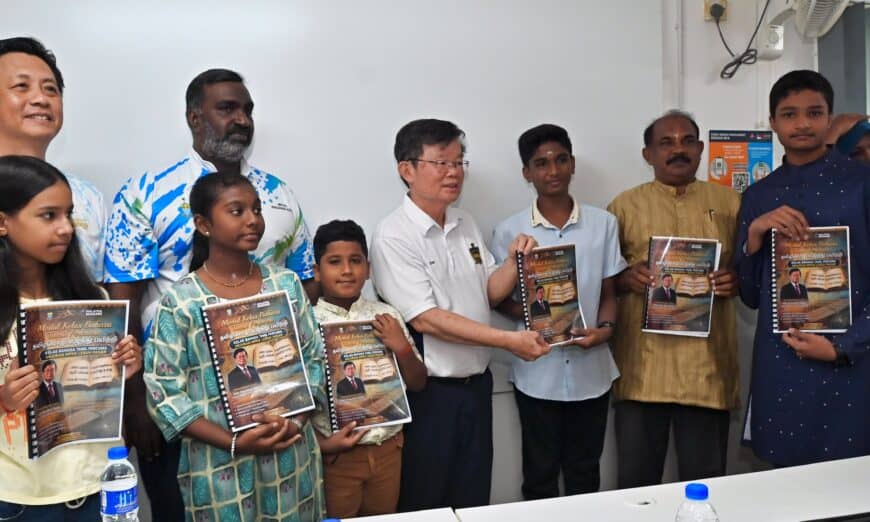
A free Tamil language programme in Penang is doing more than teaching people how to read and write.
Organised by the Lebuh Pasar Village Community Management Council (MPKK), the programme has attracted participants from different communities, including Malays and Chinese who want to learn Tamil.
In a multicultural country, understanding another community should not stop at celebrating its festivals or enjoying its food. Learning its language is a more meaningful way to understand its culture and history.
Language opens the door to culture
The programme began on September 5 and will run for 12 months, with classes held four times a month. Its 25 participants range from children as young as seven to senior citizens, and lessons cover basic Tamil reading, writing and everyday conversation.
The classes are also open to people who do not speak Tamil as their mother tongue.
That is where the programme gets it right.
Tamil is not simply a language for everyday communication. It carries thousands of years of history, literature and cultural knowledge.
Learning the language gives participants an opportunity to explore that heritage, including works such as the Thirukkural and the ideas it contains about morality, life and humanity.
That experience should not be limited to the Tamil-speaking community.
Culture becomes more widely understood when people outside the community are given the opportunity to engage with it.
Unity requires participation
Malaysia often celebrates its multicultural identity, but celebrating diversity is not the same as understanding it.
We can recognise that different cultures exist without ever learning anything about them.
That is why grassroots programmes like this matter.
Someone who chooses to learn Tamil is making a deliberate effort to understand a part of Malaysian heritage that they did not grow up with.
They are learning the language, but they are also gaining a new way to understand the people and culture behind it.
The same approach should extend beyond Tamil.
Malaysians should have more opportunities to learn Mandarin, Punjabi, Iban, Kadazan-Dusun and other languages that form part of the country's cultural fabric.
The aim is not to make everyone fluent in every language but to make cultural curiosity part of everyday life.
Communities have a role to play
The programme also shows that cultural preservation does not have to depend entirely on government initiatives.
The state government provides support for Tamil education, including RM2.42 million annually for 28 Tamil primary schools in Penang. But programmes such as the one in Lebuh Pasar show what communities can build themselves.
The MPKK is starting small, with 25 places and a community learning space at the National Information Dissemination Centre (NADI).
That is enough to make a difference.
A classroom gives people a place to interact directly instead of simply hearing about multiculturalism in speeches or campaigns. It creates an opportunity for different generations and communities to learn alongside one another.
If the response is strong, the programme should expand to accommodate more students and introduce higher levels of learning.
Other communities should consider doing the same.
Malaysia needs more shared spaces
Preserving a language is important. Making that language accessible to people outside its traditional community is even more powerful.
It turns cultural heritage into something that can be shared rather than something that remains within separate communities.
Penang's free Tamil classes are a small initiative, but they demonstrate the kind of multiculturalism Malaysia needs more of: one built through participation, curiosity and genuine effort to understand one another.
Unity does not become stronger simply because we acknowledge our differences.
It becomes stronger when we take the time to learn them.