
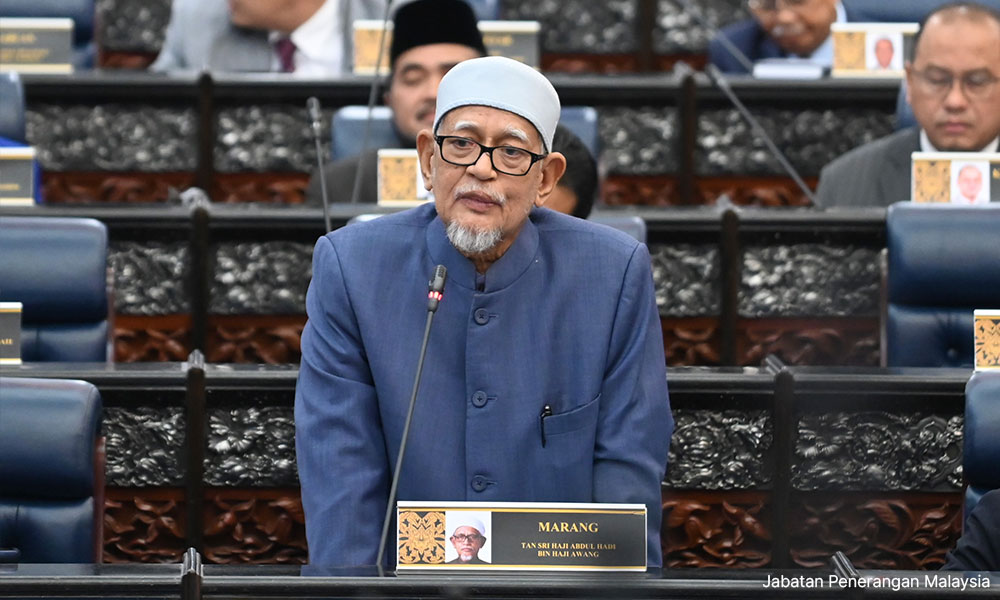
Just days ago, PAS president Hadi Awang claimed non-Muslims could be ministers—but only if they stick to portfolios "unrelated to Islamic policy." He gave two examples: Works and Forestry. Everything else? Reserved for Muslims.
This isn't a religious argument. It's fear-mongering dressed up as governance.
Let's be clear. Over 60 percent of Malaysians are Muslim. The remaining 30-plus percent are Buddhists, Christians, Hindus, and others. No one is questioning that Islam is the religion of the Federation. But Hadi's proposal raises three critical questions that he has not answered.
What Exactly Is the Difference?
Since the department of Islamic affairs was established, has it ever been headed by a non-Muslim? The answer is no. It has always been led by Muslims. So if that has always been the case, what exactly is Hadi proposing that is different from what has already been practised for decades?
If there is no difference, then what is the point of making this distinction? And if there is a difference, what is it?
Why Only Works and Forestry?
Hadi offered only two examples of portfolios supposedly "unrelated" to Islamic policy. But is the Works Ministry really unrelated? That is the ministry responsible for building schools, mosques, government buildings, and infrastructure.
How can Hadi say this has nothing to do with Islamic policies? When a school is built, when a mosque is constructed, when government buildings are erected—are these not decisions that affect the Muslim community?
And what about forests? The Quran frequently mentions rivers, trees, fruits, and mountains as signs of Allah's blessings. Are forests really unrelated to Islam? Or is Hadi simply picking convenient examples without thinking through the implications?
There are 28 ministries in total. If non-Muslims can only hold Works and Forestry, what happens to the other 26? Who will be in charge of education, health, finance, and human resources? And how will the government function when policy-making is effectively off-limits to a significant portion of the population?
Where Does This Leave Non-Muslims?
Hadi's proposal effectively creates a two-tier cabinet. Muslims make policy. Non-Muslims execute. This is not inclusion. This is tokenism.
Hadi's own assistant later said the remarks were open to interpretation and that the two departments mentioned were "merely examples".
But if they are merely examples, what are the actual criteria? Which departments are considered "policy-making"? Who decides? And what safeguards exist to prevent this from becoming a tool for marginalisation?
And here is the irony. Hadi's own party has previously accused non-Muslims and non-Bumiputeras of being the "roots of corruption". Yet now he claims they can be ministers—just not policy-makers.
The Irony of Fear-Mongering
Hadi's proposal is not just flawed—it is inconsistent with the party's own history.
In 1999, PAS leaders served in a government alongside non-Muslims. In 2018, PAS's own president was part of a government that included non-Muslims. PAS's own voters have shown they can accept non-Muslims in government.
But Hadi seems to be playing a different game now.
By limiting non-Muslims to non-policy roles, Hadi is essentially saying: you can be in government, but you cannot govern. This is not about Islam. It is about maintaining a narrative that only PAS can protect Malay-Muslim interests.
A Country Can’t Run On Religion Alone
A country cannot run on religion alone. It needs economic policy. Education policy. Health policy. Human resource development. None of these were mentioned by Hadi. Instead, he focused on who gets which portfolio, as if governance is about dividing spoils rather than delivering results.
Malaysia is a multi-racial, multi-religious nation. Any credible government must reflect that reality—not merely in token appointments, but in genuine participation in policy-making. Every Malaysian, regardless of faith, has the right to serve their country at the highest level.
Hadi's vision is not about Islam. It is about power. And the people of Malaysia deserve better.