
UMNO may not be choosing between Pakatan Harapan and Perikatan Nasional. It may be trying to make sure it never has to.
The party’s latest signals ahead of GE16 point towards a strategy built around flexibility. Remain within Barisan Nasional, stay open to cooperation with other parties and avoid becoming subordinate to any political bloc.
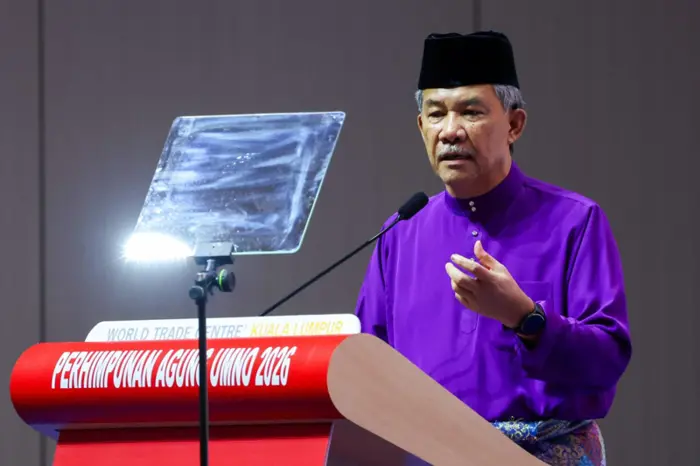
That strategy became clearer this week when UMNO deputy president Datuk Seri Mohamad Hasan said the party was open to Malay-Muslim political cooperation but would not allow itself to be used as a “political pawn” again.
He also made UMNO’s position clear. The party cannot depend on PH, PN, PAS or DAP to rebuild itself.
UMNO Does Not Want a New Master
Mohamad’s message was not that UMNO is closing the door to cooperation.
It is almost the opposite.
He said UMNO would welcome anyone proposing Malay unity, but such cooperation must have clear objectives, sincerity and strategic value for the Malay-Muslim community.
Any arrangement must also fit within UMNO’s “Rumah Bangsa” vision, with UMNO remaining the central pillar.
He also reaffirmed UMNO’s commitment to Barisan Nasional and said the party would not form a new political alliance. Instead, it would continue building its own support base while remaining open to cooperation.
That distinction is crucial.
UMNO is not saying it wants to join PAS. It is not saying it wants to remain permanently tied to PH either.
It is saying that it wants the freedom to work with whoever serves its interests without surrendering its own identity or leverage.
The Door to PAS Is Clearly Open
The recent warmth between UMNO and PAS makes this strategy even more interesting.
PAS has just approved a resolution to strengthen Malay-Muslim political unity ahead of GE16.
Its president, Tan Sri Abdul Hadi Awang, has also signalled a softer approach towards UMNO, while saying PAS remains open to cooperation with other parties as long as its principles are respected.
UMNO has responded in kind.
Its leaders attended PAS’ annual muktamar, while PAS delegates were welcomed at UMNO’s general assembly this week. The two parties also worked together in the recent Negeri Sembilan election, where BN and PN secured a combined 25 seats.
UMNO has also authorised its state leadership to negotiate electoral cooperation with any political party interested in working with it. The party said such negotiations must be based on sincerity and trust.
That does not look like a party preparing to sign itself over to one bloc. It looks like a party keeping every option available.
PH Is Not an Easy Political Home
At the same time, UMNO has a problem with its current cooperation with PH.
Mohamad admitted this week that UMNO had struggled to convince Malay voters to accept its partnership with DAP in the Unity Government.
That makes a permanent PH-UMNO arrangement politically complicated.
UMNO needs the federal partnership for now. But it also needs to rebuild credibility among the Malay voters it lost.
Those two objectives do not always point in the same direction.
This is why UMNO's current position is more nuanced than simply choosing PH or PN.
Cooperation Without Commitment
The emerging formula appears to be cooperation without permanent commitment.
That matters because UMNO has already experienced the risks of depending too heavily on other parties.
Mohamad said the party had spent eight years in survival mode since losing federal power in 2018 and had learned from the political arrangements it entered afterwards.
The lesson, he argued, was that cooperation cannot become a substitute for rebuilding UMNO itself.
This also explains why the party is so careful with the language around Malay unity.
UMNO can support penyatuan ummah without immediately recreating the old Muafakat Nasional model.
Indeed, a recent analysis in The Star described the emerging UMNO-PAS relationship as “strategic accommodation” rather than necessarily a new formal coalition.
That may be the model UMNO prefers. Work together where necessary, negotiate where useful and remain separate where separation provides an advantage.
The Kingmaker Calculation
This strategy becomes especially valuable if GE16 produces another fragmented Parliament.
There is no guarantee that will happen. But Malaysia's recent political history has shown how valuable a bloc of seats can become when no coalition can comfortably govern alone.
In that situation, UMNO would not necessarily need to emerge as the largest party.
It would need to emerge as a party that neither side can afford to lose.
Instead of asking whether UMNO will return to its old dominant position, the more interesting question is whether it can rebuild enough support to become indispensable again.
A party with enough seats to determine who forms the government has bargaining power far beyond its raw numbers. And UMNO appears to understand that.
UMNO Wants to Be Needed
There is an irony in UMNO's current approach.
The party is talking about Malay unity while refusing to permanently bind itself to the parties most likely to participate in that unity.
But perhaps that contradiction is the point.
UMNO may no longer believe that political survival comes from choosing the strongest bloc and attaching itself to it.
Instead, it may believe survival comes from ensuring every major bloc has a reason to negotiate with UMNO.
That makes penyatuan ummah more than an ideological project. It can also become a source of political leverage.
UMNO does not necessarily need to marry PAS. It does not necessarily need to return to PH. It may simply need both sides to believe they cannot govern without it.
For a party trying to recover from eight years of political decline, becoming everyone's necessary partner may be a more realistic path back to power than trying to dominate GE16 outright.