
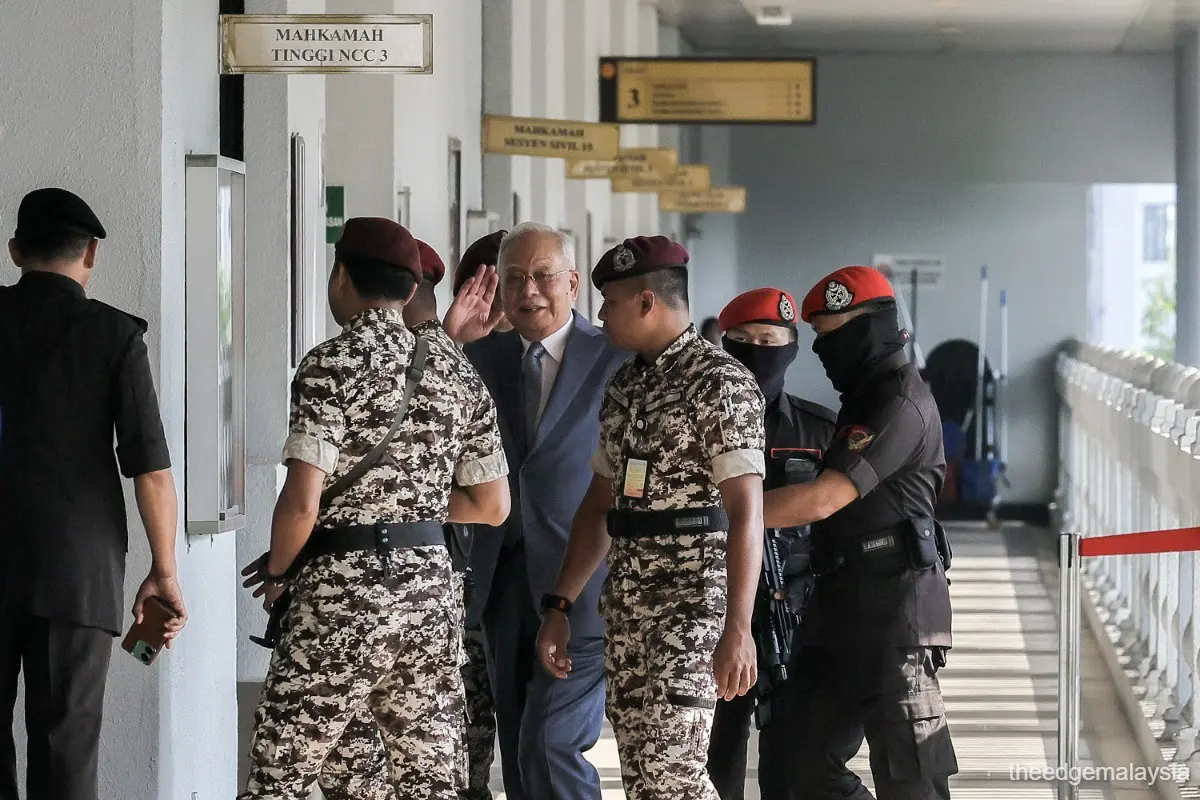
On September 11, the Federal Territories Pardons Board is expected to meet, with Najib Razak's latest clemency application reportedly among the matters to be discussed. It remains unclear whether a decision will be made, or whether house arrest will formally be considered. But once again, Malaysian politics is revolving around Najib.
He has been in prison since August 2022 over the SRC International case. His original sentence was 12 years and a RM210 million fine. In 2024, the Pardons Board cut the prison term in half to six years and reduced the fine to RM50 million. Then came the alleged royal addendum for house arrest. Then the court battle over whether it could be enforced. Then an appeal. Then the withdrawal of that appeal. Now, another clemency application.
He has already received substantial mercy — his sentence halved, his fine slashed. Barely two years later, we are again discussing whether the remaining punishment should be softened further.
At what point does clemency stop looking like an exceptional act of mercy and start looking like a continuing negotiation over how much of a court-imposed sentence a powerful political figure actually has to serve?
The Pardon Is Closer Than We Think
There is a real, non-trivial chance that Najib walks free.
What makes this bid different is the broader context. Just months ago, the government advanced a new house arrest bill — a framework allowing house arrest as an alternative punishment for certain offences. Home Minister Saifuddin Nasution Ismail confirmed it had received Cabinet approval and was at the amendment matrix stage. The bill is set to be tabled next year.
Many Malaysians asked the obvious question: is this being built for Najib? The government insists it is not, pointing out that the bill targets first-time offenders, pregnant women, senior citizens, and people with disabilities — and specifically excludes corruption and abuse of power.
But the timing is impossible to ignore. A house arrest framework being crafted while Najib's legal team fights for exactly that outcome does not look like a coincidence. It looks like preparation.
The Pardons Board operates independently of that legislation. If it decides on September 11 that Najib should serve his remaining sentence at home, the legal basis will not come from Parliament. It will come from the King. The previous addendum was ruled unenforceable because it was never deliberated by the Board. A fresh decision could provide exactly the legal foundation his earlier bid lacked.
Why His Supporters Still Believe
Najib's supporters make a straightforward argument. He has served time. He has been fined. He has expressed remorse. The King has the constitutional power to grant mercy, and mercy is not something that should be rationed based on public opinion. They point out that Anwar Ibrahim himself was pardoned in 2018 while serving a sentence and that no one questioned the King's discretion then.
It is a reasonable argument on its face. But it ignores two things.
First, the scale. Anwar's conviction was widely viewed as politically motivated — a case that many believed was about removing a rival, not punishing a crime. Najib's SRC conviction, by contrast, was the result of a trial that found money from a state-owned company had flowed into his personal accounts. The two cases are not equivalent, and treating them as such is intellectually dishonest.
Second, the pattern. A pardon granted once, quietly and finally, is one thing. A pardon granted after years of public campaigning, political pressure, and repeated legal manoeuvres is another. The question is not whether Najib deserves mercy. The question is whether mercy is being granted because the law demands it — or because a political machine refuses to accept the verdict.
The PH Coalition Question
If Najib actually walks free, the Pakatan Harapan coalition — already fragile — would face an immediate crisis.
PH has built its reputation on anti-corruption. It has repeatedly stated that individuals convicted of graft "must complete their sentences in full". If Najib is released while PH is in government, the coalition's core narrative collapses.
Analysts have warned that PH supporters would accuse Anwar of failing to ensure Najib serves his full sentence. The voters who believed in 2018, who believed in the promise of a clean government would feel betrayed. Trust, once broken, is not easily rebuilt.
But the damage would go beyond perception. BN is already a junior partner in the Unity Government. If Najib returns to active politics, BN's leverage increases. Its demands become harder to resist. And PH's ability to set the agenda diminishes further.
The coalition is not held together by shared ideals. It is held together by convenience. A freed Najib would test that convenience to its breaking point.
The Zahid Reckoning
There is another dimension that few are willing to discuss openly: what happens to Ahmad Zahid Hamidi.
Zahid has spent years building his position as UMNO president and BN chairman. He has navigated the party through its worst electoral defeat, through coalition negotiations, through the formation of the Unity Government. He has survived. He has consolidated.
But Najib was never just another UMNO leader. He was the president. He was the prime minister. He was, for a long time, the face of the party. And he still commands significant support among UMNO's grassroots.
If Najib returns to active politics, Zahid's position becomes precarious. The party that Zahid has spent years reshaping could revert to its former shape. The loyalty that Zahid has cultivated could shift back to its original object.
Zahid's own rhetoric acknowledges this tension. He has pleaded with the King to grant Najib "any consideration and leniency" to allow him to return to his family and to UMNO. He has insisted that UMNO has "never wavered" in its support for Najib.
But there is a difference between supporting a prisoner and welcoming back a rival. Zahid knows this. Everyone knows this.
The Mahathir-Anwar Parallel
There is a historical parallel that should give both PH and Zahid pause.
In 2018, Mahathir Mohamad promised to hand over power to Anwar Ibrahim. He never did. The transition never happened. The PH government collapsed in the Sheraton Move. And the man who was supposed to inherit the leadership was left waiting, again.
Zahid has not made a similar promise to Najib. But the dynamic is similar: a leader who has built his position on the promise of eventual succession, facing the return of the man he replaced. If Najib returns, Zahid does not become the power. He becomes the placeholder. And placeholders do not last.
The Mahathir-Anwar saga destroyed PH from within. A Zahid-Najib rivalry could do the same to UMNO — and, by extension, to the Unity Government.
The Endless Legal Manoeuvres
Najib has every legal right to seek clemency. The Pardons Board has every constitutional obligation to consider it. But the repeated bids, the endless legal manoeuvres, the constant testing of the system — they are not about justice. They are about one man's desire to return to power.
And the country is paying for it. Not just in money, though the legal and administrative costs are real. But in attention. In political energy. In the endless distraction from the issues that actually matter: the cost of living, the state of education, the future of the economy.
If Najib returns, the PH coalition will be tested. Zahid's leadership will be tested. And the Unity Government, already fragile, will face its most serious challenge yet.
But even if he does not return, the damage is done. The obsession continues. The resources are spent. And the country moves a little slower, a little more tired, a little more distracted.
Malaysia deserves better than this. It deserves leaders who look forward, not backward. It deserves a political system that spends its energy on the future, not on relitigating the past