
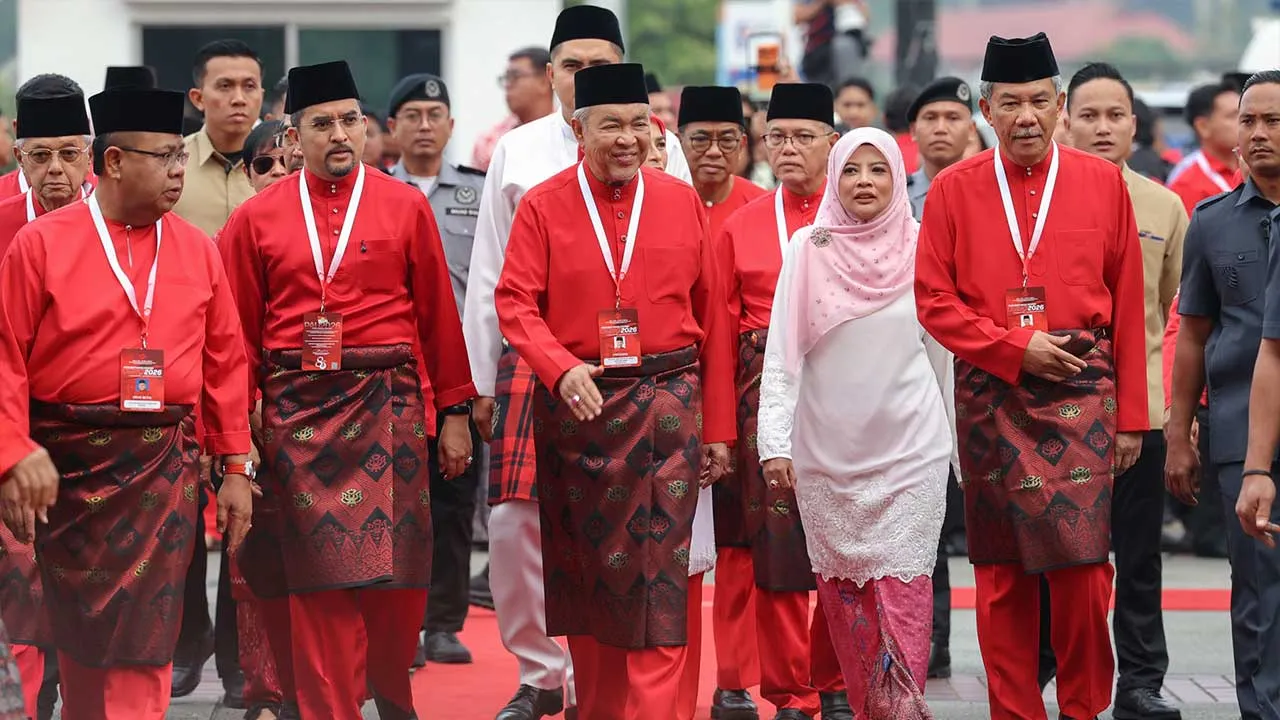
During the 2026 UMNO General Assembly, Deputy President Datuk Seri Mohamad Hasan — better known as Tok Mat — declared that UMNO will "forever be centrist."
His message was aimed squarely at non-Malays and the Bumiputera communities of Sabah and Sarawak. He said anyone who wants to work with UMNO must accept its moderation and centrist approach — and cannot impose conservative or radical ideology on the party.
Sounds clear enough.
But just hours later, UMNO Youth chief Akmal Saleh took the same stage and pushed in a very different direction. He openly called for cooperation with PAS in the coming Melaka election, describing it as the next test of penyatuan ummah — Malay-Muslim unity.
The Identity Problem
This creates a serious problem for UMNO. If UMNO becomes politically indistinguishable from PAS, why would voters choose UMNO instead of PAS?
PAS already has stronger religious credentials. PAS already has a committed conservative base. PAS has also proven increasingly capable of mobilising that base electorally — winning 43 parliamentary seats in GE15, the most of any single party.
So what exactly would UMNO be offering that PAS cannot?
UMNO's traditional strength has been its reputation for development, stability, and pragmatic governance. It was the party that built modern Malaysia, that managed the economy, that maintained the civil service. Its brand was competence, not piety.
But if UMNO starts competing on religious credentials, it will lose. PAS owns that space. It has spent decades cultivating it. It has the ulama leadership, the religious schools, the grassroots network that UMNO abandoned long ago.
The Dangerous Game
UMNO may believe it can use PAS without becoming PAS. That it can borrow PAS's conservative base, win seats, and then return to its centrist roots when convenient.
PAS may believe exactly the opposite. That it can use UMNO's machinery and establishment credentials to expand its influence, then replace UMNO as the dominant Malay-Muslim party.
Consider the Melaka election. UMNO needs PAS's support to consolidate the Malay vote. PAS needs UMNO's local networks and incumbent advantage. Both sides have something the other wants. But when the votes are counted, who benefits more?
UMNO has spent decades fracturing. Its support base is divided. Its grassroots are demoralised. Its leadership is contested. PAS, by contrast, has maintained discipline. Its members do not defect. Its leaders do not challenge each other. Its direction is set by the ulama, not by factional politics.
The Question Voters Will Ask
Eventually, voters will ask: what does UMNO actually stand for?
Because you cannot permanently be both. You cannot be the moderate alternative to PAS while constantly moving closer to PAS. You cannot tell non-Malays you are centrist while courting a party that non-Malays distrust. You cannot promise stability while allying with a partner that seeks to reshape the political system along religious lines.
UMNO has to choose.
Either it is the party of moderation, development, and multiracial governance — the party that Tok Mat described from the podium. Or it is the party of penyatuan ummah, competing for the same conservative base as PAS.
If it chooses the first, it must reject the PAS overtures. It must rebuild its non-Malay support. It must accept that it will lose some Malay votes to PAS and PN. That is the price of principle.
If it chooses the second, it must accept that it will be the junior partner. PAS will set the agenda. PAS will determine the direction. UMNO will become what Bersatu became — a party that thought it was using PAS, only to discover that PAS was using it.
Who Is The Puppet?
Is PAS becoming BN's tool to recover Malay support? Or is BN slowly becoming PAS's tool to expand its political influence?
UMNO believes it can have it both ways. It believes it can be centrist for non-Malays and conservative for Malays. It believes it can cooperate with PAS without being absorbed by it.
That belief may prove to be its undoing.
Because if UMNO does not make the choice itself, PAS may make it for them. And by then, it will be too late.