
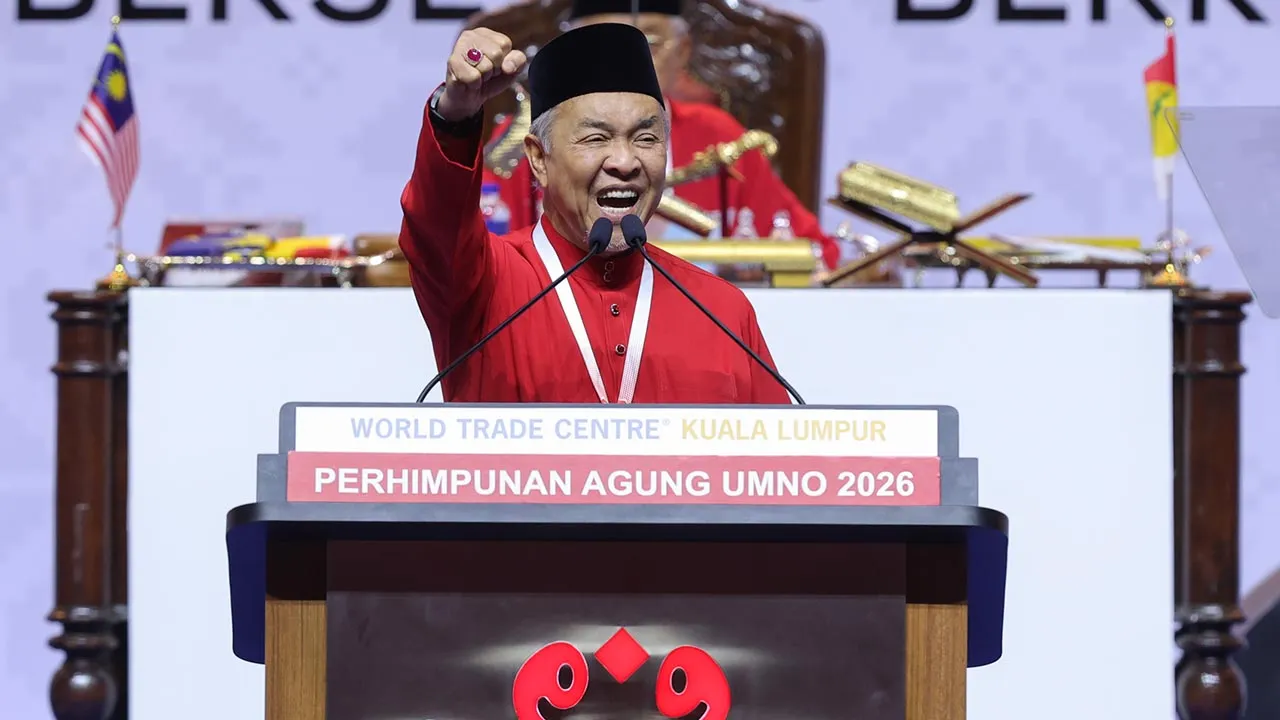
At the 2026 UMNO General Assembly, party president Datuk Seri Ahmad Zahid Hamidi made a familiar pledge.
UMNO, he said, is determined to restore the Goods and Services Tax as part of a restructuring of the national tax system. “We are determined. Insya-Allah, we will bring back GST at a more reasonable rate and percentage,” he told delegates at the World Trade Centre.
He was blunt about the current arrangement. “Change the taxation back to the GST system. Where is there a hybrid system? Nobody does a hybrid of GST and SST,” he said, referring to the Sales and Services Tax.
UMNO Youth chief Akmal Saleh made the same argument a day earlier, pointing out that GST collection once surpassed RM44.3 billion, comfortably outperforming SST revenues.
The push is not new. But it raises a question that Malaysians have been wrestling with since 2018: is GST actually better, or is it simply better remembered?
Two Systems, Two Philosophies
To understand the debate, you have to understand how the two taxes work — and why they reflect fundamentally different approaches to taxation.
GST is a multi-stage value-added tax. It is charged at every stage of the supply chain. Businesses can claim back the tax they paid on their inputs, so the tax is only levied on the value added at each stage. Its strength, proponents argue, is its transparency and its broad base. Before it was abolished, GST generated RM44.3 billion, or 20 per cent of total government revenue.
SST, by contrast, is a single-stage tax. Sales tax is imposed at the manufacturing or import level. Service tax is imposed on specific services. There is no input tax credit mechanism, meaning tax can cascade through the supply chain. The base is also narrower — covering roughly 42 per cent of goods and services, compared with GST's near-universal coverage.
On paper, GST looks like the more efficient system. But efficiency is not the only measure of a good tax. A tax must also be fair, sustainable, and accepted by the people who pay it.
Why SST Is the Right Fit
Here is the case for SST that UMNO refuses to acknowledge.
SST is narrower in scope, it is easier to exclude basic necessities from taxation. GST, by design, captures nearly everything — and while zero-rating is theoretically possible, the political promise of protecting the poor proved harder to deliver than expected. Many basic items ended up being taxed anyway, and the burden fell disproportionately on households that spend nearly all their income on consumption.
GST itemised the tax on every receipt. That transparency, however economically elegant, generated constant public grievance. Every purchase became a reminder of the tax burden. SST, embedded in prices rather than itemised, does not create the same sense of constant resentment. This is not a moral defence. But it is a practical one. A tax that the public does not accept is a tax that cannot be sustained.
The SST that exists today is not the SST of 2018. The government has expanded its scope considerably — over 4,800 additional goods and services were brought into the tax net from July 2025. SST revenue is rising, with an additional RM5 billion expected in 2025 and RM10 billion in 2026. By 2026, SST is projected to contribute 17.4 per cent of total tax revenue.
More importantly, e-invoicing has transformed compliance. Introduced as part of the government's digitalisation push, it has plugged many of the loopholes that previously plagued SST collection. The mechanism is similar to the tax invoice system under GST, making it harder for businesses to evade tax.
Critics point out that SST can cascade through the supply chain, as businesses cannot reclaim tax paid on inputs. But the expansion of SST's scope has been accompanied by measures to reduce cascading, including exemptions for certain business-to-business transactions. The system is not perfect, but it is workable.
Why GST Was Abolished
If GST is such an effective tax, why was it scrapped?
The answer is not simply politics. It is a combination of economic design flaws, administrative failures, and public distrust — all of which converged in 2018.
First, GST is regressive. The most persistent criticism is that it places a heavier burden on lower-income groups. Poor households spend nearly all their income on consumption, while wealthier households save a larger share. Even with zero-rating and exemptions, many basic items were still taxed.
Second, administrative complexity burdened businesses. The system was introduced with a multitude of rules, exceptions, and 35 different tax codes. Frequent changes created uncertainty, particularly for smaller businesses that lacked the resources to navigate the system.
Third, the price surveillance failed. Many businesses raised prices arbitrarily, well above the standard 6 per cent, and blamed the increase on GST. The authorities did not adequately monitor or penalise profiteering, and the public absorbed the cost.
Additionally, the additional revenue was meant to fund development and offset the burden on lower-income households through BR1M payments. Instead, the funds were absorbed into general government spending, and the refunds businesses were legally entitled to were delayed or withheld.
The political context mattered, but it was not the only factor. GST became a symbol of the Najib administration's failures — but it lost its legitimacy not only because it was politicised, but because it was implemented poorly, refunded late, and failed to protect the people it was supposed to serve.
The Revenue Gap
UMNO is right that Malaysia needs more revenue. The tax-to-GDP ratio sits at around 11.8 per cent, among the lowest in Southeast Asia. The country cannot fund its development needs — healthcare, education, infrastructure — on its current tax base.
But the answer is not automatically GST. Both systems raise revenue. Both are consumption taxes. Neither is a magic solution.
The difference is RM10 billion. GST could raise RM70 billion. SST is projected to raise RM60 billion. That gap is real. But it is not insurmountable.
The gap can be closed through better compliance, through careful base expansion, and through e-invoicing. The government has already taken steps in this direction. SST revenue is rising. Compliance is improving. The system is working.
What it needs is time — and the political will to keep improving it, rather than abandoning it for a tax that was twice rejected by the people.
Which Tax Is Acceptable?
The GST debate is not really about which tax is better. It is about which tax is acceptable. And for now, SST is the one Malaysians can live with.
SST is not perfect. It can be improved. It should be improved. But the push to bring back GST is not about economics. It is about politics — and about a party that wants to relitigate 2018.
The pragmatic path is to continue strengthening SST. Expand the base carefully, not aggressively. Use e-invoicing to close the gaps. Accept that the system has flaws, but that those flaws are preferable to a tax that was twice rejected by the people.
That may change. But it will not change because UMNO demands it at a party assembly. It will change when the public is ready — and not a moment before.