
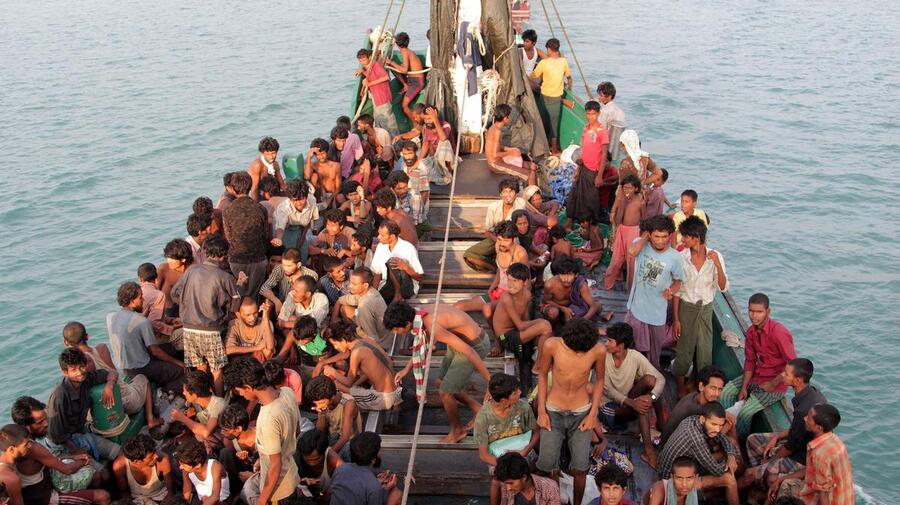
Prime Minister Anwar Ibrahim has announced he will invite Myanmar President Min Aung Hlaing to Malaysia for official talks aimed at repatriating the estimated 126,000 Rohingya refugees currently in the country. The invitation, he said, is part of a long-term plan to resolve a crisis that has festered for nearly a decade.
Anwar has framed the approach as pragmatic rather than confrontational. "We can be friends, we can trade, we can accept Myanmar, but Myanmar must accept them," he said. "If they cannot take 200,000 at once, take them in stages". Malaysia has agreed to bear logistics costs, including clothing, food, and boat fares.
The first phase is already scheduled. A total of 1,476 Myanmar nationals are due to return on September 29, as part of an initial agreement for 5,000 repatriations. Malaysia's Communications Minister Fahmi Fadzil has said the government will not proceed if returnees face persecution or threats to their lives.
Will Myanmar Accept Them?
Myanmar's foreign ministry issued a statement on September 3 pledging to work with "friendly countries to facilitate the voluntary return of verified displaced persons in a safe and dignified manner". But in the same statement, it repeated its longstanding refusal to recognise the Rohingya as an ethnic group, describing the term as one that "falsely claims an ethnic identity which has never existed in Myanmar".
Myanmar's 1982 Citizenship Law effectively denies the Rohingya citizenship, rendering them stateless. The military government has verified 308,797 Rohingya in Bangladesh as "former residents" of Rakhine State, but has made any return conditional on security improvements in a region still engulfed in civil war. The Arakan Army now controls much of Rakhine, and the military no longer governs most of the territory.
A UN report published on September 2 concluded that "conditions for their voluntary, safe, dignified and sustainable return do not currently exist". The UNHCR has confirmed it is not involved in Malaysia's repatriation process and has expressed concern about whether refugees have been consulted.
Myanmar has agreed to accept 5,000 from Malaysia. But it has not agreed to recognise them as citizens. It has not guaranteed their safety. And it has not created the conditions for a sustainable return. The agreement is procedural, not substantive.
The Humanitarian Question
The repatriation plan raises a question diplomacy alone cannot answer: can Myanmar be trusted to receive the people it has spent decades denying exist?
Myanmar's 1982 Citizenship Law rendered the Rohingya stateless, and the military government has made any return conditional on security improvements in a region still engulfed in civil war. The Arakan Army now controls much of Rakhine, and the military no longer governs most of the territory.
The domestic context adds another layer of difficulty. Malaysia is not a signatory to the 1951 Refugee Convention and does not formally recognise refugee status. Rohingya in Malaysia are exposed to arrest, detention, and deportation, with limited access to work, schooling, and healthcare.
Anwar has acknowledged the suffering of the Rohingya while insisting that Malaysia cannot accommodate them permanently. "They need to be sent home," he has said. But sending people home to a country that does not recognise them as citizens, that is still at war, and that offers no guarantee of safety is not a solution.
The 1,476 scheduled for September 29 will board Myanmar navy vessels and return to a country that has never fully accepted them. Malaysia has said it will not proceed if their lives are at risk. The question is who makes that determination — and whether Myanmar's assurances of "safe returns" can be trusted when the conditions that drove them out remain unchanged.
What Malaysia Can Realistically Do
Malaysia is not a signatory to the 1951 Refugee Convention. It has no legal obligation to accept refugees. The Rohingya presence in Malaysia is a product of humanitarian discretion, not legal duty.
Malaysia cannot absorb 126,000 Rohingya permanently. It cannot offer them citizenship. It cannot integrate them into a society that is already hostile to their presence. Sending them back is not cruelty — it is the only sustainable outcome, provided it is done safely and voluntarily.
But "safely and voluntarily" are doing a lot of work in that sentence. The refugees in Malaysia's detention centres cannot make free decisions about return. The UN has said conditions are not conducive. And Myanmar has not offered citizenship to those it has agreed to accept.
The repatriation may proceed. The 1,476 scheduled for September 29 will likely board their boats. But they will return to a country that does not recognise them, in a region still at war, with no guarantee of citizenship, safety, or a future.
Negotiation Is Better Than Condemnation
Anwar is right that negotiation is better than condemnation. He is right that Malaysia cannot host 126,000 refugees indefinitely. He is right that Myanmar must be engaged, however distasteful that engagement may be.
But engagement without conditions is not diplomacy. It is surrender. If Myanmar will not recognise the Rohingya as citizens, will not guarantee their safety, and will not create conditions for sustainable return, then Malaysia is not repatriating refugees. It is deporting them.
The invitation to Min Aung Hlaing is a step. But a step toward what? Anwar has said he will ask for safety guarantees. He has said he will ask Myanmar to make the return areas safe. He has said he will ask for citizenship recognition. These are the right questions. Whether he receives the right answers is another matter entirely.
Malaysia's Rohingya policy cannot be judged by the invitations it issues or the agreements it signs. It must be judged by what happens to the people who board those boats.