
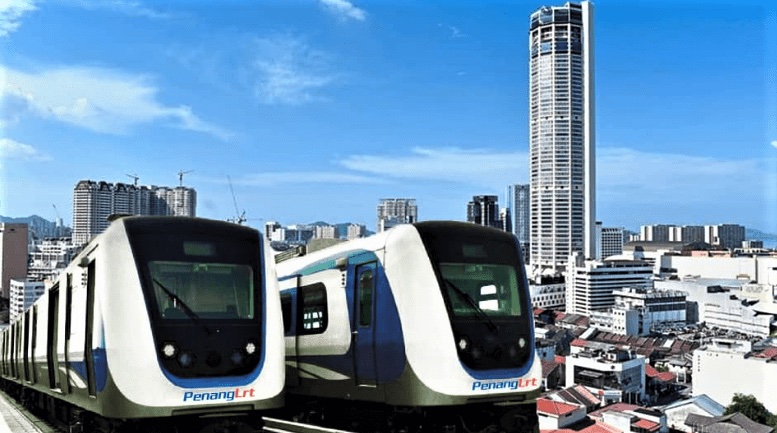
Penang does not need a new wave of condominiums simply because an LRT station is nearby. It needs neighbourhoods that make people want to use the LRT.
That is the difference between building property near transit and building Transit-Oriented Development (TOD).
As station-area planning for the Mutiara Line takes shape, Penang has introduced requirements for developers to provide covered walkways, pedestrian connections, crossings, feeder buses, pick-up and drop-off facilities, and traffic and parking management.
State local government and town and country planning committee chairman Jason H’ng Mooi Lye has also warned developers that TOD should not simply be interpreted as permission for higher density or plot ratios.
A station is infrastructure. TOD is a neighbourhood.
A 40-storey condominium beside an LRT station may be dense. It may even be marketed as transit oriented.
But if residents have to cross a six-lane road, walk beside traffic without shade, navigate poor crossings and eventually get into a car for groceries, schools or other daily needs, the LRT has not fundamentally changed how that neighbourhood works.
It has simply been placed beside a development.
KL shows the problem
Kuala Lumpur provides a useful warning.
The capital has spent decades expanding its rail network and developing around transit.
Its planning framework explicitly promotes a shift away from dependence on private vehicles, with feeder buses and active mobility built into its TOD approach. It identifies a 400-metre pedestrian catchment and an 800-metre cycling catchment around transit.
Yet KL remains a city where walking can be frustrating and disconnected.
That tension matters because TOD is not just about proximity to a station. It is about whether the journey to and from that station is practical.
A station can be 400 metres away on a map and still feel far away if the route involves hostile junctions, broken pedestrian connections, heavy traffic or an exposed walk through Malaysia's heat and rain.
For Penang, the lesson is straightforward. Rail infrastructure does not automatically create a transit-oriented city.
Density can help public transport. More people living and working around a station can create the demand needed to support frequent trains, buses, shops and services.
But density needs an accompanying street environment.
The real measure is whether people can actually walk to the station and continue their daily lives without getting back into a car.
Singapore offers a different reference point
Its current planning approach deliberately links housing with transport, amenities, public spaces and pedestrian connections.
The Urban Redevelopment Authority's plans for Marina South, for example, centre on a 10-minute neighbourhood, with homes, MRT stations, retail and daily amenities connected through pedestrian infrastructure.
The development is planned with more than 10,000 homes, two MRT stations, retail amenities, childcare, public spaces and a weather-protected underground pedestrian connection.
Singapore's wider planning approach also aims to bring more households within a 10-minute walk of train stations while improving walking, cycling and first-and-last-mile connections.
The station is not treated as an isolated piece of infrastructure. The neighbourhood around it is designed around how people move through it.
Penang's own planning conversation is moving in this direction.
A Penang Institute paper on TOD for the Mutiara Line identifies concentrated development around stations, safe walking routes and feeder connections, alongside management of private-vehicle demand.
It also warns that high-rise development surrounded by arterial roads and surface parking can remain functionally car-dependent.
Penang now has the opportunity to apply those principles before station areas become locked into car-dependent development patterns.
The land around the station will become valuable
A future rail station does more than change how people travel.
It changes the economic value of the land around it.
Singapore is currently dealing with a striking example of how valuable advance knowledge about future MRT locations can become.
A September 2026 National Bureau of Economic Research (NBER) working paper found that civil servants purchased private homes near planned but not yet publicly announced MRT stations at higher rates than matched controls, particularly one to two years before announcements.
The researchers estimated 221 excess purchase incidents involving civil servants and people identified as relatives or co-registrants, with a combined gross acquisition value of about S$270 million.
The Singapore case illustrates how quickly a future station can create economic interest in the land around it.
For Penang, that makes planning discipline even more important.
If every station becomes a signal for maximum development intensity, Penang could end up with high-density enclaves without creating the connected urban communities that make public transport genuinely useful.
Measure the LRT outside the station
Penang should judge its TOD by what happens after passengers leave the platform.
Children should be able to walk home safely. Elderly residents should be able to cross roads without navigating hostile junctions. Commuters should be able to reach stations comfortably during heavy rain. Feeder buses should connect surrounding neighbourhoods to the rail network.
Shops, clinics, schools and everyday services should be accessible on foot. Pedestrian routes should be continuous rather than disappearing at major roads.
New developments should be planned so that additional traffic does not undermine the transport investment beside them.
These are not cosmetic features.
They determine whether people actually have a practical reason to leave their cars at home.
Penang's new requirements already recognise many of them, including covered walkways, pedestrian crossings, feeder buses and traffic and parking management.
The challenge is implementation.
Penang does not need to choose between development and public transport. It needs to make them work together.
The success of Penang's LRT will not be measured only by what happens inside its stations. It will be measured by what happens outside them.