
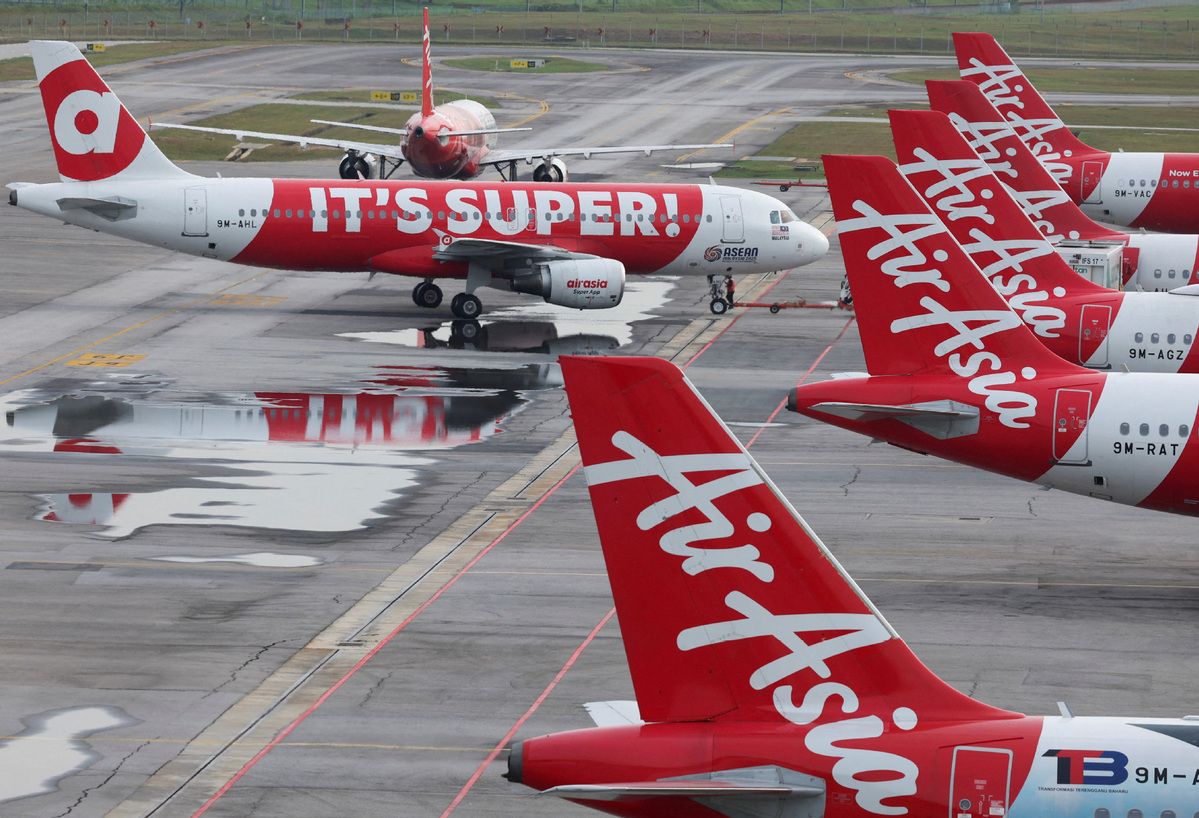
Reuters reported that the Malaysian government had approached Malaysia Airlines and Batik Air to assess whether they could absorb AirAsia’s domestic market share as part of contingency planning while authorities monitored the budget carrier’s financial condition.
Tony Fernandes dismissed the idea that AirAsia could simply be replaced, pointing to its roughly 100 aircraft operating in Malaysia and the network and infrastructure it has built over 25 years.
But financial concerns have intensified, and investors have responded sharply.
On September 17, AirAsia shares plunged 21.1% in a single trading day to 50.5 sen, their lowest closing level since December 2022. The stock has lost more than 70% of its value this year, reflecting growing market concern over its balance sheet and financing requirements.
The pressure is visible in its latest results. AirAsia recorded a RM830.5 million net loss in the second quarter of 2026, including RM331 million in foreign-exchange losses. Its average jet-fuel price reached US$183 per barrel, pushing fuel expenses 58% higher year-on-year.
As of June 30, AirAsia reported RM953.67 million in cash and RM2.27 billion in net debt. The airline has also been returning 25 older aircraft to lessors and reducing underperforming capacity.
Fernandes, however, argues that the picture has improved since June.
Speaking on September 18, he said AirAsia now has more than RM1 billion in cash and remains sustainable, stressing that the airline has not requested a government bailout.
“We are good at managing cash and we are strong in liquidity,” Fernandes said, adding that the current difficulties are far less severe than during Covid-19.
The turbulence marks a remarkable turn for one of Southeast Asia’s greatest aviation growth stories.
In 2001, Fernandes and Kamarudin Meranun acquired struggling AirAsia for a token RM1, assuming around RM40 million in debt.
Relaunched as a low-cost carrier, it transformed regional aviation by bringing cheap flights within reach of millions.
AirAsia carried its 50 millionth passenger in 2008, its 100 millionth in 2010 and surpassed 500 million passengers by 2018.
Then came Covid-19. In 2020, AirAsia operated just 29% of its 2019 capacity. Revenue collapsed 74% to RM3.1 billion, while net losses ballooned to RM5.9 billion.
Passengers eventually returned, but so did aircraft reactivation costs, maintenance obligations, financing requirements and, more recently, sharply higher fuel prices.
AirAsia is now trying to strengthen its finances while preserving the network that made it one of Asia’s biggest low-cost carriers. It is seeking up to US$1 billion from international debt markets and RM700 million in local credit facilities, mainly for refinancing and balance-sheet consolidation. About US$300 million was raised in March.
Fernandes says demand remains strong despite higher fares, and AirAsia generated RM5.1 billion in second-quarter revenue even after reducing capacity by 11%.
Twenty-five years ago, AirAsia turned a RM1 acquisition and RM40 million of debt into an airline that changed how Southeast Asia travels.
Today, its aircraft are still flying and passengers are still filling seats. Fernandes says there is more than RM1 billion in cash and no bailout is needed. The market, judging by the share-price slump, remains cautious.
Which of those signals ultimately defines AirAsia’s next chapter will depend on whether passenger demand can translate into the cash flow needed to strengthen its balance sheet and finance its future.