
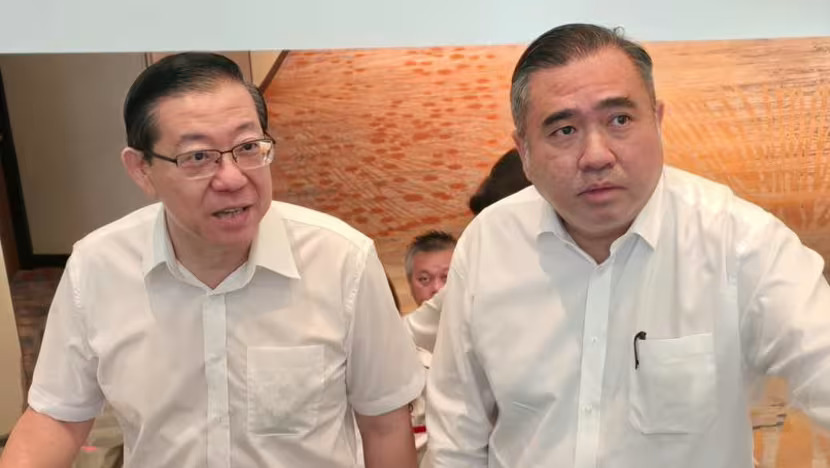
Penang has more than RM21 billion worth of approved transport infrastructure projects linked to Anthony Loke’s tenure as Transport Minister, with DAP Air Putih assemblyman Lim Guan Eng crediting Loke for securing federal approval for the investments.
Lim described Loke’s impending departure from the federal Cabinet as a significant loss for Penang, pointing to the RM16.8 billion Mutiara Line Light Rail Transit (LRT), RM1.55 billion expansion of Penang International Airport (PIA), RM30 million for KTM station upgrades, RM2.2 billion for Penang Port and RM500 million for the Swettenham Pier Cruise Terminal.
Lim also described Loke as possibly the most effective transport minister for Penang compared with previous MCA ministers who held the federal portfolio.
A long-awaited LRT
The Mutiara Line is the largest of the projects and is set to become Penang’s first LRT system.
The 29.67km line is currently under construction and will connect key areas including Komtar, Bayan Lepas and Penang International Airport, with a cross-sea connection linking Penang Island to Penang Sentral on the mainland.
The RM16.8 billion project is targeted to begin operations in December 2031. Overall construction progress reached 8.99% as of June, with the Transport Ministry saying the project remained on schedule.
The project follows decades of proposals for an urban rail system in Penang. In March 2024, the federal government officially took over the project from the Penang state government, appointing MRT Corp as its developer and asset owner. Loke said the federal takeover followed Cabinet approval for the project.
The Mutiara Line will provide connections between the island and mainland while integrating with existing KTM and ETS services at Penang Sentral.
The project is also expected to improve public transport connectivity and reduce traffic congestion, with the Transport Ministry estimating it could benefit more than 1.8 million residents in Penang as well as commuters from neighbouring states.
Expanding Penang’s transport capacity
The RM1.55 billion expansion of Penang International Airport is another major federal transport investment in the state.
The expansion is intended to increase the airport’s passenger-handling capacity and strengthen its role as a major aviation gateway for the northern region.
On the mainland, RM30 million has been allocated to upgrade Butterworth KTM Station and strengthen Penang Sentral as an integrated public transport hub.
The upgrade is intended to integrate KTM, ETS and Komuter services with the Penang ferry and the future Mutiara Line LRT.
The wider package also includes RM2.2 billion for Penang Port and RM500 million for the Swettenham Pier Cruise Terminal, according to Lim’s breakdown of the infrastructure investments.
Together, the projects span rail, aviation and maritime infrastructure across Penang Island and Seberang Perai.
The RM21 billion figure, however, represents approved infrastructure projects rather than completed infrastructure.
The Mutiara Line, for example, remains under construction and is not expected to begin operations until 2031. Its eventual impact will depend on the project’s completion and performance once operational.
The projects also involve multiple federal agencies, state authorities and other parties, meaning the overall investment cannot be attributed solely to one minister.
Loke’s role has nevertheless been significant in advancing the projects through the federal Transport Ministry during his tenure.
A national transport portfolio
Loke’s record extends well beyond Penang.
As Transport Minister, he has overseen a national portfolio covering rail, aviation, maritime infrastructure and public transport.
One of the largest projects in the national transport agenda is the East Coast Rail Link (ECRL).
The 665km railway had reached 92.62% construction progress as of February 2026, with the Kota Bharu-Gombak section scheduled to begin commercial operations in January 2027. The Gombak-Port Klang section is targeted for completion by December 2027, with full operations expected from January 2028.
The project is intended to strengthen rail connectivity between Malaysia’s East Coast and West Coast, including connections to Port Klang.
The Transport Ministry has also continued the upgrading and rehabilitation of existing railway infrastructure, alongside efforts to strengthen rail and public transport connectivity nationwide.
In aviation, Loke has overseen airport expansion and upgrading projects outside the Klang Valley, while his ministry has also pursued digitalisation across transport-related government services.
His portfolio has also covered Malaysia’s maritime infrastructure, including efforts to expand port capacity and strengthen the country’s position as a regional maritime hub.
Loke previously served as Transport Minister from 2018 to 2020 before returning to the portfolio in 2022.
What happens to the projects?
Loke offered to resign as Transport Minister on September 19 following the conditional pardon granted to former prime minister Najib Razak.
He remains DAP secretary-general and Seremban MP, while other DAP ministers and deputy ministers are staying in the unity government.
Prime Minister Anwar Ibrahim has said he had not received Loke’s formal resignation letter and would meet him before deciding on the matter.
The Transport Ministry has also said its affairs and responsibilities will continue to be carried out as usual while Loke proceeds with his scheduled official programme in China before returning to Malaysia to handle the resignation process.
Regardless of whether Loke ultimately leaves the Cabinet, the infrastructure projects advanced during his tenure will continue beyond his time in office.
For Penang, the Mutiara Line, airport expansion, Butterworth rail upgrade and investments in port and cruise infrastructure represent a substantial expansion of the state’s transport infrastructure.
At the national level, the ECRL and wider rail, aviation and maritime developments form part of a broader record spanning multiple sectors.
The projects will ultimately outlast the minister who helped advance them. Their completion and performance will determine the longer-term significance of Loke’s tenure at the Transport Ministry.