
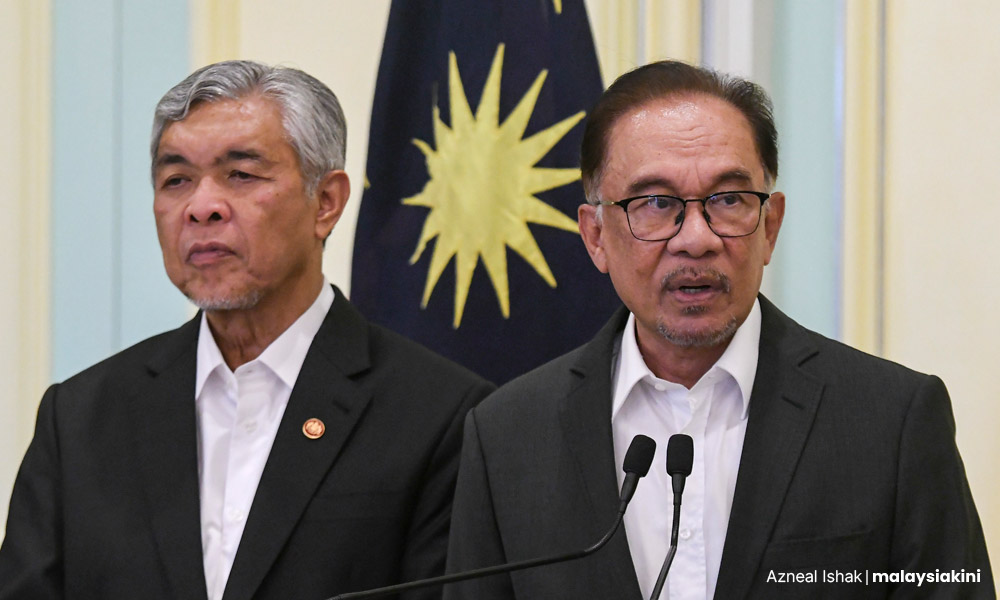
At the 2026 UMNO General Assembly, Datuk Seri Ahmad Zahid Hamidi did something he has not done in years. He attacked the Prime Minister — not by name, but by proxy.
“Enough is enough, guru,” he said, borrowing a viral TikTok catchphrase to criticise the government’s handling of the Budi95 petrol subsidy programme. “Listen to our voices, guru. We can do better than what the guru has done”. He cited the government’s reversal on the subsidised fuel quota — cut from 300 litres to 200 in April, restored to 300 on September 1 — as proof of policy indecision.
Anwar responded from New Delhi, where he was attending the 18th BRICS Leaders’ Summit. In a Facebook post, he referred to himself as the “guru” and said his “students” should learn how Madani diplomacy is put into practice. He signed off with “Slayyy” and a nail-polish emoji — the same Gen Z language Zahid had deployed at the assembly.
Then Zahid fired back again. “I was never his student,” he said during his winding-up speech. “A smart student does not need a teacher”.
The “guru and student” language that once described their relationship — a leaked 2021 phone call in which Zahid addressed Anwar as “cikgu” — is now a weapon. Zahid is using it to signal distance. Anwar is using it to signal condescension.
But the performance should not be mistaken for a rupture.
What the Rhetoric Actually Signals
Zahid’s escalation is not random. He is managing a base that has grown restless with the Unity Government. UMNO’s grassroots — particularly its Malay-Muslim core — have watched BN cooperate with DAP at the federal level while competing against PH in state elections.
Zahid needs to show UMNO’s base that he is not Anwar’s subordinate. He needs to demonstrate that UMNO has its own identity, its own agenda, its own voice. Calling the Prime Minister “guru” and then denying he ever learned from him is a way of performing independence without actually leaving the government.
Anwar, for his part, is performing confidence. By embracing the “guru” label from the international stage, he is signalling that Zahid’s jabs do not rattle him. He is also subtly reminding UMNO that it is the junior partner in this arrangement — that the Prime Minister’s office is not up for negotiation through party assembly theatrics.
The rhetoric has changed. The structural reality has not.
Why Neither Side Walks Away
BN has said repeatedly that it will remain in the Unity Government until the end of the term. Zahid himself reaffirmed this commitment on September 12, stating that UMNO would not challenge Anwar’s position and that the party’s resolution to stay must be respected.
The reason is straightforward. Leaving the government means giving up ministerial positions, access to resources, and the ability to shape policy from within. It means answering the question that UMNO has no good answer to: where does BN go next?
The obvious possibility is PAS and PN. BN and PN cooperated effectively in the Negeri Sembilan state election, where a disciplined seat-sharing arrangement — BN contesting 25 seats, PN fielding 11 — prevented a split in the Malay vote and delivered a decisive victory. That model could be replicated. But cooperation is not the same as a long-term alliance.
The moment seats, ministries, and leadership positions are negotiated, the fundamental question emerges: who leads? Would UMNO — a party that once dominated Malaysian politics — accept becoming Number Two in a Malay alliance where PAS has grown increasingly powerful? That is a question Zahid has not answered, and may not be able to.
Anwar, meanwhile, has time. GE16 is not due until 2028. If he chooses not to call an early election, he can use the remainder of the term to deliver reforms, improve governance, and rebuild public confidence. PH also has its own work to do: PKR needs internal consolidation, DAP must retain its voter base, and Amanah still lacks strong political momentum.
The Melaka Test
BN holds 21 of the state’s 28 seats, and Zahid has said the coalition will defend all of them. He has also said BN will not enter a pact with PN “blindly,” and that grassroots sentiment — which he describes as “mixed” — will dictate whether the coalition cooperates with outside parties.
The grassroots pressure is real. Analysts have noted that growing pressure from BN’s base to work with PN will become harder for the leadership to ignore, especially after the Negeri Sembilan results strengthened the case for continued BN-PN cooperation. Anti-DAP sentiment remains strong among UMNO members, and the Malay-Islam narrative still holds sway in rural constituencies.
Melaka is not Negeri Sembilan. It is a smaller, more predictable state where BN has historically dominated. But the same contradiction applies: BN cannot simultaneously campaign against PH in state elections and govern with PH in Putrajaya without eventually facing questions from voters about what it actually stands for.
Zahid has delegated the final decision on Melaka alliances to Chief Minister Ab Rauf Yusoh, who has been given full authority to negotiate with any coalition. That is a way of buying time. It is also a way of avoiding responsibility if things go wrong.
The GE16 Calculation
Zahid has called for the election to be held “immediately,” describing it as UMNO’s decisive moment to reclaim the mandate to lead. Anwar has said proposals for an early election “can be considered,” but that the government remains focused on the economy, public wellbeing, and fighting corruption.
The tension between those positions is not accidental. Zahid wants an election while UMNO’s momentum is strong. Anwar wants an election on his own terms, after delivering the reforms that will define his legacy — institutional changes like the prime minister’s term limit and the separation of the Attorney-General and Public Prosecutor, both of which require UMNO’s votes to pass.
If Anwar calls an early election before those reforms are delivered, he risks going to the polls with nothing to show for his time in power except promises. If he waits too long, he risks facing voters on worse terms — with a stronger BN, a more united opposition, and a public that has grown impatient.
Zahid, meanwhile, does not only have to decide whether UMNO can do better without Anwar. If UMNO leaves the Unity Government, who does it walk with — and who leads that partnership? That is a question with no comfortable answer.
The End Of The Marriage?
The “guru and student” era is over. Zahid has made that clear. But the end of the metaphor does not mean the end of the marriage.
BN talking to PAS does not automatically mean a new alliance. Anwar losing patience with Zahid does not automatically mean a divorce. The two men are bound together by arithmetic, not affection. They need each other — for now.
The rhetoric will continue to escalate. The theatrics will continue to entertain. But the partnership will hold until one side calculates that the cost of staying exceeds the cost of leaving.
That calculation has not yet been made. And until it is, Malaysia’s political leadership will remain what it has been for the past three years: a marriage of convenience, conducted in public, with both partners performing for their own audiences.