
The Rukun Negara is recited in schools, printed on posters, and invoked at every national celebration. Its second principle is “Loyalty to King and Country.” Its third is “Supremacy of the Constitution.”
In Negeri Sembilan, UMNO and BN have violated both. Not through negligence. Not through misunderstanding. Through deliberate, calculated action designed to remove a sitting Yang di-Pertuan Besar from his throne.
If this is not treason, what is?
The Act Itself
On September 15, the Negeri Sembilan state executive council led by Menteri Besar Datuk Ismail Lasim unanimously resolved to endorse a proclamation purportedly removing Tuanku Muhriz Tuanku Munawir as Yang di-Pertuan Besar. Ismail confirmed the decision and instructed the state secretary to proceed with gazettement.
The proclamation was dated April 19. It had already been ruled invalid by the Dewan Keadilan dan Undang (DKU), the state’s highest customary and constitutional authority on royal succession matters. The DKU had declared that no inquiry under Article X(1) of the Negeri Sembilan Constitution had been conducted, that three of the four signatories did not hold the office of Undang at the time, and that the proclamation was defective from the outset.
The Attorney-General’s Chambers went further. On September 17, the AGC declared the proclamation invalid for failing to comply with the mandatory requirements of Article 10 of the state constitution, and stated that the Menteri Besar and the state executive council had no unilateral power to terminate or vacate the position of the Yang di-Pertuan Besar.
This was not a gray area. It was not a matter of legal interpretation. It was a clear, unambiguous constitutional violation — committed by the very people who swore an oath to uphold the constitution.
The Oath They Broke
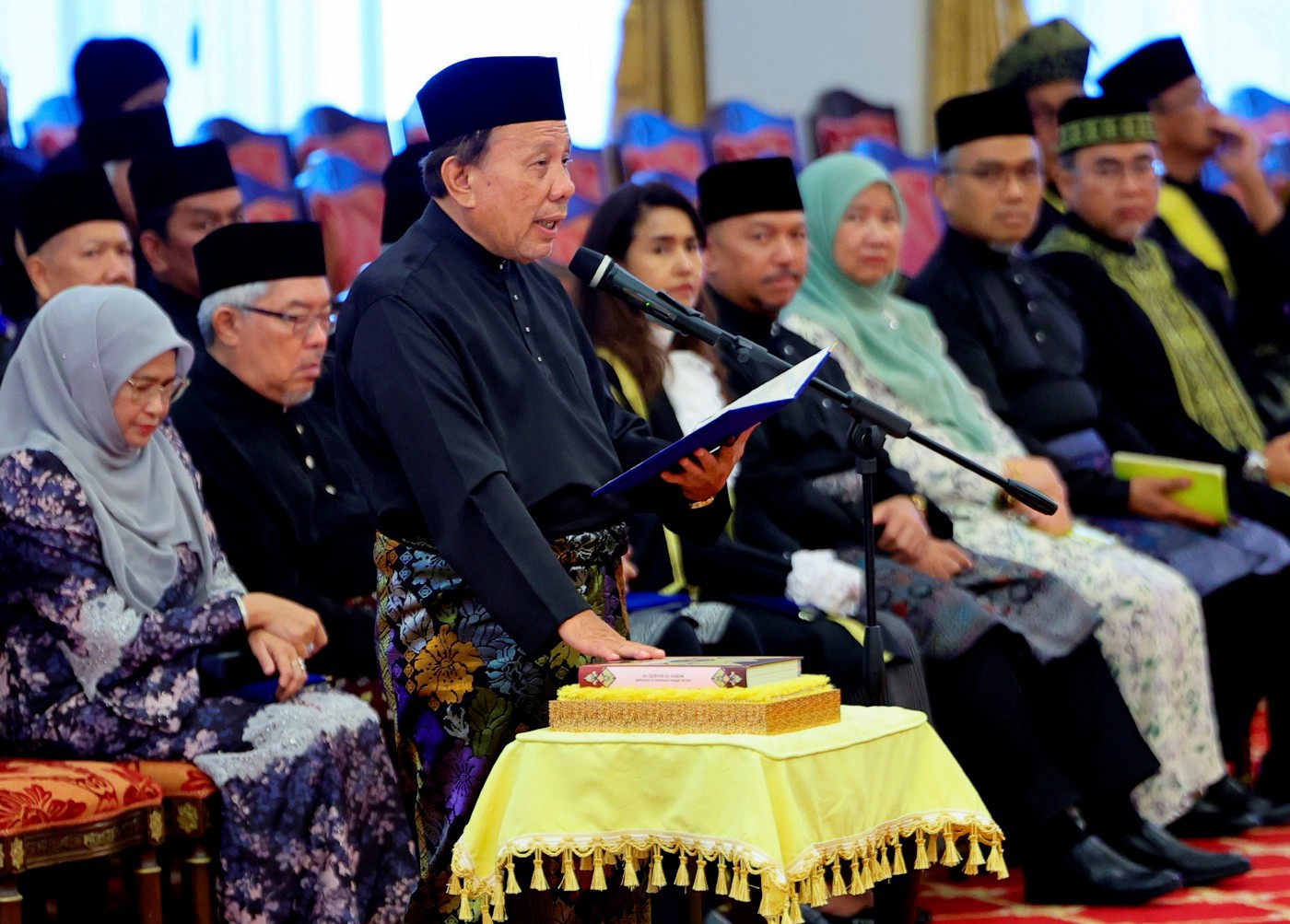
On August 7, the executive council members took and signed an oath and pledge of allegiance before the Yang di-Pertuan Besar prior to their appointment. They pledged allegiance to the Ruler and the Royal Institution. They undertook to protect and preserve the sovereignty of the state constitution. They acknowledged the authority vested in the Dewan Keadilan dan Undang.
Less than six weeks later, they breached that oath.
On September 20, Tuanku Muhriz revoked their appointments with immediate effect, finding that they had violated their oath of office. The royal statement noted that the members had “breached that oath by their actions and statements on September 15”.
This is the definition of derhaka — treachery against the throne. It is the betrayal of a sacred trust, committed by individuals who had just knelt before the very Ruler they sought to depose.
The Rukun Negara They Trample
The Rukun Negara was introduced in 1970 in the aftermath of racial riots. Its purpose was to forge national unity and loyalty to the constitutional order. The principle of “Loyalty to King and Country” is explicit: every citizen must be faithful and bear true allegiance to His Majesty and to the country.
UMNO and BN have spent decades positioning themselves as the defenders of this principle. They have accused their opponents of being disloyal. They have invoked the monarchy when it suited their political agenda. They have lectured Malaysians about respect for institutions.
But when a state executive council they control attempts to remove a sitting Ruler, where is their outrage? Where is the party that claims to be the guardian of Malay rights and royal institutions?
There is none. Because the Rukun Negara, for UMNO and BN, has never been a principle. It has been a weapon — to be wielded against opponents, and to be abandoned when it constrains their own ambitions.
The Silence That Speaks Volumes
Prime Minister Anwar Ibrahim has condemned the action. He warned that the royal institution would fail if rulers could be “changed by the month” and that politicians who “make a lot of noise about the Malay Rulers” but then seek to remove one when a decision does not go their way cannot be accepted.
Anthony Loke, DAP secretary-general, has called on the executive council members who no longer recognise Tuanku Muhriz to resign.
But from UMNO’s national leadership? From BN’s central command? From the party that claims to be the custodian of Malay tradition?
Silence.
The same party that launched a solidarity fund to pay Najib Razak’s corruption fine, invoking loyalty and justice, has nothing to say when its own state government commits derhaka. The same party that demands respect for the monarchy in its speeches has no words of condemnation when the monarchy is attacked by its own members.
Treason by Any Other Name
The chairman of Tuanku Muhriz’s loyalist secretariat, Datuk Seri Megat, has described the executive council’s actions as “treason” and not merely in a political sense. He noted that from an Islamic perspective, it constitutes a grave sin, and from a legal perspective, it is a very serious offence. He called for those responsible to resign and face legal action, including arrest and imprisonment if the law demands it.
Under Sections 121 and 121A of the Penal Code, offences against the sovereignty of a Ruler carry heavy statutory penalties, including life imprisonment. Combined with the Sedition Act, threatening a Malay Ruler is no small matter.
Is this what UMNO and BN have come to? A party that once claimed to be the guardian of Malay political tradition now stands by while its own members attempt to depose a Ruler? A party that lectures others about loyalty while its state executive council breaches its oath of allegiance?
The Question That Demands an Answer
UMNO and BN have not condemned this action. They have not distanced themselves from it. They have not called for accountability.
Their silence is complicity.
If the Rukun Negara means anything, if “Loyalty to King and Country” is more than a slogan to be recited in schools — then the events in Negeri Sembilan demand a reckoning. Those who breached their oath must face consequences. Those who stood by must explain why.
Because if a state executive council can attempt to remove a Ruler and face no political cost from its own party, then the Rukun Negara is not a foundation for national unity. It is a prop for political theatre. And those who use it only when it benefits them are not patriots. They are opportunists.