
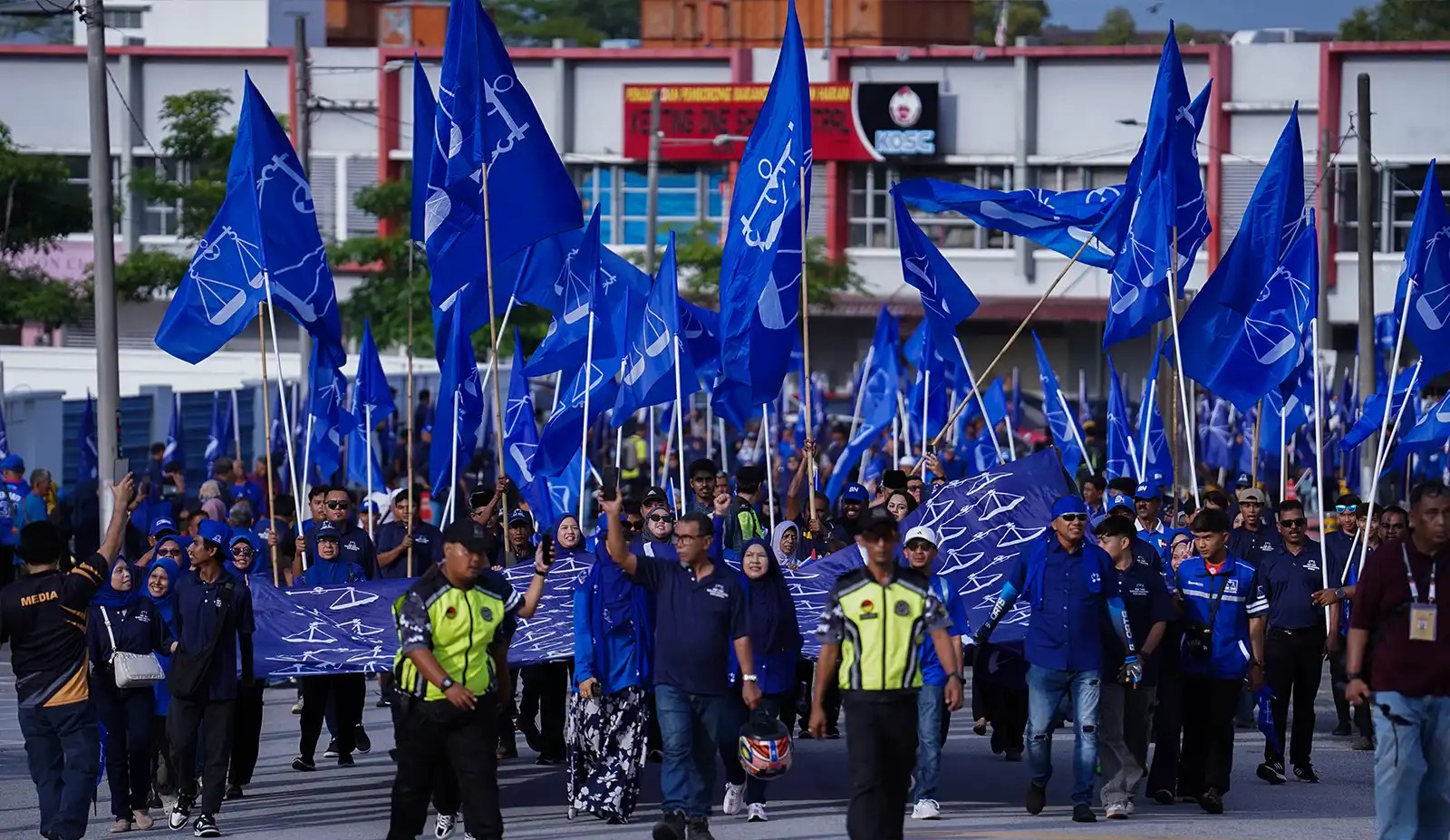
The Melaka state assembly was dissolved on September 23, triggering the 16th state election within 60 days. In 2021, Barisan Nasional won 21 of 28 seats, Pakatan Harapan took five, and Perikatan Nasional secured two. The result looked decisive then. The campaign ahead looks considerably messier.
No party is entering this contest from a position of comfort. Each is managing internal contradictions, shifting alliances, and voter bases that are harder to read than the seat arithmetic suggests.
BN's PR Crisis
Barisan Nasional should be the clear favourite. It holds 21 seats. It has governed Melaka for most of the state's history. Its machinery is embedded in every constituency.
But BN is fighting a two-front political war, and both fronts are bleeding.
The first is Negeri Sembilan. The state's Menteri Besar, Datuk Ismail Lasim, signed a proclamation purportedly removing Tuanku Muhriz Tuanku Munawir as Yang di-Pertuan Besar, reversed himself, then confirmed the executive council had endorsed the removal. Analysts say the crisis could be used by opponents to question BN's political stability, though its impact may vary across Melaka's constituencies. The issue is particularly sensitive because it touches on loyalty to the monarchy — a core principle of the Rukun Negara.
The second is grassroots unease over BN's cooperation with PN. Zahid Hamidi has acknowledged that sentiment within the party is "mixed" and that a detailed study is needed before any alliance is confirmed. He has also said BN will not enter a pact with PN "blindly". That is not the language of a coalition confident in its direction. It is the language of a coalition managing internal dissent.
The good news for BN is that analysts believe the Negeri Sembilan turmoil is unlikely to have a major impact on its Melaka prospects, as the political circumstances in the two states are different. The bad news is that the grassroots unease is real, and it will not disappear simply because the campaign begins.
PAS's Squeeze
PAS is caught between ambition and rejection.
Akmal Saleh, the UMNO Youth chief and Merlimau assemblyman, has openly called for BN-PAS cooperation in Melaka, describing the state as a "test" of whether penyatuan ummah can be translated from rhetoric into electoral strategy. PAS leaders have welcomed the call. PAS president Hadi Awang has claimed that most of BN's grassroots support cooperation with PN.
But the response from UMNO's establishment has been cooler. Tok Mat, the party's deputy president, declared at the general assembly that UMNO will "forever be centrist" and that anyone working with the party must accept its moderate approach. The message was aimed at non-Malays and the Borneo states, but it was also a signal to PAS: do not expect UMNO to adopt your ideological framing.
The practical outcome is that PAS may end up with a seat-sharing arrangement without the political narrative it wanted. Reports suggest PAS intends to contest 16 of Melaka's 28 seats, including Tanjung Bidara, held by caretaker Chief Minister Ab Rauf Yusoh. That is an ambitious claim for a party that won zero seats in 2021. If BN concedes too much, its own base will revolt. If it concedes too little, PAS may walk away — or run against BN and split the Malay vote.
The Bridge Nobody Is Using
Parti Wawasan Negara was built to be the bridge between UMNO and PAS. Its president, Hamzah Zainudin, positioned it as the middle path — a party that could speak to both sides, facilitate cooperation, and claim credit for the resulting unity.
That strategy has been overtaken by events. BN and PAS are now negotiating directly. Tok Mat's speech at the UMNO general assembly was a signal that UMNO wants a direct relationship with PAS, without intermediaries. And Hamzah was not invited to the assembly at all — not to the speeches, not to the closed-door sessions, not even to the sidelines.
The message could not be clearer. Why bring Hamzah when you can talk to PAS directly?
In Negeri Sembilan, the party won three of the four seats it contested — an impressive debut for a party that had been registered just seven weeks before the election. But those victories were achieved under the PN banner, with PAS and Bersatu machinery supporting them. In Melaka, Wawasan will have to prove that its brand has independent value, not just borrowed momentum.
If BN and PAS become increasingly comfortable negotiating directly, Wawasan has to prove it is not just an intermediary — but a party with real electoral value. That is a difficult argument to make when the two parties you were supposed to connect have already started talking without you.
Bersatu's Sidelined Position
If Wawasan is being squeezed out of the middle, Bersatu is being squeezed out of the coalition entirely.
The party that once helped build Perikatan Nasional is now being treated as an inconvenience. In June, PAS formally ended its political cooperation with Bersatu. In July, Bersatu announced it would contest the Negeri Sembilan election using its own logo — not the PN banner — after being excluded from seat negotiations and left out of the PN Supreme Council meeting that finalised allocations.
Wawasan, meanwhile, has taken Bersatu's place. It has been accepted as a PN component. It participated directly in the Negeri Sembilan arrangement. Its rise is the clearest indication that PN has moved on.
For Melaka, the implications are straightforward. Bersatu is unlikely to be a significant factor. Wawasan will contest some seats, but its role is unclear. And the real contest will be fought between BN, PAS, PH, and whatever space Bersama manages to carve out for itself.
PH's Uphill Climb
Pakatan Harapan is contesting in BN's heartland. That is the simplest way to describe the challenge.
In 2021, PH won five seats. DAP retained four of its eight, many with thumping majorities, while Amanah held a single seat. PKR won nothing. That is not a strong base from which to expand.
The seat arithmetic is unforgiving. DAP is expected to hold Ayer Keroh, Bandar Hilir, Kota Laksamana, and Kesidang. Amanah has a 1,057-vote majority in Bukit Katil, which UMNO and PAS will fight hard for. PKR has no seats and few obvious paths to winning any. The Sungai Udang seat, won by Bersatu in 2021 with a 530-vote majority, is likely to fall to either UMNO or PAS.
PH has completed its internal seat distribution — Amanah allocated eight seats, with PKR and DAP taking the rest — but it has not finalised any arrangement with BN. PH election director Amirudin Shari has said the coalition is prepared to go solo if BN does not want to cooperate, and has questioned BN's shifting signals.
The internal challenge for PH is that its base is not naturally loyal. Many PH voters are swing voters — people who voted for the coalition as an alternative, not out of deep party allegiance. In a state where BN has governed for most of its history, and where Akmal Saleh's brand of confrontational politics has deep resonance, those voters may drift away or stay home.
Bersama's Long Game
Bersama is the newest variable in the equation. The party, led by Rafizi Ramli and Nik Nazmi Nik Ahmad, announced 15 candidates for Melaka in August — before the assembly was even dissolved.
The candidate list includes Dr Muhamad Solehin Saleh, the elder brother of Akmal Saleh, in the Bemban seat. That is not a coincidence. It is a deliberate provocation — pitting brother against brother in a constituency that carries symbolic weight for UMNO.
Rafizi has positioned Bersama as a "third force" that appeals to voters disillusioned with both BN and PH. The party is targeting up to 15 percent voter support in Melaka as a stepping stone towards 20 percent national support in GE16. Whether that strategy translates into seats remains to be seen. But Bersama's presence adds another layer of fragmentation to a contest that already has too many variables.
Who Has It Easiest?
No one.
BN has the seats, the machinery, and the incumbency advantage — but it is managing a royal crisis in one state and grassroots unease about its alliance strategy. PAS wants Malay unity but is being told to stay in its lane. PH is fighting in hostile territory with a fragile voter base. Bersama is building for the future while risking irrelevance in the present.
The election will be decided by turnout, local dynamics, and the ability of each coalition to manage its contradictions without letting them become the story. The usual rules do not apply. And the only certainty is that no one is entering this fight with the luxury of confidence.