
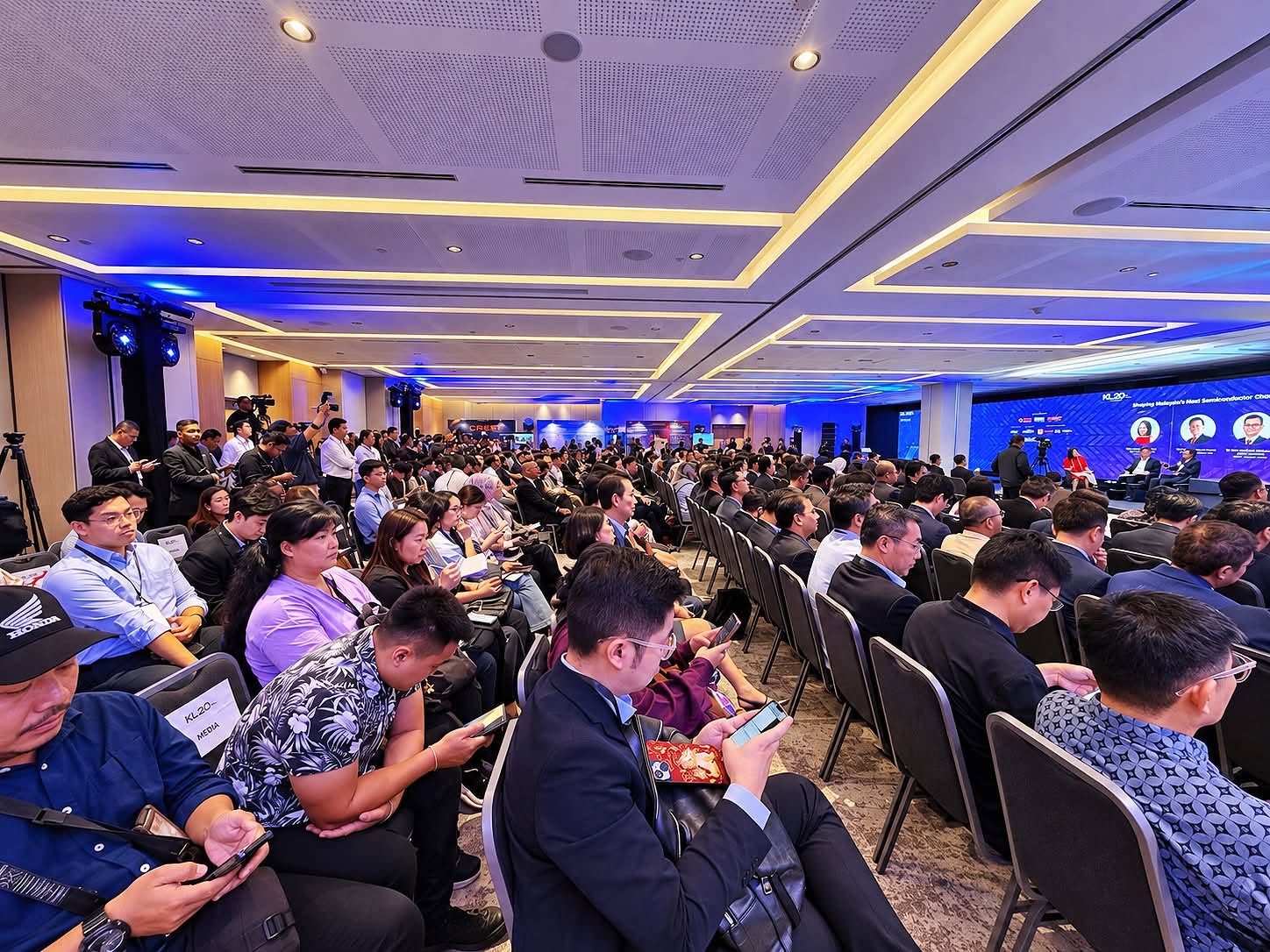
KL20 @ Penang 2026 took place today at the Penang Waterfront Convention Centre, bringing together the stakeholders who will determine whether Malaysia's semiconductor ambitions move beyond manufacturing and into ownership.
It convenes IC-design houses, advanced-packaging startups, deep-tech founders, semiconductor equipment companies, AI and chip technology firms, venture capital, institutional investors, and major industry players. It is not a general technology conference. It is a targeted effort to connect the people who build semiconductor companies with the people who fund them.
The Ownership Question
Penang has already demonstrated that it can build an extraordinary semiconductor manufacturing ecosystem. For fifty years, the state has been the backbone of Malaysia's electrical and electronics sector. Intel, AMD, Broadcom, and countless others have built facilities, hired thousands, and exported billions.
But the question for the next generation is different. Who owns the intellectual property?
If a foreign semiconductor company builds a RM5 billion facility in Penang, that is valuable. It creates jobs, procurement opportunities, and exports. It supports local suppliers and service providers. It trains Malaysian engineers in world-class processes.
But if a Malaysian engineer builds an IC-design company that becomes worth RM5 billion, Malaysia captures something additional: equity, intellectual property, headquarters functions, high-level engineering decisions, and potentially an entire Malaysian-owned global supply chain.
That is how economies move from industrial hosts to technology owners. That is what KL20 @ Penang is designed to accelerate.
What Penang Already Has
The foundation is already in place. Penang is home to more than 350 multinational companies and over 3,000 local SMEs in the E&E sector. It accounts for about 5 percent of global semiconductor exports. The state hosts a growing number of IC-design firms, advanced packaging companies, and equipment manufacturers.
The Penang Skills Development Centre has trained thousands of engineers over decades. The state's universities and technical institutes produce a steady stream of talent. And the local supply chain — built over five decades — has the depth and sophistication to support complex semiconductor operations.
What Penang has lacked is the financial infrastructure to convert manufacturing expertise into owned technology. That is what KL20 is trying to address.
The Funding Gap
Malaysia has not historically been a venture capital hub. The country's tech ecosystem has lagged behind Singapore, Indonesia, and Vietnam in attracting institutional investment. Startups often struggle to raise early-stage funding, and those that succeed frequently relocate to Singapore or the United States to access larger markets and deeper capital pools.
KL20 @ Penang is designed to change that. By bringing venture capital and institutional investors into direct contact with deep-tech founders, the programme aims to create the connections that turn promising companies into funded companies. It is not enough to have good ideas. Someone has to pay for them.
The government has taken steps in this direction. The KL20 initiative, launched in 2024, aims to position Kuala Lumpur as a top-20 global startup ecosystem by 2030. The Penang edition extends that ambition to the semiconductor sector, where Malaysia has a genuine competitive advantage.
Why This Matters for Penang
Penang's economic identity has been defined by manufacturing for half a century. That has been a source of strength. But it has also been a limitation. Manufacturing creates jobs. Ownership creates wealth. Manufacturing generates wages. Ownership generates equity. Manufacturing produces goods. Ownership produces intellectual property.
The shift from one to the other is not automatic. It requires deliberate effort, targeted investment, and a supportive ecosystem. It requires engineers who want to become founders, and founders who can access capital. It requires a culture that celebrates risk-taking as much as it celebrates employment.
KL20 @ Penang is a step in that direction. It connects the people who have technical expertise with the people who have capital. It signals that Penang's future is not just about building more factories. It is about building companies.
The Next Fifty Years
Penang has spent fifty years making chips. The next fifty should be about owning the technology.
That is not a rejection of manufacturing. It is a recognition that manufacturing alone is not enough. The value chain extends far beyond the factory floor. Design, intellectual property, brand, and headquarters functions are where the highest returns are captured.
Malaysia has the talent. It has the infrastructure. It has the track record. What it needs now is the capital and the culture to turn its engineers into entrepreneurs and its manufacturing base into an ownership base.
KL20 @ Penang is not the answer by itself. But it is the right conversation. And if it leads to even a handful of Malaysian-founded semiconductor companies reaching global scale, it will have been worth it.
The chips are already being made. The question is who will own them.