
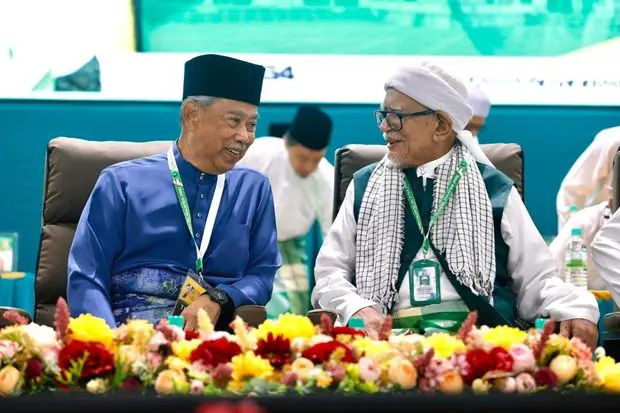
The Registrar of Societies (ROS) has ordered Perikatan Nasional to temporarily cease using its name and logo, following a complaint from Parti Pribumi Bersatu Malaysia.
The decision effectively freezes the coalition's operations until it resolves an internal dispute over its leadership and composition. For PAS, which has spent the past year consolidating control over PN, the order is more than a procedural setback.
The Car and the Driver
The easiest way to understand what has happened to PN is to think of it as a car.
The car was built by Muhyiddin Yassin. When he founded Perikatan Nasional in 2020, Bersatu was the engine. PAS was brought in as a passenger. Gerakan and the Indian party were added later, filling out the seats. Muhyiddin drove. PAS rode along.
But PAS was never content to be a passenger. It had more parliamentary seats than Bersatu. It had stronger grassroots machinery. It had a more committed base. The arithmetic did not match the seating arrangement, and PAS knew it.
The opportunity came when Hamzah Zainudin — Muhyiddin's own deputy — broke ranks. In February 2026, Bersatu expelled Hamzah, accusing him of attempting to unseat the party president. He formed Parti Wawasan Negara. PAS seized the moment.
By June, PAS had formally taken over PN. Ahmad Samsuri Mokhtar — the Terengganu Menteri Besar and a PAS leader — was confirmed as PN chairman. Bersatu's representation on the PN Supreme Council was reduced from six to four. PAS now held eight positions. The driver's seat had changed hands.
The OEM Problem
The car's original parts — Bersatu's machinery, its identity, its founding vision — were replaced with substitutes. Wawasan was brought in to fill the space Bersatu once occupied. PAS kept the PN branding, kept the name, kept the logo. But the vehicle underneath was no longer the original.
It was, in effect, a car built from OEM parts — substitute components assembled under the same badge. It looks like a PN car. It sounds like a PN car. But it is not the PN that was originally manufactured.
PAS did not simply take over the coalition. It hollowed it out. Bersatu remains nominally a member, but it has no role. It was excluded from the PN Supreme Council meeting that finalised seat allocations for the Negeri Sembilan election. It was forced to contest under its own logo because it could not use the PN banner. It fielded 24 candidates and won nothing, losing deposits in 23 of them. The party that helped build PN has been reduced to a political footnote.
Bersatu's complaint to the ROS was inevitable. The ROS's response — suspending the use of PN's name and logo — was a direct slap to PAS. The registry is not saying PN is illegal. It is saying that until the internal dispute is resolved, the coalition cannot market itself under the PN brand.
The Melaka Implications
Melaka's state assembly was dissolved on September 23. Nominations are expected in late October.
If the ROS suspension is not lifted by then, PN cannot field candidates under its own banner. PAS, Wawasan, Gerakan and the Indian party would have to contest individually — running under their own logos, without the coalition framework that gives them integration.
In Negeri Sembilan, the BN-PN seat-sharing arrangement worked precisely because PN could function as a single entity. BN contested 25 seats, PN fielded 11 — five through PAS, four through Wawasan. The arrangement prevented a split in the Malay vote and delivered a decisive victory.
Without PN, that coordination becomes harder. PAS would have to negotiate directly with BN, seat by seat, without the coalition structure that gives it collective bargaining power. Wawasan would have to fend for itself. Gerakan would have to decide whether to contest independently or sit out.
What PAS Miscalculated
PAS believed it could take over PN without consequence. It believed that because it had the seats and the grassroots machinery, it could simply replace Bersatu and carry on as if nothing had changed.
What it underestimated was the institutional weight of the coalition's founding. PN was not created by PAS. It was created by Muhyiddin and Bersatu. The name, the logo, the registration — these belong to the original entity. PAS may have taken control of the leadership, but it did not take ownership of the brand.
That distinction may seem technical. But in Malaysian politics, where coalition branding matters for voter recognition and party machinery, technicalities have consequences. PAS tried to use PN as a vehicle for its own ambitions. Now the vehicle has been impounded, and PAS is stranded.
What Comes Next
The ROS suspension is temporary. PN is not deregistered. The dispute can be resolved, and the branding restored.
But the episode has exposed something deeper: PAS's control over PN is not as secure as it appears. It rests on a technicality — a takeover that changed the leadership without changing the name. Bersatu's complaint was not frivolous. It was a direct challenge to the legitimacy of what PAS had done.
For now, PAS remains the dominant force in PN. It has the seats, the machinery, and the leadership positions. It has Wawasan as a substitute partner and Bersatu as a sidelined member.
But it is driving a car it does not own, with parts that do not fit as well as the originals, under a badge it may not be allowed to use. The road ahead — Melaka, then GE16 — will test whether the vehicle holds together.