
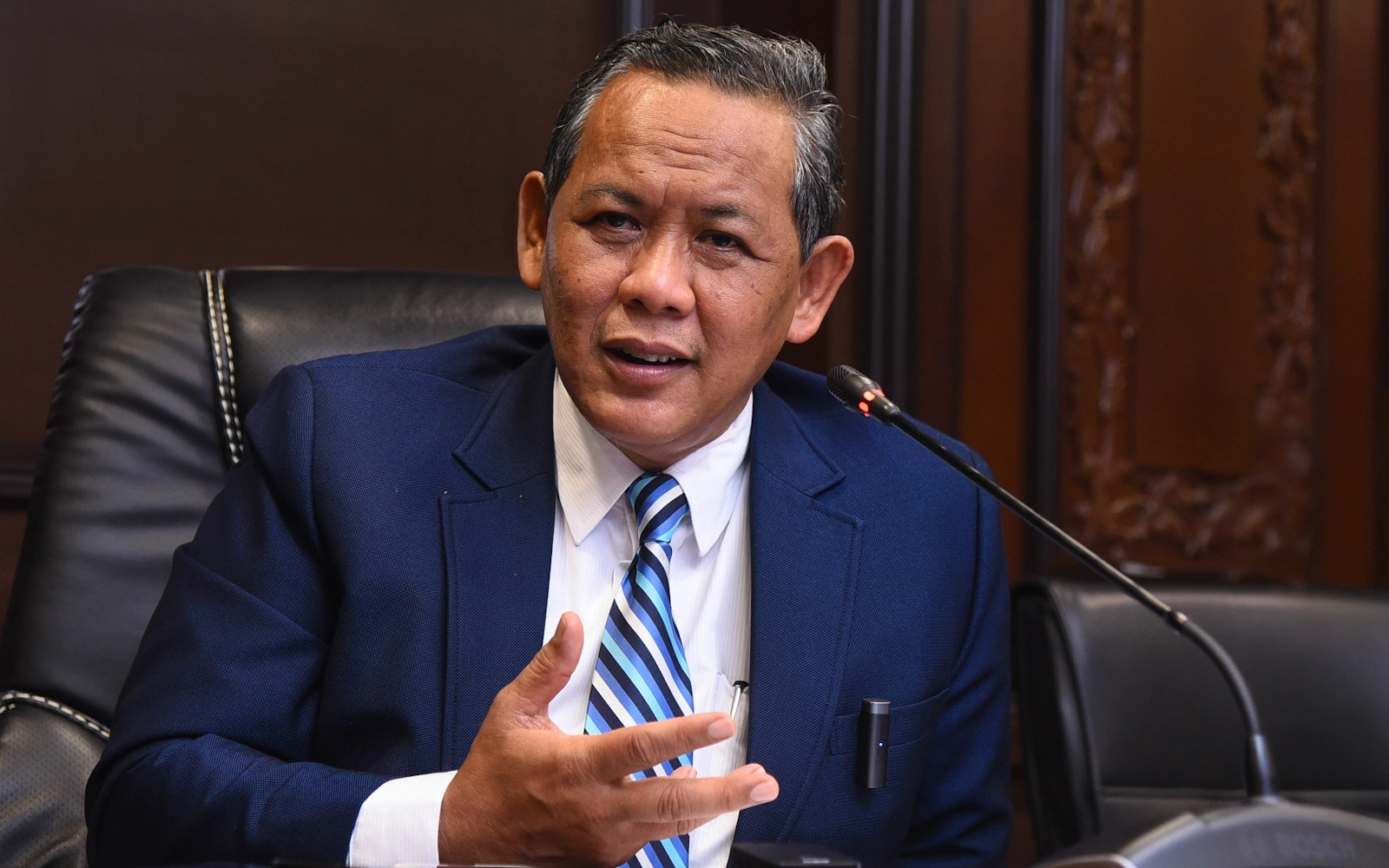
Former Negeri Sembilan Menteri Besar Aminuddin Harun has hit back at his successor Ismail Lasim after Ismail blamed the previous administration for the state's ongoing constitutional crisis.
Aminuddin wants Ismail to specify exactly what the previous government supposedly did wrong, including which provision of the Negeri Sembilan Constitution 1959 was breached, what action was not taken and when the alleged violation occurred.
He has also pointed to one particularly uncomfortable fact: he refused to sign the April 19 proclamation concerning the removal of Tuanku Muhriz, while Ismail later signed it.
That matters because the Attorney-General's Chambers has since said the April proclamation was invalid, as the mandatory requirements under Article 10 had not been fulfilled.
It also said the Menteri Besar and State Executive Council had no unilateral power to depose or vacate the office of the Yang di-Pertuan Besar.
But there is an even bigger problem with Ismail's argument that his government merely inherited Aminuddin's crisis.
Ismail did not simply inherit the crisis, his government also created a new chapter of it.
The political circumstances may have changed after the August election, but the constitutional question remained the same. Who has the authority to determine the position of the Yang di-Pertuan Besar?
And instead of leaving that question to the royal and customary institutions and the constitutional and legal processes governing them, Ismail's administration became directly involved.
On September 15, the state Exco endorsed the disputed April proclamation and instructed the state secretary to proceed with its gazettement. The state secretary's office subsequently refused to gazette or implement it after receiving the AGC's view that the proclamation was invalid.
That is not simply Aminuddin's old crisis being passed from one Menteri Besar to another.
It is a new confrontation involving a new government.
And it has now reached the point where the palace revoked the appointments of 10 Exco members, citing breaches of their oath of office and their pledge of allegiance to the Ruler and the Royal Institution.
Under Article 38(5), the Constitution provides that Exco members other than the Menteri Besar hold office at the pleasure of the Yang di-Pertuan Besar.
Ismail rejected the revocations and maintained that the existing Exco remained valid, arguing that he had not been consulted.
The central issue is no longer simply whether Aminuddin handled the original dispute correctly.
The more fundamental question is why elected politicians have repeatedly positioned themselves inside a dispute over an institution whose authority is specifically defined by Negeri Sembilan's constitutional and customary framework.
Negeri Sembilan is not an ordinary hereditary monarchy.
Its system is built around the Yang di-Pertuan Besar and the four Undang, with specific constitutional and adat mechanisms governing the appointment and removal of both.
The AGC itself has acknowledged the distinct authority of the Undang and the Dewan Keadilan dan Undang over matters concerning Malay customs, including the selection, appointment, abdication and removal of the Undang.
It also said the advice of the DKU on those matters is final under Article 16(3).
That should make politicians extremely cautious about treating a royal and customary dispute as though it were simply another matter of state administration.
Instead, the opposite appears to have happened.
Aminuddin's government became politically consumed by the dispute. BN assemblymen subsequently withdrew their support for him, citing his handling of the royal crisis among their reasons.
The state assembly was eventually dissolved, a snap election followed, and Aminuddin lost his Linggi seat as BN and PN secured 29 of the 36 seats.
Ismail then came into office.
But rather than ending the political government's involvement, his administration moved further into the dispute by endorsing the contested proclamation and seeking its gazettement.
The result is now an extraordinary situation in which the political government and the palace are openly disputing the status of the state's Executive Council.
That is not merely a continuation of Aminuddin's problem. It is Ismail's crisis too.
And that distinction matters because blaming the previous government risks reducing a constitutional question to a political blame game.
Aminuddin can be questioned over every decision his administration made. Those decisions should be examined against the Constitution, the records and the chronology.
But Ismail's government should be held to exactly the same standard.
If the previous government crossed a constitutional line, show where.
If the current government acted within its constitutional powers, explain the legal basis.
And if the Constitution places certain questions within the authority of the Ruler, the Undang and the established customary institutions, then elected politicians should not assume that winning an election gives them authority over those questions.
An election gives a government a mandate to govern.
It does not automatically give the government authority over every institution in the state.
That distinction appears to have been blurred throughout this crisis.
The political government changed. The Menteri Besar changed. The election changed the balance of power.
But the constitutional institutions at the heart of the dispute remained.
And perhaps that is why the crisis has continued.
The palace is not another political party competing for power. The royal institution occupies a different constitutional position, and Negeri Sembilan's unusual system gives its customary institutions a role that cannot simply be folded into ordinary partisan politics.
That is the part of this crisis that risks being lost when every development is framed as Aminuddin versus Ismail.
This is bigger than either man.
Aminuddin's government became embroiled in a dispute involving the royal institution and eventually fell.
Ismail won the election, took over the government and then became embroiled in his own confrontation with that same institution.
The common denominator is not the Menteri Besar.
It is the political government's repeated involvement in a dispute over royal and customary authority.
At some point, the question should stop being who is better at blaming the previous administration.
The question should be much simpler. Why are politicians fighting over a constitutional and customary dispute that was never theirs to settle in the first place?
That is the question Negeri Sembilan should be asking now.