
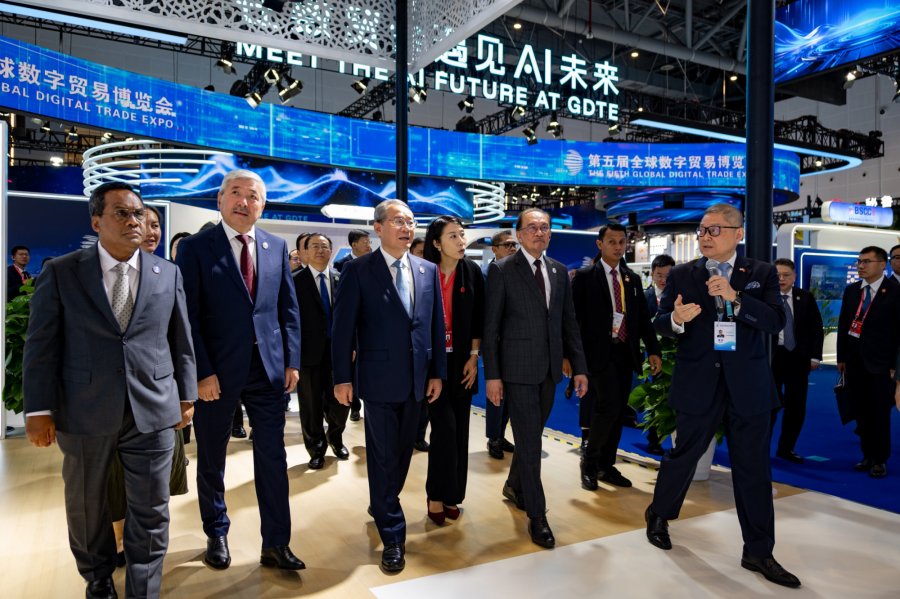
Prime Minister Datuk Seri Anwar Ibrahim’s three-day working visit to Shanghai and Hangzhou concluded on September 24 with a headline figure that deserves attention: more than RM28 billion in potential investments secured through engagements with 26 Chinese companies, including five major industrial giants.
But the number is only part of the story. The sectors involved — semiconductors, artificial intelligence, robotics, electric vehicles, battery materials, advanced optics, biotechnology and advanced manufacturing — tell us where Malaysia sits in the economic geography of the next decade.
Semiconductors: The Strategic Core
The semiconductor sector is where Malaysia’s industrial future will be decided. Penang has spent five decades building an ecosystem that now attracts Chinese investment at scale. In the first half of 2026 alone, Penang recorded RM2 billion in approved manufacturing investments from China, with approximately 90 Chinese companies now operating in the state, including Guangdong Fastrain Technology and BYD Electronics.
The investment pipeline is real. Forehope Electronic, a Chinese integrated circuit packaging and testing services provider, is investing CNY2.1 billion (approximately USD300 million) in a new factory in Penang. V-Chip, a subsidiary of China-listed Sai Microelectronics, established a new IC design facility in Penang in September 2025.
These are not passive investments. They are capability transfers. When Chinese semiconductor companies build facilities in Malaysia, they bring process technology, training, and access to global supply chains. Malaysian engineers learn from them. Local suppliers integrate with them. The ecosystem deepens.
AI and Robotics: The Next Frontier
The most significant single commitment from the visit came from AgiBot Innovation, a Chinese general-purpose AI robotics company, which pledged a potential investment of RM1 billion by 2035 and the creation of 5,000 job opportunities. ZTE Corporation outlined initiatives and investments worth RM170 million to drive Malaysia’s digital transformation, creating quality career opportunities for local talent.
Discussions with Alibaba Group, Geely Automobile Holdings and Huawei Technologies covered digital infrastructure, AI, EV technology and e-commerce, with Alibaba exploring ways to expand market access for Malaysian MSMEs and halal products through its digital ecosystem.
These are not photo-opportunity meetings. They are the building blocks of an industrial policy that positions Malaysia as a production and innovation hub for the technologies that will define the next twenty years.
The Trade Dividend
The investment figures are significant. But the export potential is equally important. Potential exports to China worth RM8.2 billion over the next one to three years were secured during the visit, alongside the investments. China has been Malaysia’s largest trading partner for 17 consecutive years, with bilateral trade reaching US$113.82 billion (RM456.68 billion) between January and August this year.
The relationship is not one-sided. Malaysia offers Chinese companies a stable, well-connected, and business-friendly base for regional expansion. Anwar’s visit included participation in the Fifth Global Digital Trade Expo (GDTE), where Malaysia became the largest exhibitor, with 68 companies and 10 government agencies showcasing products and services. Malaysia’s participation in WorldSkills Shanghai 2026, where Anwar delivered a keynote on technical and vocational education, reflects a broader agenda that links investment to talent development.
Why Chinese Companies Are Investing
Anwar attributed the commitments to confidence in Malaysia’s stability and policy direction. “Business leaders are constantly observing geopolitical developments and bilateral relations,” he said. “The friendly ties between Malaysia and China are currently on a very strong footing and progressing positively”.
That stability is a competitive advantage. In a region where supply chains are being rerouted and geopolitical tensions are reshaping trade flows, Malaysia offers a neutral, reliable and welcoming environment for Chinese investment. The Madani government’s consistent engagement with Beijing has reassured Chinese firms that Malaysia is not subject to the policy swings that affect other countries in the region.
The Bottom Line
The RM28 billion secured by Anwar’s visit is a signal. It signals that Malaysia is not just a place where Chinese companies do business. It is a place where they want to build, invest, and grow.
The investments span the sectors that will determine economic success in the coming decades: chips, AI, robotics, electric vehicles, and advanced manufacturing. They come with job creation — 5,000 from AgiBot alone — and with technology transfer that will upgrade Malaysia’s industrial capabilities.
This is what economic diplomacy looks like when it works. Not just handshakes and communiqués, but capital, capability and commitment. The RM28 billion is a vote of confidence. The question now is whether Malaysia can convert that confidence into sustained, high-value growth. The foundation is in place. The momentum is real.