
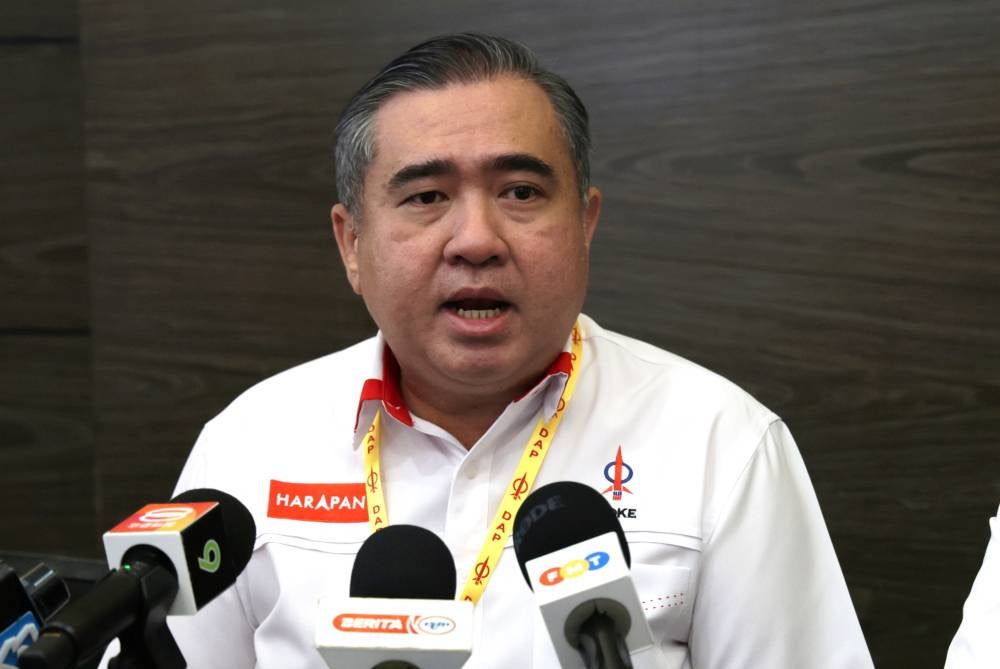
Anthony Loke has now handed in his resignation letter.
But he has not left the Cabinet. At least, not yet.
The DAP secretary-general confirmed on September 29 that he had personally handed his resignation letter to Prime Minister Anwar Ibrahim the previous day.
Anwar asked him to continue performing his duties for the time being, with Loke saying his resignation would take effect when former Prime Minister Najib Razak returned home to begin serving his sentence under house arrest.
That has opened another round of criticism, particularly from opposition figures.
PAS Information Chief Ahmad Fadhli Shaari has questioned why Loke is still carrying out his ministerial duties after announcing his resignation, arguing that a resignation made on the basis of principle should be reflected in how a minister conducts himself before leaving office.
After Loke submitted his letter, Fadhli questioned why its effective date was tied to Najib returning home, asking whether Loke already knew when that would happen.
From UMNO, Kedah strategic communications director Syed Mohd Johan Rizal argued that Loke's resignation had added to the political uncertainty surrounding the government and called for Parliament to be dissolved.
Those criticisms point to two separate questions. First is whether Loke is actually following through on his resignation, and second, whether the decision itself makes political sense.
But underneath both is a bigger question. What is a political principle worth if you are not willing to pay a price for it?
Loke is not resigning because he failed
The easiest part of this story to misunderstand is why Loke is leaving.
This is not a resignation over his performance as Transport Minister. In fact, that is precisely the point Anwar has raised.
After receiving Loke's letter, the Prime Minister questioned why attention was being placed on losing a minister whose work and performance had been good.
From Anwar's perspective, the logic is straightforward.
Loke did not make the decision to grant Najib a conditional pardon, nor was he responsible for Najib's criminal conviction.
So why should a performing minister be the one to leave?
But Loke is operating from a different idea of political responsibility. He is not saying that he is responsible for the pardon.
He is saying, in effect, that he cannot continue holding a Cabinet position after a decision that his party considers fundamentally difficult to accept.
Politics is not only about who personally made a decision. It is also about what a politician is willing to be associated with by remaining in a particular position.
Loke announced his resignation after DAP's Central Executive Committee decided on its response to Najib's conditional pardon.
At the time, he made clear that DAP respected the King's constitutional authority to grant pardons while maintaining that the party had its own position on the issue.
His resignation was described as the party's response to Najib being allowed to serve the remainder of his sentence under house arrest.
So, his resignation is less about admitting responsibility for the decision and more about drawing a line over what he is willing to continue participating in politically.
Is Loke moving the goalposts?
On September 19, Loke announced that he would resign and said he would submit his resignation letter to Anwar.
Ten days later, he submitted the letter but remained in office until Najib returned home.
At first glance, that can look like a retreat. But there is an important distinction between changing the decision and changing the timing.
Loke has not withdrawn his resignation. In fact, he has submitted it.
According to Loke, Anwar asked him to continue his duties temporarily after receiving the letter, and Loke said there needed to be a clear timeframe for his departure.
That timeframe is now tied to Najib returning home to begin house arrest.
So, the original decision, which was resigning in response to the pardon, remains intact. What has changed is the transition period.
And there is a reasonable argument on both sides.
If Loke's principle is that he cannot remain part of a government that allows Najib to serve his sentence at home, critics can ask why he is comfortable remaining in Cabinet until that happens.
But if his position is that the pardon itself crosses a political line, while his resignation is already settled, there is also a distinction between temporarily completing his responsibilities and reversing his position.
The question, therefore, is not simply whether Loke “moved the goalposts.”
It is whether the timing is consistent with the principle he says motivated the resignation.
Principles only mean something when they cost you
This is where the Loke story becomes bigger than Loke.
Politicians routinely disagree with decisions made by their own governments.
They cannot resign every time a policy goes against them. The Cabinet government requires compromise.
But there are also moments when a politician decides that a particular issue is important enough that compromise has reached its limit.
That is what makes Loke's resignation significant.
He is not leaving because he has been pushed out. He is not leaving because his ministry failed. And he is not claiming that he personally made the decision on Najib's pardon.
He is leaving because he has decided that remaining in the position carries a political cost he is no longer willing to accept.
That does not determine if his decision is automatically correct. It does, however, make it a test of political principle.
Anwar's argument is that Malaysia should not lose a good minister over a decision he did not make.
Loke's position is that being a good minister does not erase the responsibility to decide what you are willing to stand for.
Both arguments can exist at the same time. And perhaps that is the uncomfortable part of politics.
Sometimes standing by a principle does not mean changing the decision. Sometimes it means deciding what you are willing to give up for it.
For Loke, that appears to be his Cabinet position.
The real test now is whether that principle remains intact when the moment he has attached his resignation to finally arrives.