
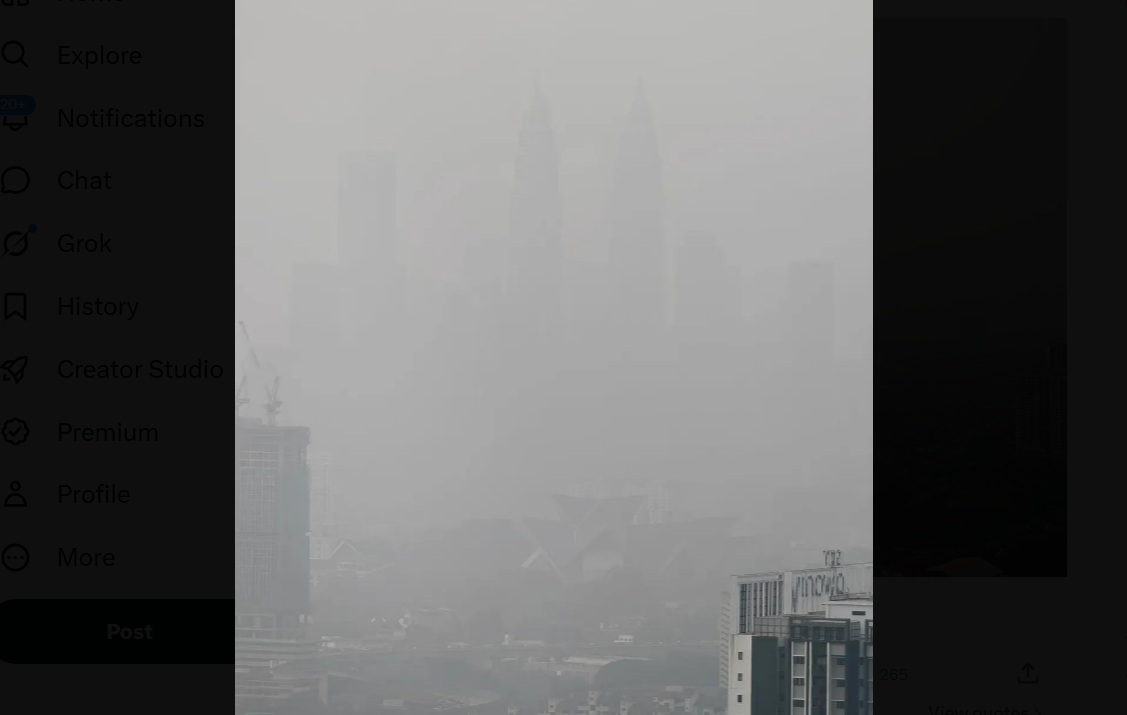
Malaysia is once again dealing with the consequences of transboundary haze, with worsening air quality forcing schools to close across several states and federal territories.
Meanwhile, Indonesia is facing renewed scrutiny over its handling of recurring forest fires, with a government no-show at the first hearing of a lawsuit seeking accountability for the haze crisis.
For Malaysians who have lived through years of recurring haze, the frustration is understandable.
Every episode brings the same disruption, the same health concerns and the same questions about what is being done to prevent the next one.
At some point, repeatedly managing the consequences cannot be mistaken for solving the problem.
Malaysians are paying the price again
On October 9, schools in Johor, Melaka, Negeri Sembilan and Selangor, as well as Kuala Lumpur, Putrajaya and Rompin in Pahang, were ordered to close as air pollution reached unhealthy levels.
For students, this means disrupted lessons. For parents, it means scrambling to make alternative childcare arrangements.
For vulnerable groups, particularly children, older people and those with respiratory conditions, it means worrying about the health risks of breathing polluted air.
These are not abstract consequences of an environmental crisis. They affect people's daily lives, often with little warning and through no fault of their own.
The public should not have to keep adjusting to the same preventable risks every time haze returns. School closures may be necessary to protect children, but they are a response to the problem, not a solution to it.
Across the border, accountability remains a question
The frustration is compounded by developments in Indonesia, where a class-action lawsuit over recurring forest and land fires has brought government accountability into focus.
On October 7, Indonesia's central government failed to appear at the first hearing of a lawsuit filed in West Kalimantan. The case names President Prabowo Subianto and other officials among 10 defendants, with plaintiffs alleging negligence in preventing and responding to recurring fires. The hearing was postponed until October 21.
The case has yet to establish legal liability, but the demand behind it is clear. Communities affected by recurring haze want their government to do more than respond after the damage has been done.
The government's failure to attend the first hearing only adds to the frustration surrounding a crisis that has persisted for years.
When people are repeatedly exposed to environmental harm, seeking accountability should not be an unreasonable expectation.
For Malaysians watching another haze episode unfold, the development raises an equally pressing concern.
While affected communities in Indonesia seek answers, neighbouring countries are once again left dealing with the consequences of pollution that crosses their borders.
How many more years of the same cycle?
Southeast Asia has dealt with transboundary haze for decades.
Each episode brings emergency measures, diplomatic discussions and renewed calls for cooperation.
Yet the recurrence of the problem suggests that existing efforts have not been enough to prevent another round of disruption.
Weather conditions, including prolonged dry spells, can increase the risk of fires. But they do not erase the need to address human-caused burning, irresponsible land management and failures in enforcement where these contribute to the crisis.
The region already has the ASEAN Agreement on Transboundary Haze Pollution, which provides a framework for regional cooperation.
The question is whether that cooperation can deliver more effective prevention, stronger enforcement and meaningful consequences for those responsible for illegal burning.
Agreements and official assurances mean little to the public if the same crisis continues to return.
Cooperation must translate into action on the ground, not merely renewed commitments after air quality has deteriorated.
Malaysia can monitor air quality, issue health advisories and close schools when necessary.
These measures are important, but they cannot independently address the sources of pollution beyond its borders.
Lasting progress requires the countries involved to confront the causes of the fires and ensure that prevention is treated as a priority, rather than an issue to revisit only when the smoke becomes impossible to ignore.
The public should not have to accept this as normal
There is something deeply frustrating about having to prepare for a crisis that has happened repeatedly over the years.
Families should not have to wonder whether their children's schools will close because of the haze. Communities should not have to endure recurring health risks while waiting for governments to resolve questions of responsibility.
And people living in fire-affected areas in Indonesia should not have to keep seeking legal remedies simply to have their grievances heard.
The consequences are borne by ordinary people, while the mechanisms meant to prevent the crisis continue to be tested.
That disconnect is precisely why accountability matters. It is not about assigning blame for the sake of it; it is about ensuring that those with the power to prevent environmental harm are held responsible for doing so.
The haze will eventually clear. Schools will reopen, daily routines will resume and public attention will move on. But unless the underlying problems are addressed, the reprieve may be temporary.
Southeast Asia does not need another year of emergency responses followed by another round of promises. It needs sustained action that reduces fires, enforces environmental protections and makes those responsible, answer for the damage they cause.
Malaysians have endured this cycle before. They should not have to keep enduring it.