
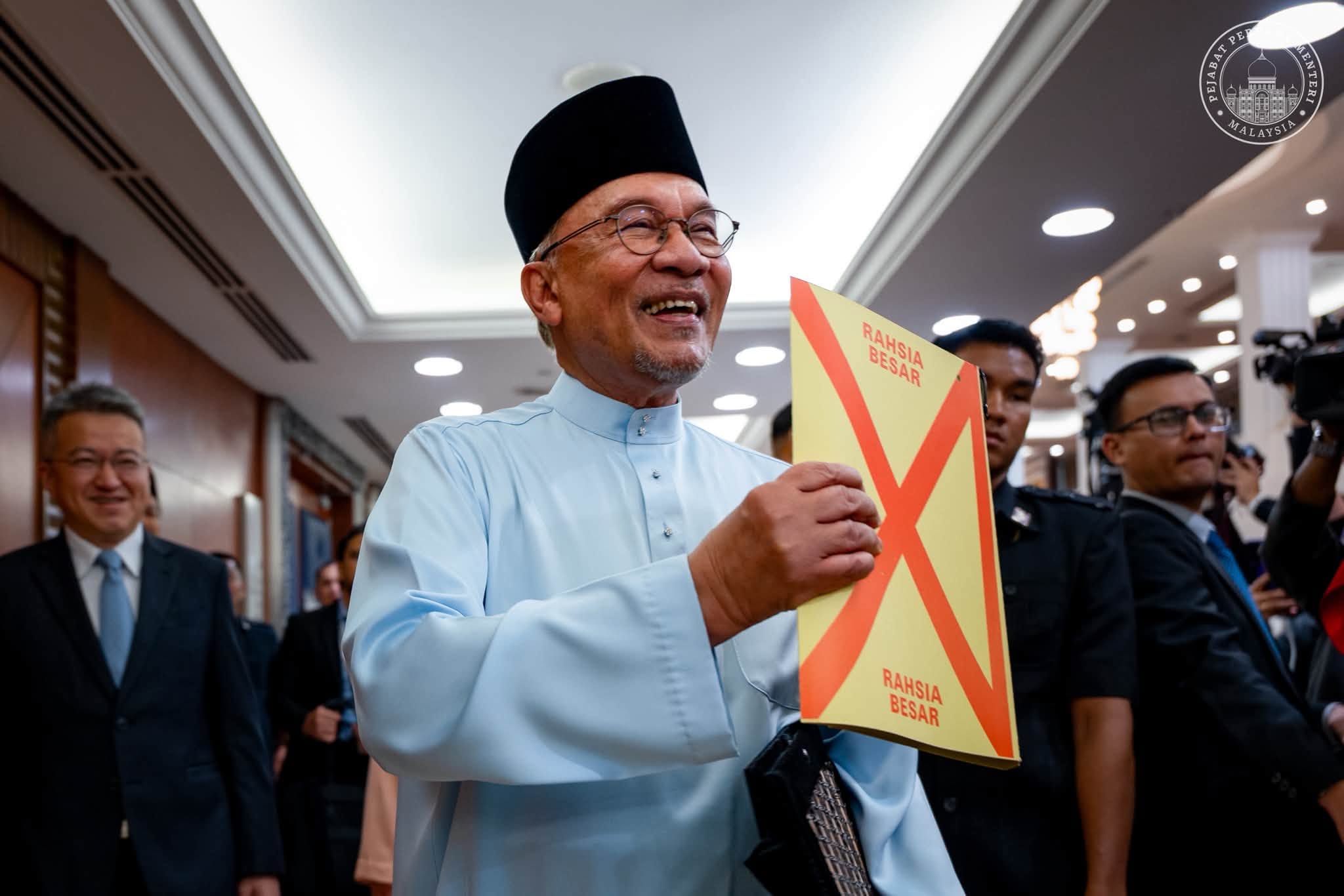
Malaysia has tabled a RM459.8 billion federal budget for 2027, with higher minimum wages, expanded income tax relief and cash assistance programmes among measures announced by Prime Minister Anwar Ibrahim to address the cost of living.
The budget, tabled in Parliament on Friday (Oct 9), comprises RM376.8 billion in operating expenditure and RM83 billion in development expenditure, representing an increase of about 3.6% from the revised 2026 allocation.
Anwar, who is also Finance Minister, said the government would continue efforts to ensure the benefits of economic growth reach households, workers and businesses while maintaining fiscal discipline.
The government is targeting a fiscal deficit of 3.3% of gross domestic product (GDP) in 2027, down from the revised estimate of 3.6% for 2026.
The broader spending and investment package, including commitments from government-linked investment companies (GLICs), public-private partnerships and other government-linked entities, is expected to reach RM510 billion.
Cost-of-Living Assistance
The government expects to spend more than RM80 billion on subsidies, assistance and incentives in 2027, with fuel subsidies projected to remain at RM40 billion.
Under the Sumbangan Asas Rahmah (SARA) programme, eligible Sumbangan Tunai Rahmah (STR) recipients will receive assistance of up to RM150 monthly to help cover essential purchases, benefiting up to nine million people.
Separately, Malaysians aged 18 and above who are not STR recipients will receive RM100 in SARA assistance on two occasions, with the measure expected to benefit up to 13 million people.
Civil servants in Grade Utama B and below, including contract employees, will receive special financial assistance of RM1,500, benefiting about 1.3 million people.
More than one million government pensioners, including retired and non-pensionable veterans, will receive RM750 each.
The minimum monthly pension will also rise from RM1,000 to RM1,350, benefiting nearly 59,000 retirees, armed forces veterans and recipients of derivative pensions.
Minimum Wage to Rise To RM2,000
The minimum monthly wage will increase from RM1,700 to RM2,000 from June 2027, a move expected to benefit more than four million workers.
Micro, small and medium enterprises (MSMEs) with annual sales revenue below RM50 million will be exempted from the increase to allow them time to adjust their business operations.
The government will also introduce a minimum starting salary of RM2,500 monthly for semi-skilled workers and graduates.
Separately, GLICs and government-linked companies (GLCs) have committed to raising the living wage benchmark from RM3,100 to RM3,400 monthly, benefiting an estimated 230,000 workers.
Measures for gig workers include a RM160 million package co-funded by the government and Grab to improve the earnings and welfare of e-hailing and p-hailing workers.
The government will also offer contribution-matching incentives through the Social Security Organisation (PERKESO) and Employees Provident Fund (EPF) to encourage social protection and retirement savings among eligible self-employed workers.
Income Tax Relief Expanded
The individual income tax relief limit will increase from RM9,000 to RM12,000, its first revision since 2010.
Tax rates for chargeable income between RM70,000 and RM100,000 will be reduced from 19% to 18%, while the rate for income between RM100,000 and RM150,000 will fall from 25% to 24%.
The changes to tax relief and rates are expected to provide up to RM1,600 in additional disposable income to five million taxpayers.
The government will also expand tax relief to cover additional expenses, including postnatal care, caregiving for parents and grandparents, education and skills training, as well as artificial intelligence (AI) subscriptions.
For MSMEs, the tax rate on the first RM150,000 of chargeable income will be reduced to 14%, while the rate for chargeable income between RM150,000 and RM600,000 will fall to 16%.
However, individuals earning more than RM1 million annually will face a higher income tax rate of 30%.
Education Receives Largest Ministry Allocation
The Education Ministry will receive RM69 billion, the largest allocation among ministries, while the Health Ministry has been allocated nearly RM48 billion.
The education allocation includes RM2 billion for school repairs and maintenance, with nearly RM1.3 billion set aside to upgrade 682 dilapidated schools, particularly in Sabah and Sarawak.
National schools will receive RM900 million, while national-type Chinese schools will receive RM100 million and national-type Tamil schools RM50 million.
All Form Six students will receive an annual allowance of RM2,500, matching the allowance provided to matriculation students.
The government will also increase the FlySiswa Madani flight ticket subsidy for university students from RM400 to RM500, benefiting more than 60,000 students at public universities.
For higher education financing, repayments of National Higher Education Fund Corporation (PTPTN) loans will be deferred in 2027 for borrowers earning RM2,500 or less monthly. Borrowers earning between RM2,500 and RM3,000 will be required to make minimum repayments of RM50 monthly.
The measures are expected to benefit more than 400,000 borrowers.
Healthcare and Public Transport
The government will offer permanent positions to more than 9,000 contract doctors in the public healthcare service in 2027. Medical graduates completing their degrees will also be offered permanent appointments as medical officers.
Monthly post allowances for paramedics and nurses will double from RM100 to RM200.
Private hospitals will adopt standardized billing categories from 2027, while the government will introduce MediAsas, an affordable basic medical insurance and takaful plan, in January 2027.
In public transport, a new MyKomuter50 pass will be introduced for KTM Komuter users, with potential savings of up to RM160 monthly.
Free travel passes will also be provided to 360,000 school pupils, persons with disabilities and children below six years old.
Support For Sabah and Sarawak
Allocations for Sabah and Sarawak will each increase by RM1.1 billion.
Sabah will receive RM18.7 billion, up from RM17.6 billion, while Sarawak's allocation will rise to RM16.2 billion from RM15.1 billion.
The interim special grant for both states will increase to RM1.5 billion, with payment scheduled to be settled before the end of 2026.
The number of Public Service Department scholarships offered to students from Sabah and Sarawak will also double to a combined total of 4,200.
Business, Investment And Skills Development
The budget includes measures to strengthen local businesses, expand access to financing and encourage investment in higher-value industries.
An e-commerce bill will be tabled at the next parliamentary sitting to strengthen accountability among online platforms and sellers, address unfair competition from unregulated foreign operators and protect local MSMEs.
The government will also provide RM3 billion through the Human Resource Development Corporation (HRD Corp) for skills training, with three million training opportunities planned. The Skills Development Fund Corporation will allocate RM500 million to finance trainees in skills development programmes.
Additional measures include financing for small businesses, incentives for halal certification and support for start-ups and companies operating in sectors such as semiconductors, electronics, digital technology and advanced manufacturing.
The government will also continue investing in infrastructure, renewable energy and industrial development to support economic activity and job creation.
Economic Outlook For 2027
Malaysia's economy is projected to grow between 4.2% and 5.2% in 2027, following a growth forecast of 4.8% to 5.3% for 2026.
The government expects the fiscal deficit to narrow to 3.3% of GDP next year as it continues efforts to manage public finances while funding development and assistance programmes.
Budget 2027 is themed Malaysia MADANI: Reaching for the Skies, While Anchored on Our Values, reflecting the government's stated focus on economic development alongside social welfare and long-term national priorities.