
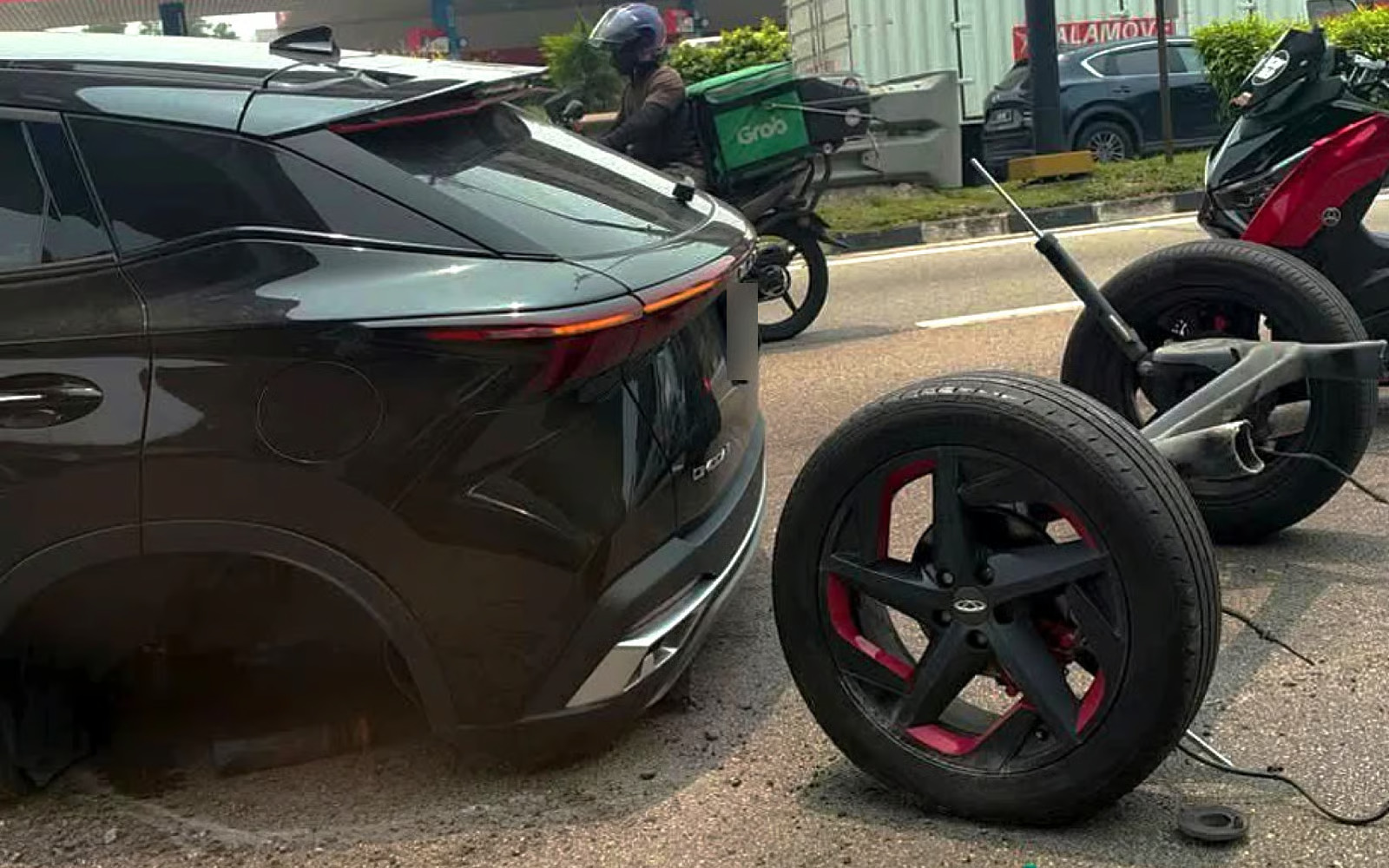
A second rear-axle failure involving the Chery Omoda 5 in Malaysia has renewed concerns over vehicle safety, prompting the Road Transport Department (JPJ) to suspend the model’s Vehicle Type Approval (VTA) and halt new registrations while investigations are underway.
The latest incident occurred on October 6 in Johor Bahru, where photographs and videos circulating on social media showed the vehicle’s rear suspension assembly and wheels separated from its body.
On October 11, JPJ director-general Aedy Fadly Ramli said the suspension was a precautionary measure targeting models and variants potentially affected by the safety issue.
The department has also ordered a technical audit of the vehicle’s production and assembly processes, as well as its rear-axle component suppliers.
The incident has drawn renewed attention because a similar failure in April 2024 led to a recall campaign involving 600 Omoda 5 vehicles.
A similar incident in 2024
Following the 2024 incident, Chery Malaysia said an investigation had traced the problem to a supplier’s welding equipment.
A worn welding tip had been replaced without the equipment being properly recalibrated, resulting in a potential defect in the rear-axle components.
The company identified 60 vehicles fitted with affected components produced on August 15, 2023.
As a precaution, the inspection campaign was expanded to cover 600 vehicles fitted with components produced between August 14 and 17 that year.
The earlier campaign raised questions about manufacturing quality control and the importance of identifying all vehicles potentially affected by a component defect.
However, the latest incident does not, by itself, establish that the same welding problem has recurred or that the previous recall was ineffective.
Those questions will depend on the findings of the latest technical investigation.
JPJ orders technical audit as Chery begins another recall
JPJ has instructed Chery Malaysia to identify potentially affected vehicles using component part numbers, production batches, Vehicle Identification Numbers (VINs) and other relevant technical information.
The technical audit will examine compliance with good manufacturing practices, quality control systems, welding inspection procedures and the safety of the components used.
JPJ said the suspension would only be lifted after corrective and preventive measures had been completed and the department had confirmed that the identified safety risks had been addressed.
Chery Malaysia announced a new recall campaign on October 11 covering affected Omoda 5 C and H variants.
Owners can check their VIN through the company’s website to determine whether their vehicles are involved.
Inspections and necessary component replacements will be carried out free of charge, according to the manufacturer.
Chery also encouraged owners seeking reassurance to visit an authorised service centre and apologised for the inconvenience caused.
The company said its current-production models were not affected by the campaign.
The latest recall provides an immediate route for identifying and inspecting potentially affected vehicles.
The wider question is whether the investigation will establish the precise cause of the latest failure and clarify the full scope of the safety risk.
A recall must deliver more than reassurance
Vehicle recalls are an important safety measure, but their effectiveness depends on more than announcing an inspection campaign.
Affected vehicles must be identified, owners must be informed, necessary repairs must be completed, and corrective measures must address the underlying problem.
The latest incident makes it particularly important to establish whether the vehicle shared any components, suppliers or production links with those involved in the 2024 case.
Without that information, it would be premature to conclude that the earlier corrective measures failed.
The investigation should also clarify how many vehicles may be affected, what technical evidence links them to the defect and whether further action is needed beyond the announced recall.
Transparent updates from both the regulator and manufacturer would help owners understand the risks and the steps required to address them.
For owners, the immediate priority is to check whether their vehicles are included in the latest campaign and follow the manufacturer’s inspection guidance.
Ultimately, the measure of an effective recall is not the announcement itself, but whether the identified safety risk is adequately addressed and the corrective action verified.
With another rear-axle incident now under investigation, the findings will be crucial in establishing what went wrong and what must be done to prevent a recurrence.