
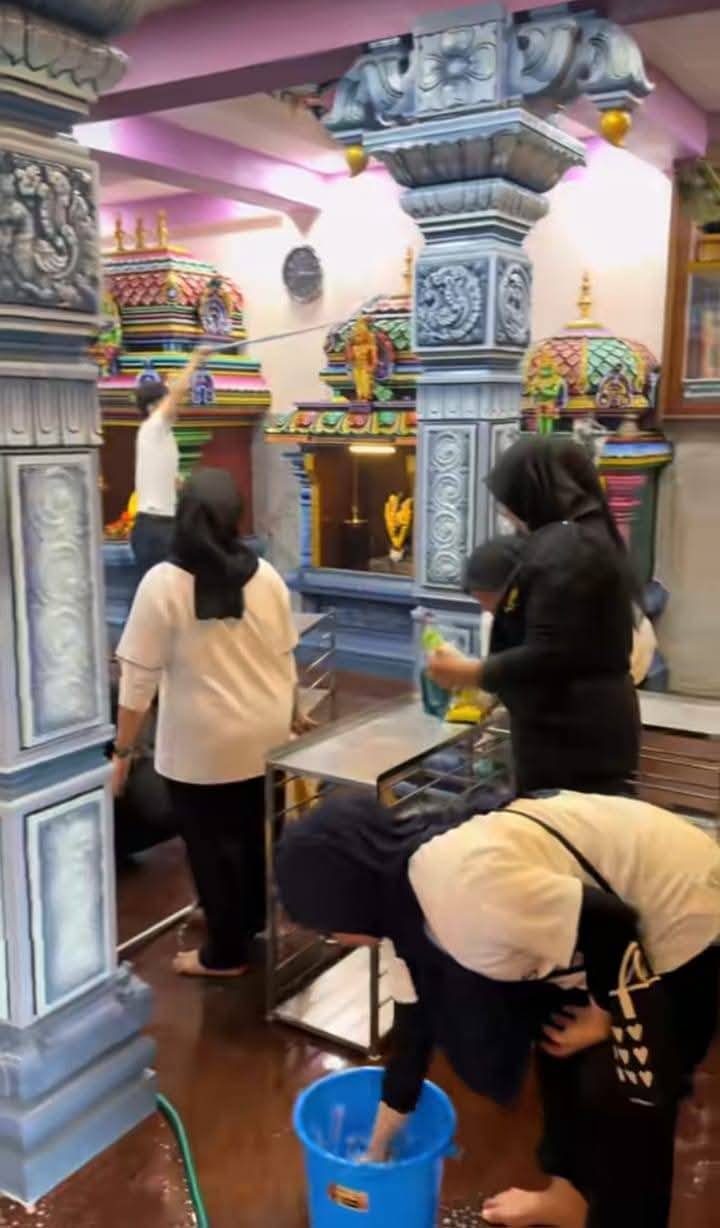
A video showing multiracial hotel staff, including Muslims, cleaning a Hindu temple in Penang has sparked debate on social media, prompting the Penang Mufti to clarify the boundaries of Muslim participation in activities involving non-Muslim places of worship.
The viral video showed staff participating in a gotong-royong activity at a Hindu temple along Jalan Dato Keramat in George Town.
The footage showed participants pouring water and cleaning the temple’s interior and surrounding areas as part of what was presented as a community initiative.
The hotel accompanied the video with the message, “Different Backgrounds; One Community, One Heart”, highlighting the theme of unity among people from different backgrounds.
The initiative initially drew praise from some social media users, who viewed the activity as an example of community spirit and religious harmony.
However, the video subsequently circulated more widely online, drawing criticism from some Muslim users who questioned whether participating in the clean-up was permissible under Islamic teachings.
Some commenters argued that Muslims should not be involved in cleaning other religions’ places of worship, while others highlighted the distinction between helping communities of different faiths and participating in activities directly connected to religious practices.
The debate gained further attention as the discussion spread across social media platforms, with users expressing differing views on religious boundaries and interfaith cooperation.
In response to the controversy, Penang Mufti Associate Professor Datuk Dr Mohd Sukki Othman advised Muslims to safeguard their akidah (faith and religious beliefs) when participating in activities involving other religions.
He explained that Islam does not prohibit Muslims from maintaining good relations with people of different faiths, but activities must remain within the boundaries of Islamic teachings.
According to the clarification, Muslims should avoid tasks directly connected to the preparation, maintenance or handling of places and objects specifically used for religious rituals, such as cleaning worship statues, altars or preparing designated spaces for ceremonies.
However, he distinguished these activities from general community service, which remains permissible when it does not involve religious rituals.
Examples include cleaning public drains, collecting rubbish in neighbourhoods and helping flood victims, regardless of their religious backgrounds.
Mohd Sukki also stressed that safeguarding Islamic beliefs should not be used as a reason to insult, discriminate against or mistreat people of other religions.
He urged organisations, educational institutions, government agencies and volunteer groups to take religious sensitivities into account when planning interfaith activities.
He suggested that community initiatives could instead focus on public spaces, residential areas, schools and other facilities used by the wider community.
The incident has highlighted differing views over how interfaith community initiatives can be conducted while respecting religious beliefs in Malaysia’s multiracial society.
While the hotel presented the activity as an expression of unity, the ensuing debate centred on whether cleaning a place of worship crossed the religious boundaries observed by Muslims.
The hotel’s full explanation of how the activity was organised, including the specific tasks assigned to participants, has not been independently established.