
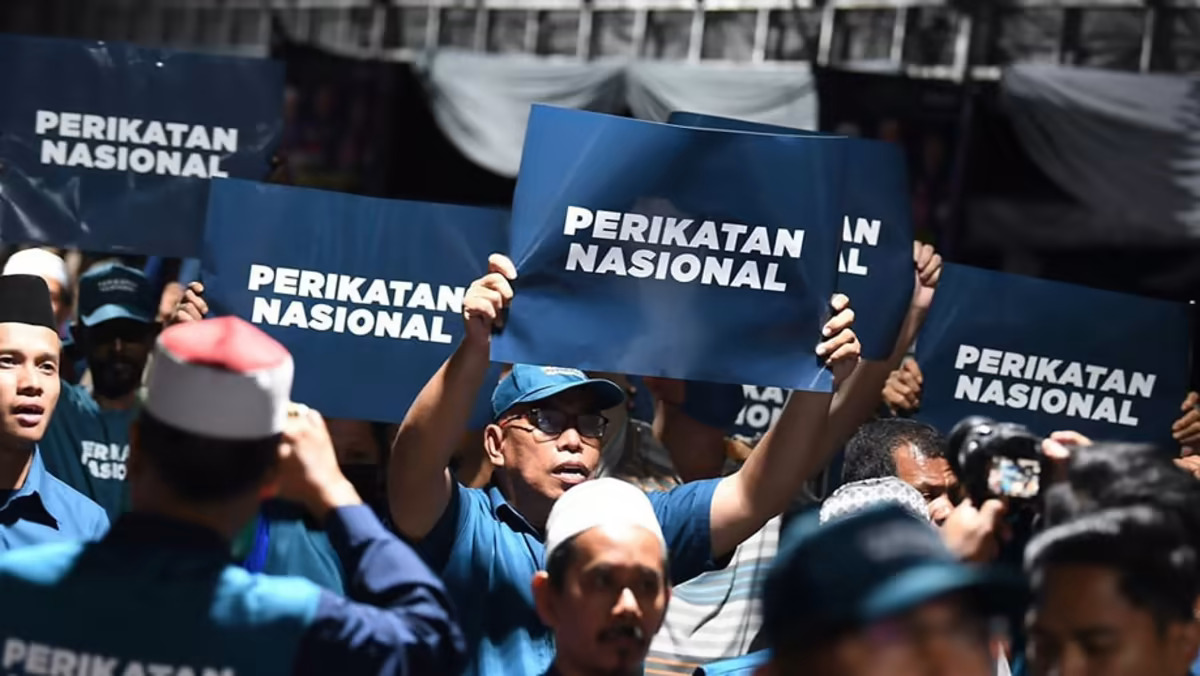
Perikatan Nasional (PN) faces uncertainty over its Melaka election strategy following the cancellation of its registration, forcing its component parties to consider alternative arrangements as nomination day approaches on October 31.
The Registrar of Societies (RoS) cancelled PN's registration on October 20, prompting the coalition to pursue legal action while its component parties prepare for the November 14 state election.
The timing leaves PN facing two challenges: restoring its legal status and ensuring its component parties can contest the election under an agreed electoral strategy.
Meanwhile, PAS and Barisan Nasional (BN) have finalised a seat-sharing arrangement for Melaka, with BN contesting 21 seats and PAS and its allies contesting the remaining seven.
Under the agreement reached on October 21, BN will use its own logo, while PAS and its allies have yet to determine which symbol to use.
Although the arrangement provides a framework for electoral cooperation, it does not resolve PN's registration dispute or establish how all its component parties will contest the election.
PN challenges RoS decision
RoS cancelled PN's registration after determining that the coalition's response to an earlier notice had failed to adequately address the grounds for deregistration under the Societies Act 1966.
The dispute followed a complaint by Bersatu concerning its alleged exclusion from a PN Supreme Council meeting on July 16 and questions surrounding its position within the coalition.
RoS examined PN's response, submitted on October 12, before proceeding with the cancellation.
PN has rejected the decision and pledged to challenge it through legal channels.
The coalition also questioned the timing of the cancellation, which came shortly before a scheduled High Court hearing concerning its earlier suspension.
PN's lawyer, Ivanpal Singh Grewal, said the coalition would seek urgent relief covering three RoS actions: the notice to cancel its registration, the suspension of its activities effective September 23, and the subsequent cancellation order.
PN is also considering an appeal to the Home Minister.
The outcome of these proceedings could affect whether PN can resume operating under its own name and logo.
However, the legal challenge does not remove the need for its component parties to prepare for the election.
Alternative arrangements could reshape PN's campaign
If PN cannot resolve its legal difficulties in time, its component parties may need to contest under their respective party symbols or coordinate through alternative electoral arrangements, subject to election requirements.
PAS and its allies could use the PAS logo to maintain a common electoral identity without relying on PN's registration.
Alternatively, Bersatu and other participating parties could contest under their own symbols.
Neither option has been established as a final decision. The parties would still need to clarify their arrangements and communicate them to candidates and voters.
The central challenge is maintaining a recognisable political identity while coordinating candidates and avoiding overlapping contests between allied parties.
The PAS-BN seat-sharing agreement offers one framework for electoral coordination among its participants.
However, it does not automatically determine how every PN component party will contest or resolve the coalition's internal disagreements.
Without clarity over the use of party symbols and the relationship between the participating parties, PN's registration crisis could complicate how its candidates present themselves to voters.
PAS-BN pact raises questions over political alignment
The agreement also raises questions about the future relationship between PAS and UMNO, which leads BN.
The two parties have historically competed for Malay-Muslim political support, although they have periodically explored cooperation.
Their Melaka arrangement establishes an electoral understanding but does not confirm a permanent alliance or political merger.
For PAS, the agreement provides a way to contest alongside BN while retaining its party identity.
For UMNO, it establishes a division of constituencies while BN continues to contest under its own banner.
Whether the cooperation extends beyond Melaka remains uncertain.
The current agreement does not establish that PAS and UMNO will form a lasting alliance or that all PN component parties will join a broader BN-led arrangement.
For PN, the development presents a separate challenge. Its component parties must determine how to maintain their political cooperation while the coalition's legal status remains uncertain.
Internal divisions remain unresolved
PAS president Abdul Hadi Awang has pledged legal action alongside aligned PN parties, arguing that the deregistration interferes with democratic rights.
He also claimed that most PN components remained aligned, although he did not identify the party he said had distanced itself from the coalition.
The statement signals PAS' intention to maintain cooperation with its allies, but it does not resolve the internal disagreements that contributed to the registration dispute.
Even if PN obtains favourable court relief, the coalition would still need to address questions surrounding its internal governance.
Conversely, its component parties could pursue alternative electoral arrangements while the legal process continues.
With nomination day set for October 31, the parties have limited time to clarify their electoral identities and campaign arrangements.
PN's deregistration has therefore created a challenge beyond the courtroom.
While the legal proceedings will determine the next stage of the coalition's registration dispute, its component parties must also establish how they intend to contest Melaka under the circumstances.
The election will test whether their political cooperation can continue without the certainty of PN's formal status, while the PAS-BN arrangement introduces another dimension to the state's electoral landscape.