
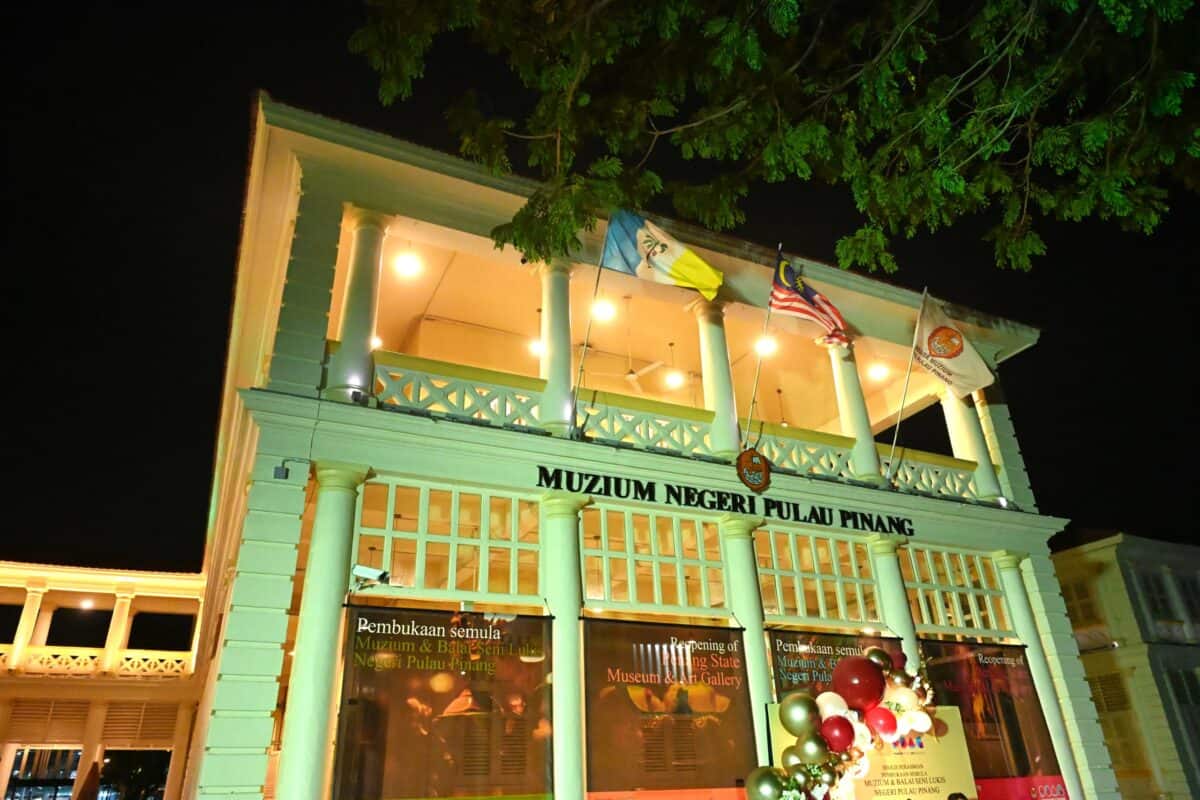
The Penang State Museum and Art Gallery’s Macalister Road branch has reopened after nearly six years of closure, with free admission offered to the public until November 30, 2026.
Located at No. 57, Jalan Macalister, the historic building will introduce an admission fee from December 1, with rates matching those charged at the Penang State Museum on Farquhar Street.
The reopening gives residents and visitors an opportunity to explore the state’s historical collections and visual arts exhibitions, while raising the question of how Penang can sustain public access to its heritage sites beyond promotional periods.
Chief Minister Chow Kon Yeow said the reopening reflected the state government’s commitment to preserving historical heritage, supporting the arts and ensuring Penang’s cultural legacy is passed on to future generations.
The building previously housed the King Edward VII Memorial Hospital, which was officially opened as a maternity hospital on September 13, 1915.
It underwent repairs during its closure, including work on the roof, electrical wiring and painting. Improvements also included the establishment of an Automotive Gallery within the compound, expanding the exhibition space and introducing visitors to the history of transportation in Penang.
Chow said the gallery offered a distinctive experience that would allow visitors to learn more about the state’s transport history.
The Penang State Art Gallery has also been temporarily relocated to the premises while upgrading works at Dewan Sri Pinang are planned to begin in early 2027. The temporary arrangement is intended to allow visual arts activities and exhibitions to continue during the upgrading period.
The reopening is part of a series of heritage-related developments in Penang this year. The Automotive Gallery opened on February 3, while the Penang State Museum on Farquhar Street reopened on July 23 after nine years of closure for extensive restoration and conservation work.
Together, the projects expand the state’s heritage and cultural offerings, although their long-term value will depend not only on the buildings being restored but also on how effectively they attract visitors, support learning and remain accessible to the public.
Chow said museums should serve as more than repositories for historical artefacts, describing them as spaces for learning, research and knowledge-sharing between generations.
He encouraged visitors to look beyond the buildings and artworks on display to understand the stories and historical significance behind them.
The reopening also comes as Penang continues to promote its tourism sector in conjunction with Visit Malaysia 2026.
According to figures cited by Chow, Penang recorded 967,742 international hotel guests in the first quarter of 2026, ranking third highest in Malaysia. International passenger movements at Penang International Airport also rose by 11.1% to 2.65 million between January and July.
Penang was also selected by National Geographic as one of 25 places to visit in 2027, a recognition the state government has linked to its appeal as a destination offering heritage, arts, culture, food and other attractions.
The museum’s reopening could contribute to that appeal by offering visitors an additional cultural destination.
However, maintaining these sites as meaningful public institutions will require more than their inclusion in tourism promotions. Their exhibitions, educational programmes and upkeep will be important in ensuring they remain relevant to both tourists and local communities.
The Penang Art Open 2025 exhibition, themed Future Ecologies, is also being held at the premises. The exhibition highlights the role of art in encouraging awareness of environmental sustainability and sustainable development.
Meanwhile, state executive councillor for tourism and creative economy Wong Hon Wai said admission charges would take effect on December 1 as part of efforts to support the building’s ongoing management and maintenance, preserve collections and improve visitor facilities.
Under the announced rates, Malaysian adults holding MyKad will pay RM5, while Malaysian children aged five to 12 with MyKid will pay RM3.
For international visitors, admission will cost RM25 for adults and RM10 for children aged five to 12. Malaysian visitors with disabilities and senior citizens aged 60 and above will pay RM3, while their non-Malaysian counterparts will pay RM10.
The free admission period provides a limited opportunity for the public to visit the reopened branch before the charges take effect.
Beyond the initial reopening, the broader test will be whether the restored institution can establish itself as a lasting part of Penang’s cultural life, not merely as a historical building to visit, but as a space where residents can engage with the state’s history and contemporary creative scene.