
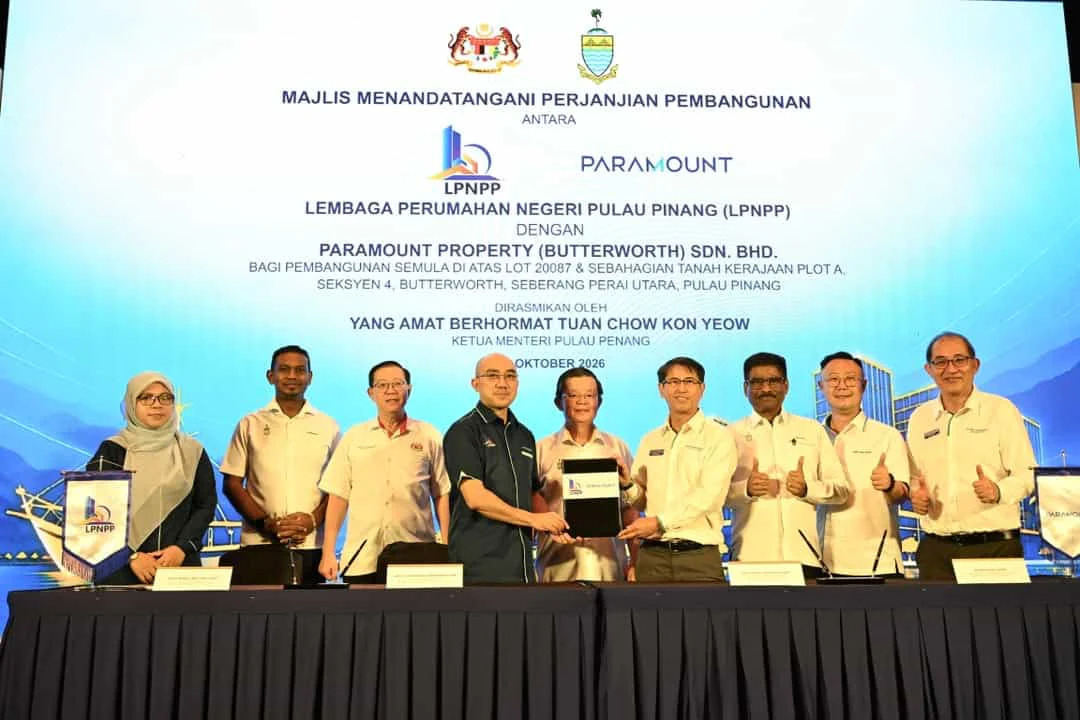
Butterworth is set to get 350 affordable homes under a proposed redevelopment of Kampung Ujong Batu.
But the project also highlights a broader question facing Penang: whether the state’s housing targets are translating into homes that residents can actually access.
Paramount Property (Butterworth) Sdn Bhd signed a development agreement with the Penang State Housing Board (LPNPP) for the redevelopment of a 6.19-hectare site in Seberang Perai Utara on Oct 25.
The first phase will comprise 350 homes under the Rumah MutiaraKu (RMKu) scheme, with the wider redevelopment to be carried out in phases.
Penang Chief Minister Chow Kon Yeow said eligible existing residents would be offered homes free of charge, in line with the state government’s social justice approach.
He added that the state intended to recover only the land costs borne by private developers for social housing projects, without imposing a profit margin on them.
However, the project remains at an early stage, with development plans and planning permission still required.
The overall development value, subsequent phases and construction timeline have not been disclosed.
Penang’s housing target faces a delivery test
The project comes as Penang works towards its target of providing 220,000 affordable homes by 2030 under the Penang2030 vision.
As of March 31, 2026, the state had reported providing 172,550 affordable housing units, equivalent to 78.43% of its target, according to Bernama.
This leaves 47,450 units to reach the 2030 goal.
While the figures indicate progress, the distinction between housing units provided, completed and handed over to eligible buyers remains important when assessing whether the state’s housing initiatives are meeting residents’ needs.
A housing target measures the scale of the state’s ambition, but it does not, on its own, show how many households have successfully secured homes or how long eligible applicants must wait.
The Rumah MutiaraKu scheme continues to serve as a key part of the state’s efforts to improve homeownership among lower-income residents.
In November 2025, state Housing and Environment Committee chairman Datuk Seri S. Sundarajoo said 6,249 applications were on LPNPP’s waiting list.
He also said 8,567 low-cost and low-medium-cost RMKu A and B units had been completed since 2020.
The waiting-list figure represents a snapshot from November 2025, rather than the current number of applicants, but it illustrates the need to assess housing provision alongside demand.
The state had also reported 5,096 units under its Rent-to-Own scheme as of March 31, 2026, against a target of 22,000 units, or 23.16% of the target.
The scheme is intended to offer a more flexible route to homeownership, particularly for households that face difficulties obtaining conventional housing loans.
These figures suggest that progress across Penang’s different housing initiatives has not been uniform, making it important to examine each programme separately rather than relying solely on the overall housing target.
More homes must mean better access
Penang’s housing challenge is not simply about increasing supply, but ensuring that the homes being delivered match the needs and financial circumstances of residents.
In March 2026, a Kenanga Research report citing National Property Information Centre data recorded 16,560 unsold residential units in Penang as of the fourth quarter of 2025.
The figure included serviced apartments and units at different stages, including completed properties, units under construction and those not yet constructed.
The existence of unsold properties does not necessarily mean affordable housing is readily available to those who need it. Homes may differ in price, location, size and eligibility requirements, limiting their suitability for lower-income households.
Nevertheless, the figures underline the importance of aligning housing development with actual demand.
For the state, this means looking beyond the number of units announced or built to examine whether eligible households can afford, obtain and sustain homeownership.
A clearer public breakdown of housing progress could help residents understand how many units are planned, under construction, completed and handed over, alongside updated waiting-list figures and the time taken to receive housing offers.
Such information would also allow the public to assess whether the state’s housing programmes are keeping pace with demand as the 2030 deadline approaches.
Ujong Batu offers a test case
The proposed Kampung Ujong Batu redevelopment provides an opportunity to assess how public-private partnerships can contribute to Penang’s affordable housing agenda.
LPNPP had issued three requests for proposals for the site between November 2024 and February 2026, but none attracted interested parties.
The state executive council and LPNPP’s procurement board subsequently agreed in April and May 2026, respectively, to proceed through direct negotiations. Paramount Property later expressed interest in the project.
The sequence highlights the challenges of getting housing projects off the ground, although the reasons behind the unsuccessful proposals have not been established.
The development agreement is an important step, but its eventual contribution will depend on whether the project secures the necessary approvals and progresses towards completion.
The state has also pledged to provide eligible existing residents with replacement homes free of charge, placing their welfare among the key considerations for the redevelopment.
Ultimately, Penang’s progress towards 220,000 affordable homes should be measured not only by the number of units promised, but by the number of households that benefit from them.
The 350 homes proposed for Kampung Ujong Batu will add to the state’s housing pipeline. Whether they translate into meaningful progress will depend on delivery, accessibility and the ability of eligible residents to turn the promise of affordable housing into a place they can call home.