
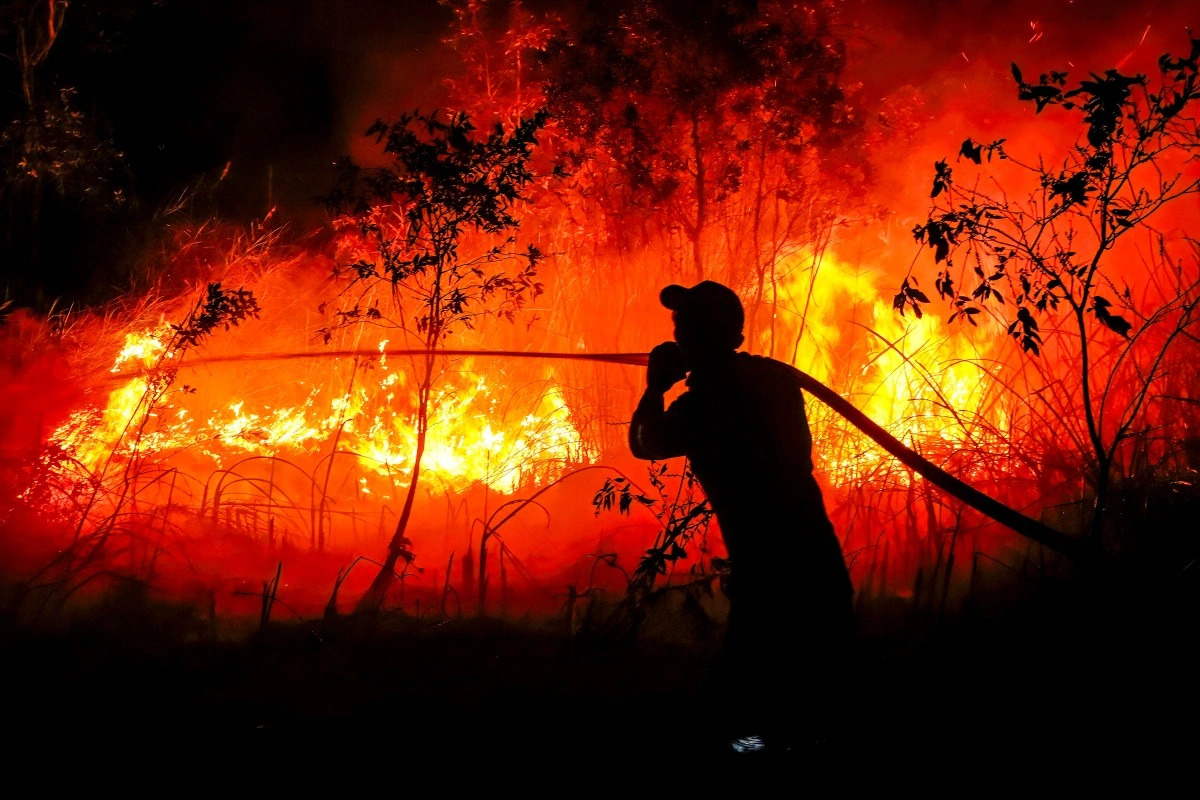
Malaysia has denied allegations that its plantation companies were responsible for forest and land fires in Indonesia, but conflicting findings from an Indonesian environmental group have raised questions about how the fires are investigated and whether companies are held accountable for their spread.
The dispute intensified after the Indonesian Forum for Environment (WALHI) identified 21 companies linked to Malaysian business groups in its analysis of forest and land fires recorded between January and September 2026.
The group said its mapping analysis detected fire hotspots within concession areas associated with several Malaysian-linked parent companies.
Plantation and Commodities Minister Datuk Seri Dr Noraini Ahmad said reports from the Malaysian Palm Oil Board (MPOB) indicated that the fires had originated outside plantations owned by Malaysian companies before spreading into nearby areas because of extremely hot weather.
On October 27, Noraini said the fires had been extinguished and maintained that the initial ignition points were outside the plantations.
She also said plantation companies were subject to the Roundtable on Sustainable Palm Oil (RSPO) and Malaysian Sustainable Palm Oil (MSPO) standards, both of which prohibit open burning, while MPOB conducts regular monitoring.
The government had previously issued a broader denial on October 16, when Communications Minister Datuk Fahmi Fadzil said checks conducted by the Plantation and Commodities Ministry found that the fires occurred outside oil palm concessions owned by Malaysian companies. In one case, a fire had spread from outside into a Malaysian-owned plantation before being extinguished.
However, WALHI's findings have put the focus on a distinction central to the dispute: identifying where a fire started does not necessarily establish whether a plantation operator fulfilled its responsibility to prevent, contain and report fires on land under its control.
WALHI forest and plantation campaigner Umi Ma'rufah called for investigations into the situation on the ground, arguing that concession holders should be scrutinised under Indonesian law for their fire-prevention obligations, even when the initial ignition occurs outside their boundaries.
The distinction matters because satellite-detected hotspots are indicators of possible fire activity, not definitive proof of who started a fire or whether a company committed an offence.
Establishing responsibility requires further investigation into the location and timing of the fires, concession boundaries, ownership and control of the land, and the actions taken by operators after fires were detected.
At the same time, determining that a fire originated beyond a plantation does not, on its own, establish whether the operator responded adequately once flames reached its land.
Several companies named in the wider controversy have disputed allegations against them.
SD Guthrie said claims that its subsidiaries caused fires in Indonesia were unsupported by credible evidence.
It also said some companies identified in public reports as its affiliates were not owned, managed or controlled by the group.
The company reported that its teams extinguished 2,411 fires between January and September, including 2,376 on community land. Its Indonesian subsidiary, Minamas Plantation, also spent about RM800,000 monthly maintaining 67 firefighting teams comprising 1,006 personnel, supported by drone and infrared monitoring.
Genting Plantations and Kuala Lumpur Kepong have likewise said fires attributed to their Indonesian operations originated outside their concession areas and were subsequently extinguished, according to previous reports.
Separately, Johor Corporation (JCorp) rejected claims linking it to Indonesian plantation companies implicated in the fires. In a statement on October 27, it said it had no ownership or operational involvement in the companies concerned, citing divestments by its subsidiary Kulim (Malaysia) Berhad in 2007 and 2023.
These responses highlight another complication.
A company appearing in a report because of historical ownership, a corporate affiliation or a concession connection is not necessarily the entity currently operating the land.
Establishing the correct ownership and control structure is therefore essential before responsibility can be attributed.
The wider issue extends beyond Malaysia's response.
Indonesia has faced recurring forest and land fires that produce smoke affecting neighbouring countries, making enforcement dependent on evidence gathered across jurisdictions.
Singapore and Indonesia agreed on October 27 to establish a joint task force to strengthen cooperation on the fires, including information sharing and cross-border investigations.
Singapore has also issued notices to companies potentially linked to fires on land they own or occupy in Indonesia, requiring measures to extinguish fires, prevent their spread and submit action plans.
The regional response illustrates how authorities can examine not only whether companies initiated fires, but also what measures they took to manage fire risks and prevent smoke from crossing borders.
For Malaysia, the immediate question is whether MPOB's monitoring findings and WALHI's concession mapping can be reconciled through transparent, site-specific investigations.
Publicly detailing the locations examined, the evidence used to determine fire origins and the response taken by each relevant operator would help clarify why the two assessments differ.
The government has cited industry certification and regular monitoring as safeguards against open burning. However, the existence of such standards does not by itself establish what happened at each reported site or whether the measures were sufficient in practice.
Ultimately, the allegations remain contested, and the identification of hotspots within a concession should not be treated as proof that a company deliberately started a fire.
But neither should the reported origin of a fire be the sole basis for dismissing questions about how it was managed after detection.
Resolving the dispute will require verifiable evidence, clear identification of the companies responsible for each concession and cooperation between Malaysian and Indonesian authorities.
Without that scrutiny, the gap between corporate denials and environmental groups' findings risks remaining unresolved while communities across the region continue to bear the consequences of recurring haze.