
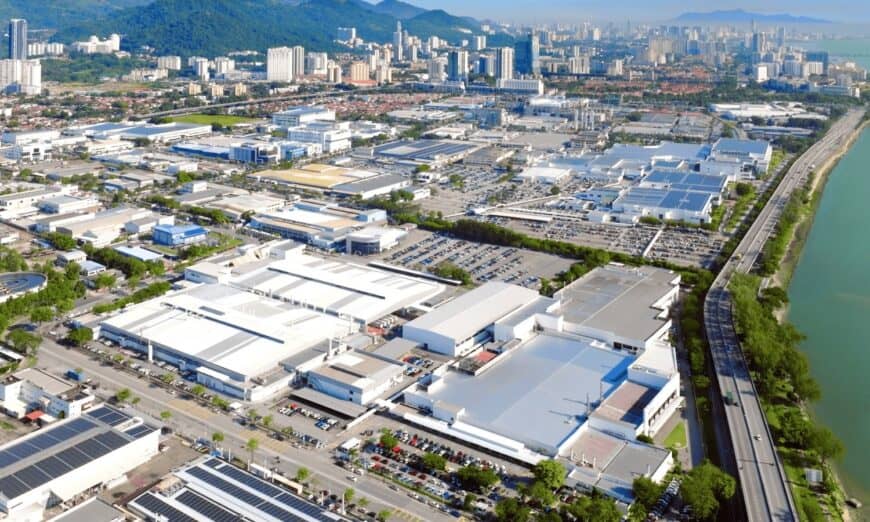
Penang’s record-breaking export performance has reinforced its position as a cornerstone of Malaysia’s manufacturing economy.
But as global demand for semiconductors accelerates, the state faces a longer-term challenge: ensuring more Malaysian companies develop the capabilities to capture greater value from that growth.
Penang recorded RM461.7 billion in exports in the first half of 2026, accounting for approximately 47.5% of Malaysia’s total exports, according to a Buletin Mutiara report published on October 27.
Electrical and electronics (E&E) products contributed RM350 billion, or about 76% of the state’s exports, reflecting strong demand for semiconductors used in artificial intelligence infrastructure, data centres and high-performance computing.
The figures demonstrate the strength of Penang’s manufacturing ecosystem.
Yet export value alone does not reveal how much economic value is retained by Malaysian-owned businesses, how many local small and medium enterprises (SMEs) secure higher-value contracts or whether domestic firms are developing their own technologies.
The question is not whether Penang’s export success is real, but whether that success is building a broader base of competitive Malaysian companies.
A strong export sector, but room to deepen local participation
Malaysia’s SME sector provides an important context for examining this challenge.
According to the Department of Statistics Malaysia’s Micro, Small and Medium Enterprises Performance 2025 report, published on July 30, 2026, micro, small and medium enterprises (MSMEs) contributed RM689.8 billion, or 39.7%, of Malaysia’s gross domestic product in 2025.
Their exports increased by 10.5% to RM214.5 billion, representing 14.7% of the country’s total exports. MSMEs also accounted for 48.7% of national employment, or 8.09 million people.
The figures highlight the sector’s economic significance. SMEs are major contributors to domestic output and employment, but their direct contribution to exports remains relatively limited at the national level.
The data do not establish whether Penang’s SMEs are underperforming specifically, as the national figures cover businesses across different sectors and regions.
Nevertheless, they reinforce the importance of examining how smaller domestic businesses can participate more deeply in export-oriented industries.
In Penang, this means looking beyond the number of factories established or goods shipped overseas to consider whether local firms are progressing into more sophisticated activities.
These include precision engineering, automated testing equipment, specialised manufacturing systems, research and development, and technology design.
Such activities can allow companies to compete on expertise and innovation rather than price alone, potentially improving their margins and resilience against rising operating costs.
Moving beyond lower-margin supplier roles
Industry representatives have identified several challenges facing local SMEs, including rising business costs, shortages of skilled engineers and technicians, cash-flow constraints and difficulties financing automation.
SME Association of Seberang Perai chairman Chong, quoted in the Buletin Mutiara report, said some local businesses remained concentrated in lower-margin activities, leaving them with limited profits and less capacity to invest in new technology.
Smaller companies also face difficulties competing with multinational corporations (MNCs) for skilled workers. Even when businesses recognise the need to automate or digitalise, the initial investment and technical knowledge required can be prohibitive.
These constraints can reinforce one another. An SME that cannot afford advanced machinery may struggle to meet a multinational manufacturer’s technical requirements.
Without securing more sophisticated contracts, it may also lack the revenue needed to invest in further upgrades.
Financing is therefore only part of the solution. Businesses also need technical expertise, skilled workers, access to production facilities and opportunities to qualify as suppliers to larger manufacturers.
Closer cooperation between MNCs and domestic firms could help address these gaps by creating opportunities for technology transfer, joint development and supplier upgrading.
The objective should not be to move every SME into advanced manufacturing, but to ensure capable local businesses have clearer pathways towards higher-value activities.
Penang already has a foundation to build on
Penang is not starting from scratch.
The state launched the Penang Automation, Test and Equipment (ATE) Campus in April 2026 to accelerate the development and adoption of Malaysian-made automation and testing solutions.
According to InvestPenang, the initiative aims to connect local companies with global manufacturers through co-development, supplier qualification, training platforms and localisation opportunities.
At its launch, 11 memorandums of understanding between multinational companies and InvestPenang were recognised to facilitate pilot projects and localisation opportunities.
Penang also has an established base of domestic industrial technology businesses. InvestPenang reported that 19 local automation, test and equipment companies and ecosystem partners were listed on Bursa Malaysia, with a combined market capitalisation of approximately RM27 billion as of April 2026.
Together, these companies generated nearly RM5 billion in annual revenue.
This demonstrates that Malaysian companies can develop significant capabilities within Penang’s manufacturing ecosystem.
The challenge is extending those opportunities to more domestic firms and helping existing businesses scale into higher-value markets.
The ATE Campus could support that transition, but its success should ultimately be measured by commercial outcomes rather than programme participation alone.
These outcomes could include the number of SMEs qualifying as suppliers to multinational manufacturers, the value of contracts awarded to Malaysian firms, improvements in productivity and the adoption of locally developed technologies.
Public reporting on such indicators would help establish whether industrial-development initiatives are translating into sustained business growth.
From attracting investment to building local capabilities
Penang’s investment performance provides a strong foundation for this ambition.
The state attracted approximately RM193 billion in approved manufacturing investments between 2021 and 2025, according to the industry leaders cited by Buletin Mutiara.
However, approved investments do not automatically translate into realised spending, local supplier contracts or technological ownership by Malaysian businesses.
Those outcomes depend on how investment projects are implemented and how domestic companies are integrated into their supply chains.
Foreign investment remains essential to Penang’s industrial development.
Multinational manufacturers bring capital, international customers, production expertise and access to global markets.
The opportunity is to use these relationships to strengthen domestic industrial capabilities, allowing more Malaysian companies to develop technologies, supply specialised equipment and participate in increasingly complex manufacturing activities.
This also requires coordination between government agencies, financial institutions, manufacturers, universities and technical and vocational education and training institutions.
Skills programmes must reflect industry needs, while financing and vendor-development initiatives should help SMEs turn new capabilities into commercial opportunities.
For Penang, the next phase of industrial development should therefore be judged not only by export growth, but also by the competitiveness of the local businesses emerging from its manufacturing ecosystem.
The state has demonstrated that it can attract global manufacturers and serve international demand. Its next challenge is ensuring more Malaysian companies can develop, own and commercialise the technologies that those manufacturers need.
Penang’s export boom is an important economic achievement. Turning that momentum into stronger domestic enterprises would make it a more durable foundation for Malaysia’s industrial future.