
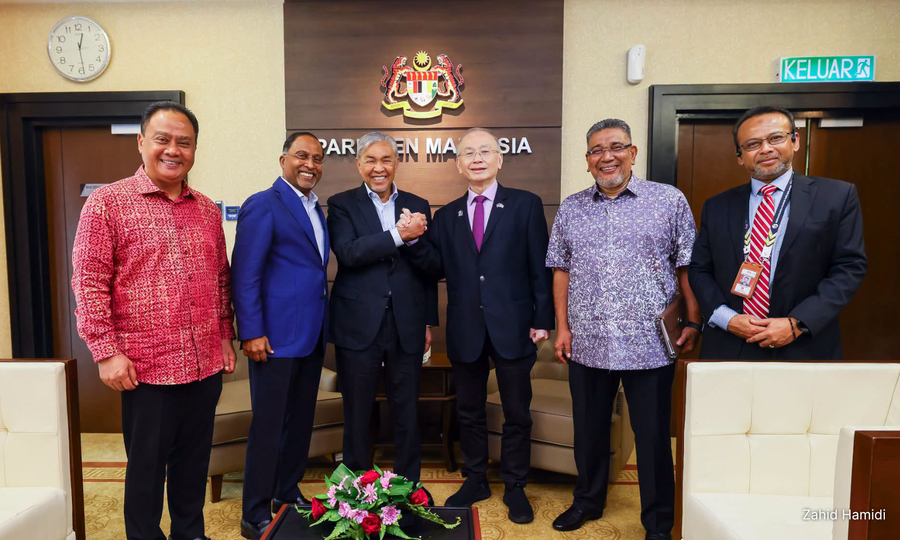
Four days of political tension, a public walkout and a dispute over representation ended with MCA accepting the same two seats it had been offered from the beginning.
The party will contest Machap Jaya and Klebang in the November 14 Melaka state election, following assurances from Barisan Nasional (BN) chairman Ahmad Zahid Hamidi that Chinese representation in a future BN-led state government would not be sidelined.
The specific terms of those assurances, however, have not been publicly detailed.
The seats remained unchanged. What changed was the promise.
But beyond the immediate dispute lies a bigger question: what is MCA's bargaining power within BN, and how might its position evolve as the coalition changes its electoral strategy ahead of GE16?
A coalition partner in name, but how much influence?
In the 2021 Melaka state election, MCA contested seven seats and won two. This time, it has been allocated only Machap Jaya and Klebang.
BN will contest 21 of the state's 28 seats, with UMNO allocated 18, MCA two and MIC one. The remaining seven seats will be contested by Perikatan Nasional (PN) parties.
The allocation reflects a clear imbalance within BN. UMNO holds the overwhelming majority of the coalition's seats, while MCA's electoral footprint is considerably smaller.
That does not automatically mean MCA has no influence. Seat allocation can reflect electoral viability, incumbency and local support, rather than seniority alone.
However, the dispute highlights the difference between being a longstanding coalition partner and having sufficient leverage to shape its decisions.
MCA can point to its history within BN and its role in representing Chinese Malaysians. But history alone cannot guarantee political influence. The party must also demonstrate its present-day electoral value.
This creates a difficult cycle. MCA needs seats to prove its relevance, while BN needs evidence of that relevance when deciding how many seats to allocate.
A party cannot easily rebuild its electoral standing if its opportunities to contest are continually limited.
BN's changing strategy raises the stakes
The question becomes more pressing as Umno expands cooperation with parties outside BN's traditional structure.
Ahead of the Melaka election, Umno formally endorsed cooperation with PAS and other PN parties, with BN and PN agreeing to use joint campaign machinery and a joint manifesto. UMNO also instructed its machinery and supporters to assist PN candidates in their allocated constituencies.
This follows electoral cooperation between BN and PN in other state contests, including Negeri Sembilan, where the two coalitions coordinated their candidacies.
For UMNO, such arrangements offer a way to coordinate candidates and reduce competition between political partners.
For MCA, however, they raise an uncomfortable question. If UMNO can negotiate directly with PAS and other parties to organise its electoral strategy, what gives MCA the leverage to protect its own position?
Coalition politics is ultimately about bargaining. Parties negotiate based on what they can contribute, what they can win and what their partners need.
If electoral calculations take priority, MCA cannot rely on its historical status to secure a larger role. It must demonstrate that its candidates, constituency networks and support among voters offer something the coalition cannot simply assume it will receive.
The irony is that MCA's diminished electoral position may itself make that task harder. Fewer seats mean fewer opportunities to demonstrate its strength, potentially reinforcing the very argument used to justify a smaller allocation.
What does this mean for GE16?
The Melaka arrangement does not determine how parliamentary seats will be negotiated at the next general election. National-level negotiations will involve different constituencies, political dynamics and coalition considerations.
Nevertheless, the dispute raises an important question about MCA's future within BN.
If Umno increasingly relies on cooperation with parties outside BN to coordinate electoral contests, will MCA have a meaningful role in shaping those arrangements? Or will it remain a coalition partner whose participation is expected, while the larger players determine the terms?
The answer will depend partly on MCA's ability to demonstrate electoral relevance and partly on how BN chooses to balance electoral strategy with the interests of its component parties.
MCA must also clarify what its promised representation means in practical terms. Will it translate into defined roles in government, policy discussions and coalition decision-making? Without publicly established terms, assurances alone offer limited grounds for assessing whether the party has secured greater influence.
BN, meanwhile, must explain how its changing partnerships fit with its longstanding claim to represent different communities through its component parties.
After all, being invited to remain in the coalition is not the same as having the power to shape its direction.
MCA's four-day standoff ended with two seats and assurances of representation. Whether that represents a meaningful gain remains to be seen.
The larger challenge is not simply securing more constituencies. It is proving that MCA remains politically consequential in a coalition whose electoral strategy is increasingly shaped by broader partnerships.
For GE16, the question is therefore bigger than the number of seats MCA receives. It is whether the party can still influence the decisions that determine its place within BN or whether its historical importance will carry less weight as electoral calculations take precedence.
Much ado about two seats, perhaps. But the real test is whether MCA can turn its place in BN into meaningful political leverage.