
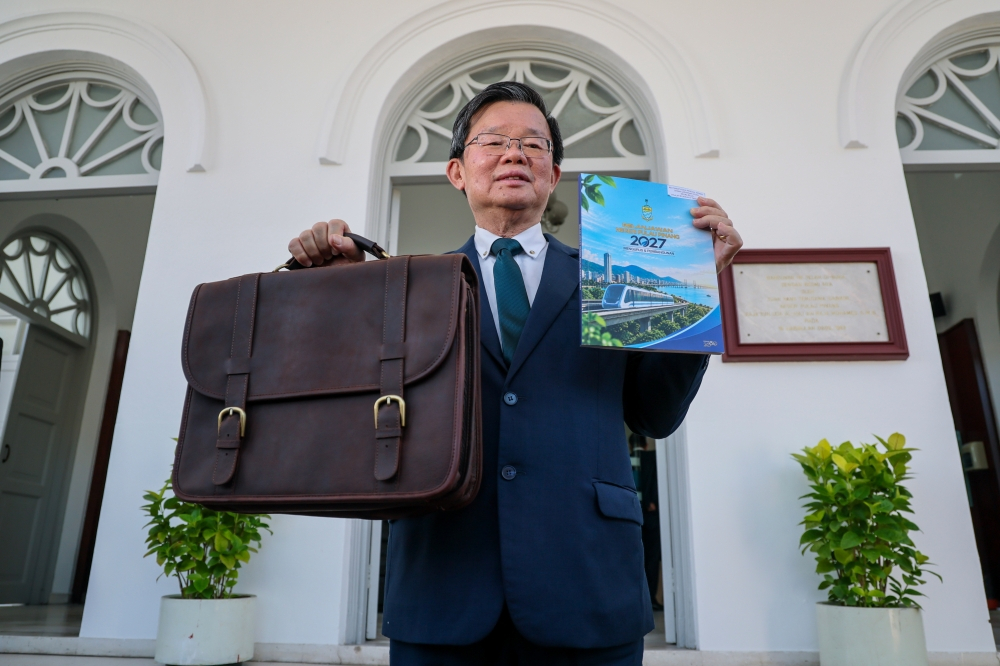
Penang has tabled a RM1.074 billion state budget for 2027, projecting a record-low deficit of RM5.62 million while setting aside funding for 514 development projects, transport infrastructure and public welfare initiatives.
Chief Minister Chow Kon Yeow said the budget was based on estimated state revenue of RM1.069 billion, with the projected deficit marking a significant reduction from the RM19.92 million deficit forecast for 2026.
The 2027 budget is also RM14 million smaller than this year's RM1.088 billion allocation, reflecting a reduction in both operating and development expenditure.
Presenting the budget at the Penang State Legislative Assembly, Chow said the state government would continue strengthening its revenue collection while ensuring that development priorities and assistance programmes remained funded.
Penang collected RM847.53 million in revenue between January and October 30, 2026, representing 79.35% of its annual target of RM1.068 billion.
One of the contributors to the increase in state revenue was quit rent collection, which reached RM167.59 million as at October 29, up 44.41% or RM51.54 million compared with RM116.05 million in 2025.
The increase followed the revision of quit rent rates earlier this year, the first review in 32 years.
Chow said the state would maintain its 50% land tax rebate in 2027, subject to the relevant conditions.
Beyond fiscal management, the state has identified 514 projects for implementation next year, covering public infrastructure, community facilities, sports development and strategic economic initiatives.
Chow said priority would be given to projects aimed at improving Penang's transport network and connectivity, including land acquisition for the Mutiara Line Light Rail Transit (LRT), the Airport Link Road and access routes to Silicon Island.
Other priorities include the development of Gurney Bay Phase 2 and projects under the Penang Transport Master Plan (PTMP).
For development expenditure, the state has allocated RM280.17 million, a reduction of RM38.4 million or 12.1% compared with 2026.
On public welfare, the state will maintain its RM58 million allocation for the i-Sejahtera programme, which provides assistance to senior citizens, persons with disabilities, single mothers and other eligible groups.
A new initiative, Mempelai Emas, will also be introduced under the programme, providing a one-off RM500 contribution to eligible newly married couples in Penang.
The state has also allocated RM16.8 million for public bus subsidies, RM9 million for one-off RM600 incentives for eligible e-hailing drivers, and RM1.2 million for assistance to taxi drivers and school bus operators.
Meanwhile, state civil servants will receive special financial assistance equivalent to one month's salary, payable in December 2026.
Eligible religious education personnel and staff of private Chinese schools will also receive a one-off RM300 payment, with the combined assistance expected to benefit 7,292 recipients at a cost of RM16.207 million.
On the state's economic outlook, Chow said Penang recorded economic growth of 7.3% in 2025, surpassing the national growth rate of 5.2%.
The state's gross domestic product (GDP) increased to RM130.3 billion in 2025 from RM121.4 billion in the previous year, with manufacturing contributing 47.3% and services accounting for 46.7%.
Between January and June 2026, Penang secured 177 approved manufacturing projects worth RM17.32 billion, with the potential to generate 19,337 job opportunities.
Chow said the state would continue strengthening its economic competitiveness while ensuring that growth translated into better opportunities and improved living standards for residents.
The 2027 budget is themed Merakyatkan Visi, Menempa Legasi, with five key priorities focusing on high-value economic growth, infrastructure and resilience, talent development, public well-being and good governance.